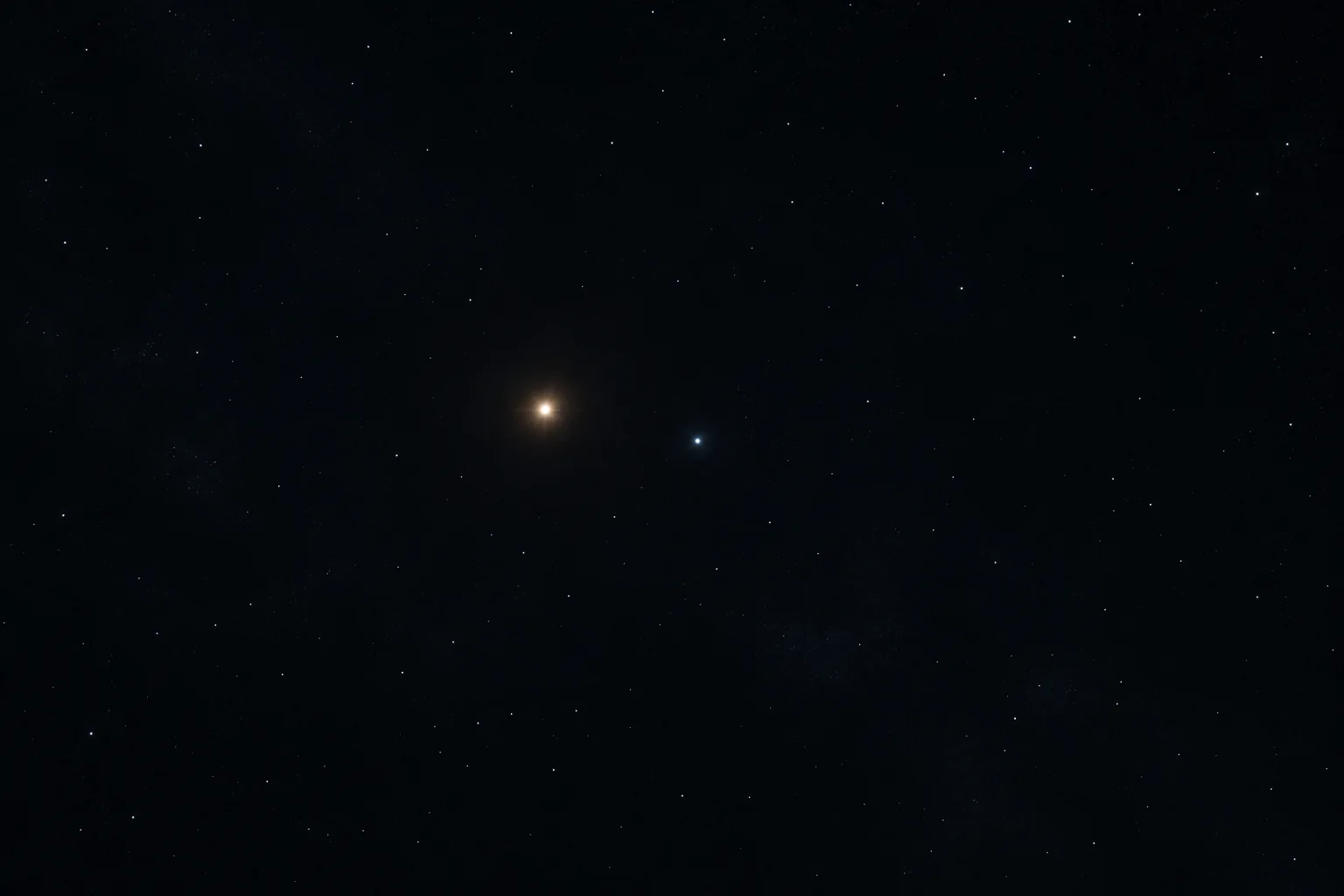
Two stars appear side by side in a telescope. One gives off much more light than the other. Which has more mass, and by how much? Brightness is a tempting clue, but the two points have something better to offer if they form a gravitationally bound pair. Their motion tells astronomers how much mass must be present to produce the observed orbit. The trick is to watch both the timing and the scale of that motion.[1, 2]
A binary orbit yields two answers in stages. The time required for one cycle and the physical size of the relative orbit give the stars’ combined mass. The way the two stars divide the motion about their shared centre of mass gives their mass ratio. Put the total and the ratio together, and each star can be assigned its own mass. “Weighing” here means measuring mass through gravitational motion.[1, 2]
The photograph that starts the clock
A neighbour in the sky need not be a neighbour in space. Stars at different distances can appear close on a single image merely because they lie in nearly the same direction. For a visual binary, astronomers make a sequence of measurements of one star relative to the other. A changing separation and direction, followed over enough of an orbit, can establish a curved path with a repeatable period.[1]
Imagine fixing the brighter star at the origin of every drawing and putting one dot where the fainter star appears each year. The finished figure shows the motion of one component relative to the other. Both stars actually move. Choosing the brighter one as the plotting origin is convenient bookkeeping. It gives the relative orbit, whose scale is the sum of the two individual orbital scales around the pair’s common centre of mass.[1, 2]
A real orbit may be tilted to the observer. A circle viewed at a slant projects as an ellipse, and an intrinsically elliptical orbit can appear distorted in other ways. Fitting a sequence of positions helps recover the orientation and size of the orbit in space. Taking the widest gap visible in a single image and treating it as the orbital size can fail both because of projection and because the stars may be far from the widest part of their orbit.[2]
Turning a tiny angle into a distance
A telescope first measures separation as an angle. The same angle corresponds to a larger physical gap when the system is farther away. This is where a distance measurement such as a stellar parallax enters the calculation. A useful feature of astronomical units is that a separation of one astronomical unit at one parsec spans one arcsecond. At ten parsecs, one arcsecond corresponds to ten astronomical units.[1, 2]
Consider an imaginary pair ten parsecs away. The fitted relative orbit has an angular semimajor axis of 0.4 arcseconds after its orientation has been accounted for. Its physical semimajor axis is four astronomical units. The word semimajor means half the long axis of the orbital ellipse. It is the number needed in the mass calculation. Using the full long axis of eight units instead would have a far larger effect than doubling the final answer.
With the period in Earth years and the relative semimajor axis in astronomical units, the combined mass in solar masses is the cube of the semimajor axis divided by the square of the period. Suppose the imaginary pair completes its orbit in four years. Four cubed is 64. Four squared is 16. The total is therefore four solar masses. Doubling the input distance at the same measured angle and period would multiply the inferred mass by eight. A reliable distance is part of the measurement, not a decorative label below the image.[1, 2]
How to divide the total
A common centre of mass, also called a barycentre, lies closer to the more massive star. Both stars complete an orbit in the same time. The one farther from the barycentre travels around a larger path. If one star’s orbital semimajor axis is three times its companion’s, that star has one third of the companion’s mass. This inverse relationship is what turns a measurement of two motions into a mass ratio.[1, 2]
Return to the four-solar-mass example. Suppose measurements against more distant reference stars show that the two components have barycentric semimajor axes of one and three astronomical units. The component taking the smaller orbit has three solar masses. Its companion has one. Their masses add to four, and three times one balances one times three. The brightness of either star was unnecessary for this calculation once the components could be tracked.
If only the relative ellipse is available, the split can remain uncertain even when the total is well measured. Draw a line four units long between the stars. It is possible to place the balance point at the midpoint or a quarter of the way along without changing the line’s length. Astronomers need evidence that locates the motions about that point. Tracking both against an external reference or measuring suitable velocities supplies information that relative separation alone lacks.[2]
What spectra contribute when the stars look like one
Some pairs are too close on the sky to separate into useful images. Their light can still contain lines from both stars. As one component moves toward the observer and the other recedes, the lines shift in opposite directions. Measure those Doppler shifts over time and the ratio of the two velocity amplitudes can reveal the mass ratio. The orbit’s tilt still matters to the absolute masses because a spectrum detects only the component of velocity along our line of sight.[1, 2]
In an eclipsing binary, one star periodically blocks part of the other as seen from Earth. The light curve helps constrain the inclination of the orbit. With suitable spectra from both stars, this provides another route to individual masses. A visual orbit, shifts in spectral lines and a dip in brightness each constrain different quantities. They become especially powerful when more than one is available for the same pair.[1]
The bright and faint partners of Sirius
Sirius offers a measured example. Howard Bond and colleagues combined Hubble observations with photographic and historical positions, parallax and information about the motion of the bright component. Their 2017 analysis gave about 2.06 solar masses for Sirius A and 1.02 for its much fainter white-dwarf companion, Sirius B. The companion contributes about a third of the pair’s mass despite the enormous contrast in their visible light.[3, 4]
That result gives a reason to keep measuring even a familiar pair. An observation added many years after an old drawing can sample a part of the orbit that once had poor coverage. A more precise distance improves the physical scale. Better measurements of the brighter star’s motion can refine the split. Each improvement has a place in the same argument, from two points on a plate to the individual masses of stars.
Keep exploring
Follow stars from their formation to one especially dense kind of stellar remnant.
Sources and further reading
- OpenStax Astronomy 2e — Measuring Stellar Masses
- Ohio State University — Finding Stellar Masses from Binary Stars
- Bond and colleagues — The Sirius System and Its Astrophysical Puzzles
- VizieR — Historical and HST Astrometry of Sirius A,B
Keep exploring.
One remarkable idea at a time—nature, science, history and beyond.
Last updated November 19, 2026.

Barnakle Editorial Team
Barnakle Editorial Team is the collective byline used for Barnakle’s editorial articles. The contributor profile explains the team identity and links to the publication’s editorial policies.
More from the editorial team →