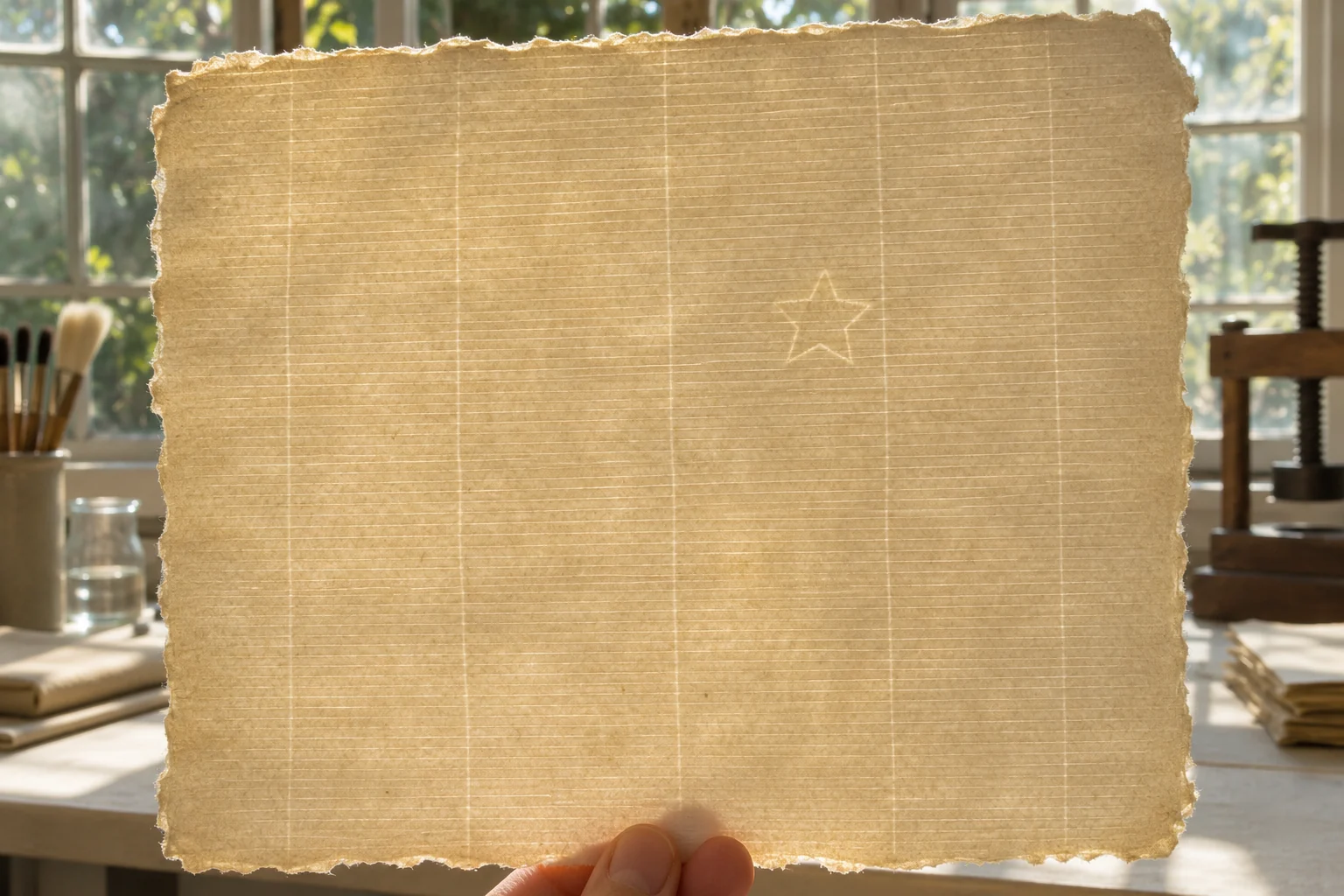
Hold an old sheet of handmade paper flat on a desk and it may look perfectly blank. Lift it toward a window and a star, a shield or a little cluster of letters can appear between the fibres. Turn it face down and the outline is still there, only reversed. Whoever made the mark worked on the sheet before it was dry enough to write on.[1, 2]
A traditional wire watermark begins on the papermaker’s mould. A wire bent into a design sits slightly proud of the mesh that catches the wet pulp. Fewer fibres settle over that raised line, leaving a thinner patch that lets more light through. You can read the mark centuries later because the picture is a variation in the thickness of the sheet itself. The water drained away long ago.[1, 2]
A drawing built into the screen
Imagine making one sheet by hand. The papermaker lowers a framed screen into a vat of fibres suspended in water and lifts it out again. A removable frame called a deckle helps define the edges. As the water drains through the screen, a mat of wet fibres stays behind. It has to be lifted off, pressed and dried before somebody can fold it into a letter or pull a print on it. The watermark takes shape during those first moments at the vat.[2, 3]
In traditional European laid paper the screen leaves a second, less celebrated pattern. Many fine parallel lines sit close together. Another set, the chain lines, crosses them at much wider intervals. Hold the sheet so the close lines run sideways and the wider ones will stand upright. Rotate it, and their apparent directions change together. This distinction matters when researchers describe the position of an emblem relative to the wires that carried it. The edge of a cut page is a much less dependable reference point.[1, 2]
Even the means of fastening the design can leave a trace. Fine wire stitches attached the emblem to the mould. Small bright points sometimes survive at those attachments. If two stars look much alike, a dot on the wrong side of a point or a different distance to the nearest chain line can distinguish them. A reader might pass over those tiny imperfections to admire the design. For a conservator, the imperfections can be the most informative part.[2, 4]
How much does a matching mark prove?
Start with a drawing of a crown on one sheet and a similar crown on another. Both may belong to the same family of designs. That is a different claim from saying that both sheets came off a particular piece of workshop equipment. Papermakers could copy a popular mark. One maker could use several marks. A wire could bend during use or acquire an altered outline after a repair. Two genuine impressions needn’t match an ideal drawing made from either of them.[2]
Now suppose the wire outline, stitches and chain-line intervals agree. The case for a shared mould gets stronger. Researchers sometimes call sheets from the very same mould “mouldmates.” It is rather like recognizing which baking tin made a cake from a little dent in the side. Recognizing a star-shaped cake tells you the general design of the tin. Finding the same dent at exactly the same place is a much more specific observation.[4]
There is another date to keep straight. A watermark belongs to the manufacture of the paper. A poem copied onto it or a drawing added later could be younger. A stationer might have kept a stack on the shelf before selling it, and its purchaser might have had little occasion to use it for years. A good catalogue match can narrow a search or prompt another look at a date. It cannot tell you the afternoon on which the writer picked up the pen.[1, 2]
A page with only half the answer
A printer or bookbinder could fold a large sheet and trim the edges. On a single leaf you might find half an emblem at the gutter or no visible emblem at all. This is where the plain-looking lines earn their keep. They run well beyond the picture, and their spacing varies slightly across a handmade screen. A sufficiently clear stretch can preserve evidence of the mould in a part of the sheet that never carried a recognizable symbol.[2, 4]
Researchers tested that idea with blank leaves inserted into a copy of a book printed in 1536. They compared the marks, the intervals between chain lines and the density of the finer laid lines. In that group of papers each approach could distinguish the work of four moulds. It is a lovely reversal of the usual way of reading a book. A page with no writing at all supplied measurements precise enough to help reconstruct the equipment at the paper mill.[4]
Why some watermarks look like portraits
A wire bent into an outline can draw a handsome emblem, but a portrait needs shadow. Papermakers can press a relief into woven wire mesh, shaping shallow hollows as well as raised areas. More fibre collects in the low parts and less over the high ones. Held up to light, the thicker areas appear darker. The Robert C. Williams Museum of Papermaking shows a watermark portrait of Queen Elizabeth II in which that difference gives the face its modelling.[5]
Machine papermaking introduced another way to impress a design. A patterned cylinder called a dandy roll meets the damp sheet as it travels through the machine. That lets a maker repeat a mark along a continuous length of paper. So a watermark alone doesn’t establish that a sheet was made by hand. Its surroundings, including the structure of the paper and the way the mark repeats, help establish how it was made.[5]
Next time you come across a modern watermarked sheet, try looking at it on a tabletop first, then with light passing through it. The mark may all but disappear on the table. What changes at the window is the path the light takes to your eyes. For a moment you can see where fibres gathered, where a wire got in their way and where a tool once touched a sheet that was still more water than paper.[1, 3]
Related reading
- How Does Paper Marbling Turn Floating Colours Into Patterns?
- How Do Japanese Woodblock Printers Line Up Different Colours?
Sources
- British Library — Revealing the hidden story of paper
- University of Victoria Special Collections — Watermarks and the evidence they preserve
- Museum Boijmans Van Beuningen — Watermarks in Piranesi’s paper
- Gorske and colleagues — Identifying mouldmates from watermarks and line measurements
- Robert C. Williams Museum of Papermaking — Wire marks, relief portraits and dandy rolls
Keep exploring.
One remarkable idea at a time—nature, science, history and beyond.
Last updated November 21, 2026.

Barnakle Editorial Team
Barnakle Editorial Team is the collective byline used for Barnakle’s editorial articles. The contributor profile explains the team identity and links to the publication’s editorial policies.
More from the editorial team →