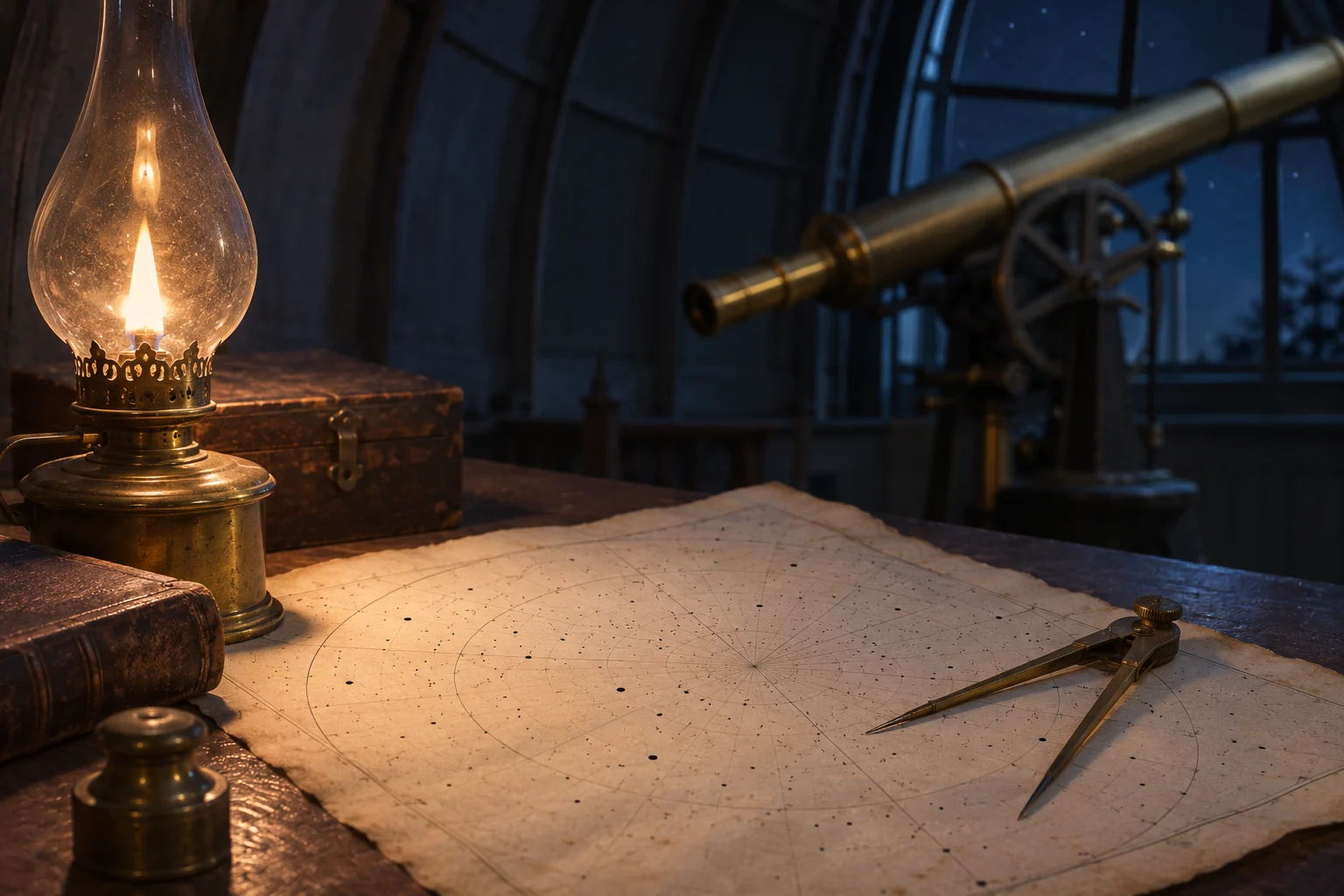
On September 23, 1846, Johann Galle pointed a telescope in Berlin toward a position sent to him by a mathematician in Paris. His young collaborator Heinrich d’Arrest had a particularly useful idea. They could compare what Galle saw with a detailed chart of the same patch of sky. One of the points of light in the telescope had no counterpart on the chart. By the following night it had shifted against the background stars. The object was Neptune.[1, 2, 3]
The remarkable part happened before either observer went to the telescope. Urbain Le Verrier had worked out where to look from small discrepancies in the motion of Uranus. An unseen planet’s gravity, he argued, could account for a pattern that the known planets failed to explain. His forecast placed Neptune within one degree of its observed position. The planet had announced its presence by pulling on a neighbour. Recognizing it still took a telescope, a good map and people willing to compare them point by point.[1, 2, 3]
Uranus kept missing its appointment
After William Herschel identified Uranus in 1781, astronomers could combine new observations with older sightings made when the planet had been taken for a star. A record of position on one night is just a dot on a chart. A long sequence lets astronomers fit an orbit and predict where the dot should appear on a future date. Earth’s own movement must enter that calculation because the observer is riding another planet around the Sun.[1, 2, 4]
The Sun supplies most of the gravitational pull that shapes Uranus’s path, but the other planets also attract it. Astronomers already expected departures from a simple ellipse and allowed for the influence of known bodies. Even so, calculated and observed positions failed to match across the available record. A poor measurement could put a single dot in the wrong place. An error that persisted and changed in a systematic way over many observations called for a more interesting explanation.[1, 2]
Working the calculation backwards
Imagine being given the position and mass of an additional planet. In principle you can work forward and calculate its effect on Uranus. Le Verrier faced the reverse problem. He had the effect and wanted to infer a possible cause. He explored what mass, orbit and present location an outer planet would need to account for the discrepancies. John Couch Adams in England independently worked on the same problem. No telescope image of the proposed planet was available to guide either set of calculations.[1, 2, 4]
Why should one part of the sky be more promising than another? Gravity acts along the line joining two bodies. Depending on where an outer planet is on its orbit relative to Uranus, part of its pull can act along Uranus’s direction of travel or against it. The relative positions change over time. A candidate explanation has to account for a sequence of offsets, including how they change, rather than just supply a sufficiently large pull on a single date.[1, 2]
There is an important difference between predicting a useful place to search and knowing the unseen world’s orbit in every detail. A finite stretch of observations constrains some combinations of mass, distance and orbital position more strongly than others. Finding a planet near the predicted spot tests a concrete consequence of the calculation. Measuring where it goes over subsequent years lets astronomers refine the orbit directly. The achievement of 1846 was already considerable without asking the prediction to do both jobs.[1, 2, 3]
The chart that made an unfamiliar dot stand out
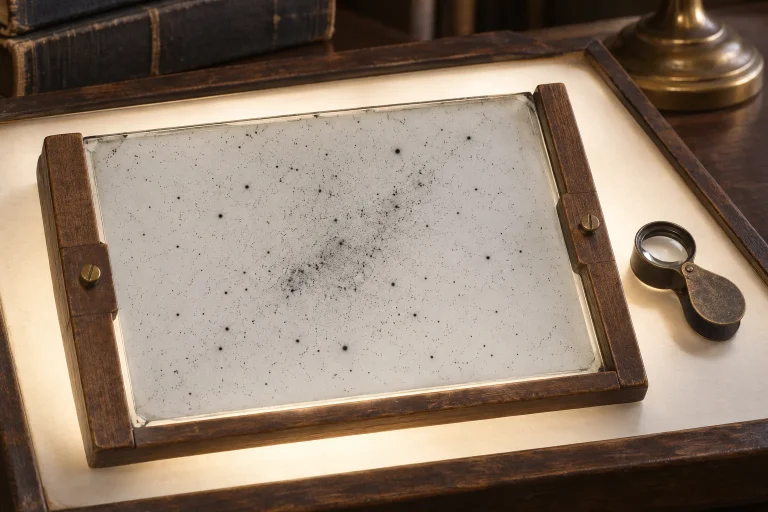
Galle and d’Arrest had more than one way to look. A distant planet can show a small disk in a telescope, while a star remains a point blurred by the instrument and the atmosphere. Picking out that tiny distinction amid a field of faint stars is demanding. D’Arrest suggested using a recently prepared star chart available at the Berlin observatory. Now the observers had another question to ask of each object in the field. Was it already on the map?[2, 3]
The unmatched object lay about 55 arcminutes from Le Verrier’s position. There are 60 arcminutes in a degree, so the difference was a little less than a degree, roughly the width of two full Moons on the sky. That would be a large error for a modern telescope commanded to centre a familiar target. For a search inferred from the gravitational influence of an object nobody had yet identified, it brought the investigators remarkably close.[2, 3]
A missing mark on a chart is suggestive, but charts can have omissions. The follow-up observation mattered because it supplied a different kind of evidence. The object changed position relative to the background from one night to the next. An omitted fixed star would still have occupied the same place among its neighbours over that interval. Galle could report agreement between the calculated search area, a new object in that area and motion of the kind expected for a member of the solar system.[1, 2, 3]
How could anyone have seen Neptune earlier?
In 1612 Galileo recorded Neptune while making telescopic observations, treating it as a star. Centuries later, with a well-established orbit, astronomers could work backwards and identify the point in his observations. He had received light from Neptune with his telescope. He did not establish that the light came from a new planet. That distinction is one reason the date of a planet’s discovery can be much later than the earliest surviving record of somebody seeing it.[1, 5]
The distance between spotting a dot and knowing a world is vast in another sense. In 1989, Voyager 2 flew past Neptune, returning detailed observations of its atmosphere, moons and rings. The nineteenth-century observers could not have recovered any of those views just by looking harder at their chart. What their instruments and calculations gave them was an address accurate enough to find the planet again. Every measurement that followed depended in some way on being able to do precisely that.[4, 5]
A mathematician in Paris could narrow a search without putting his eye to the Berlin telescope. An observer in Berlin could question a dot because a chartmaker had already recorded the stars around it. Neptune’s discovery belongs to both kinds of work. It began with a planet that kept appearing in the wrong place and ended with another one appearing, on a September night, wonderfully close to the right one.[1, 2, 3]
Related reading
- How Did a Blinking Star Reveal the Rings of Uranus?
- How Do Astronomers Weigh Two Stars That Orbit Each Other?
Sources
- NASA History — The discovery of Neptune
- American Physical Society — Neptune’s existence observationally confirmed
- Astronomy — The star chart and the night Neptune was found
- NASA Jet Propulsion Laboratory — Planetary discovery circumstances
- NASA Science — Neptune exploration and earlier observations
Keep exploring.
One remarkable idea at a time—nature, science, history and beyond.
Last updated November 21, 2026.

Barnakle Editorial Team
Barnakle Editorial Team is the collective byline used for Barnakle’s editorial articles. The contributor profile explains the team identity and links to the publication’s editorial policies.
More from the editorial team →