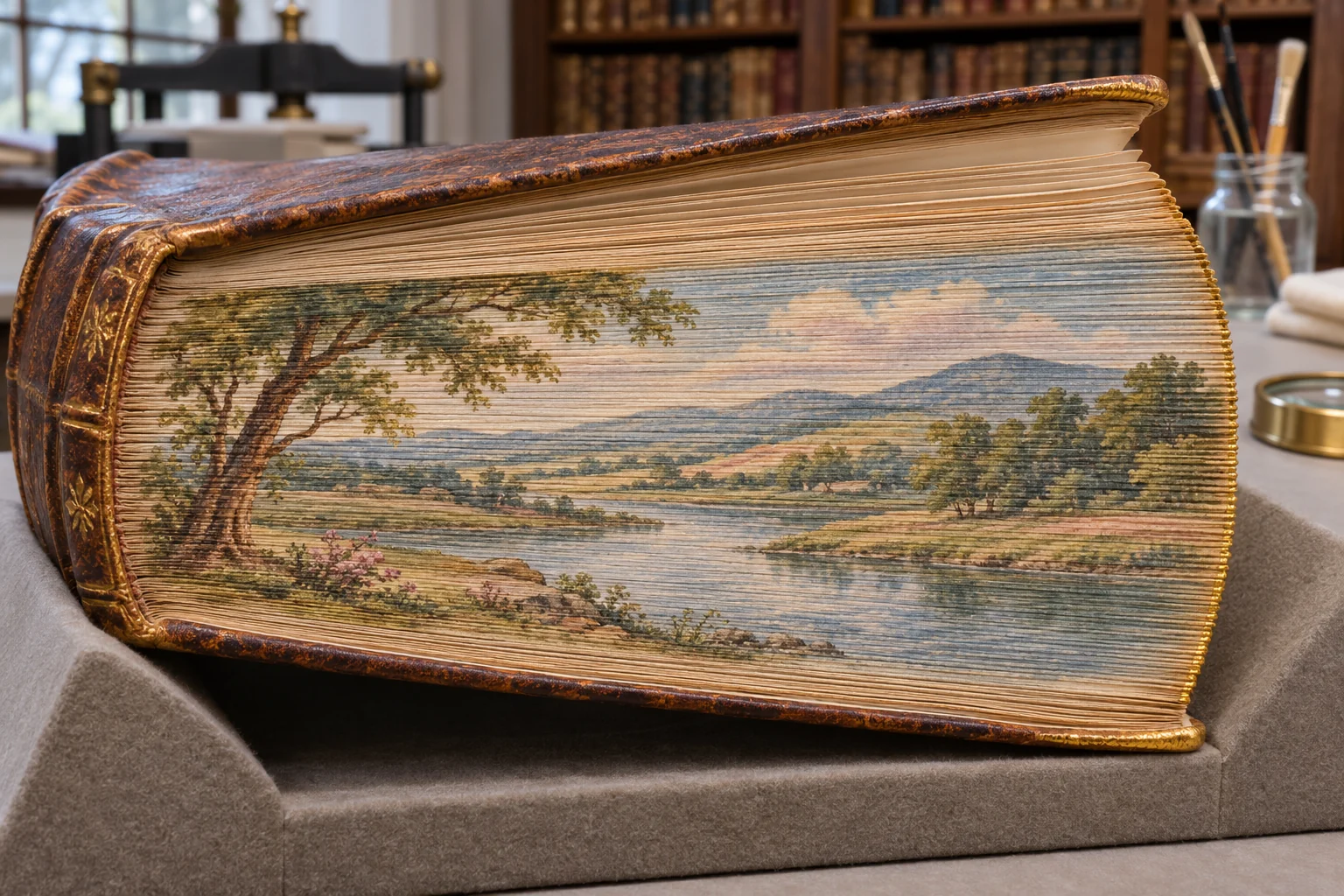
At Chetham’s Library in Manchester, an 1849 edition of Samuel Rogers’s poems contains a view of the New Bailey Bridge over the River Irwell. Looking up the bridge in the poems would be a poor way to find it. So would turning every page. The bridge runs across the outer edge of the book, distributed in slivers so narrow that no single leaf holds a useful view. A librarian can bring the spans together by gently fanning the pages. Close the book and the picture disappears.[1]
That disappearing act requires two surfaces where a casual observer sees one. There are the cut ends of the sheets, which line up when the book is closed. Then there are tiny strips just in from those ends, which come into view when the sheets slide past one another. The painter works on the second surface. The gilder finishes the first. Both can cover the apparent width of the book without either one concealing the other under an opaque coat of paint.[1, 2]
Where the painter puts the bridge
Bookbinders call the edge opposite the spine the fore-edge. On a closed volume, press your eye level in imagination with that edge. Each leaf contributes about a paper thickness to the stack facing you. Now picture a deck of unmarked playing cards on a table. Place each card a fraction farther to the right than the one below it. Seen from above, the stack has acquired steps. Each tread shows a sliver of a card face that used to be hidden. Seen from the side, the original thin edges are still there.
A fore-edge painter makes a much finer staircase. With the leaves evenly fanned and clamped, the cumulative width of those treads gives a watercolour brush somewhere to go. A bridge pier, a tree trunk and its reflection can each run over dozens of leaves. At this stage the artist can see the whole composition. The precision lies in keeping that temporary surface steady while working on it, then letting the colour dry before allowing the sheets to settle back.[1, 2]
Why the gold can stay in place
After painting, the artist can release the clamp, bring the fore-edge square again and have it gilded. On some examples the finish is marbled instead. Either treatment gives a reader a plausible reason to look no further. The aligned cut edge looks finished. Meanwhile the painted strips have slipped behind the faces of adjacent leaves. Nobody has to remove the gold to see what is underneath. The pages simply present a different set of surfaces when the block is fanned.[1, 2]
The width of each exposed strip matters. Imagine a horizontal line passing across the painted view at a shallow angle. If one cluster of leaves opens more than its neighbours, a stretch of the line may look wider, and the next stretch will seem pinched. Restore the fan that the painter used and the pieces return to their intended proportions. Even the water in the brush matters. Chetham’s notes that excessive moisture can buckle the paper, while overly dry paint risks flaking. On a surface this small, a minor distortion can cut straight through a building.[1]
Two theatres on the same edge
The Folger Shakespeare Library has a volume that can answer a lovely follow-up question. What happens if the pages fan the other way? On its copy of an English translation of Torquato Tasso, one direction brings Covent Garden Theatre into view. Reverse the fan and the reader sees Drury Lane Theatre. Close the book and the edge is gold. The two views occupy the same length of the book. The slivers visible in one direction lie on the opposite faces of the leaves from those visible in the other.[3]
This particular copy also separates the date and subject of the text from those of its decoration. The printed book dates from 1822 and contains Italian literature in translation. Its two London theatre scenes would make a peculiar choice for an illustration commissioned to explain the text. A book offered a painter a ready-made block of suitable paper, irrespective of the story inside. A catalogue entry for the literary work alone would give a theatre historian little reason to order this copy. Its description as a physical object changes who might seek it out.[3]
A Canadian landscape in the margins
One volume at the University of Alberta brings those different histories closer together. A copy of Paul Kane’s account of his North American travels bears a fore-edge view of historic Fort Edmonton. The library identifies the painter as H. Lory and the model as an 1846 work by Kane. Those credits distinguish three things that could easily merge in a casual description. Kane wrote the book and made the earlier image. Lory painted the little scene that emerges from this particular copy.[4]
Set that example beside the Manchester bridge. Chetham’s can identify the river crossing and the edition of the poems but leaves the painter’s identity open. Recognizing a building is one kind of historical evidence. Finding the person who translated it into a watercolour a few centimetres wide is another. The printed date on a title page gives a starting point for the history of the copy. On its own it cannot date the brushwork on the edge.[1, 4]
The problem with putting one behind glass
A rare book on display can usually be left open to a particularly fine page. A disappearing fore-edge gives a curator a different problem. A photograph taken square to the closed edge records the gilding perfectly and misses the scene. A photograph of the fan records the scene and loses the surprise of the original surface. Staff at William & Mary have described the difficulty of displaying the painted edges in their collection. Paired views can show a reader something a single view in a case cannot.[5]
For the Manchester volume, try looking at the library’s image before studying its description. Follow the bridge horizontally, then look for the much finer lines of paper cutting across the scene. They are both the reason the picture looks slightly ribbed and the mechanism that makes it disappear. The last step of this artwork belongs to the person holding the book. After the painter’s brush and the gilder’s leaf, a small movement of the pages supplies the view.[1]
Related reading
- How Ancient Papyrus Survived for Thousands of Years
- How Do Japanese Woodblock Printers Line Up Different Colours?
Sources
- Chetham’s Library — The New Bailey Bridge fore-edge painting
- University of Florida — Fore-edge paintings in the rare book collection
- Folger Shakespeare Library — Two London theatres on one volume
- University of Alberta — Books with fore-edge paintings
- William & Mary Libraries — The Ralph H. Wark collection
Keep exploring.
One remarkable idea at a time—nature, science, history and beyond.
Last updated November 22, 2026.

Barnakle Editorial Team
Barnakle Editorial Team is the collective byline used for Barnakle’s editorial articles. The contributor profile explains the team identity and links to the publication’s editorial policies.
More from the editorial team →