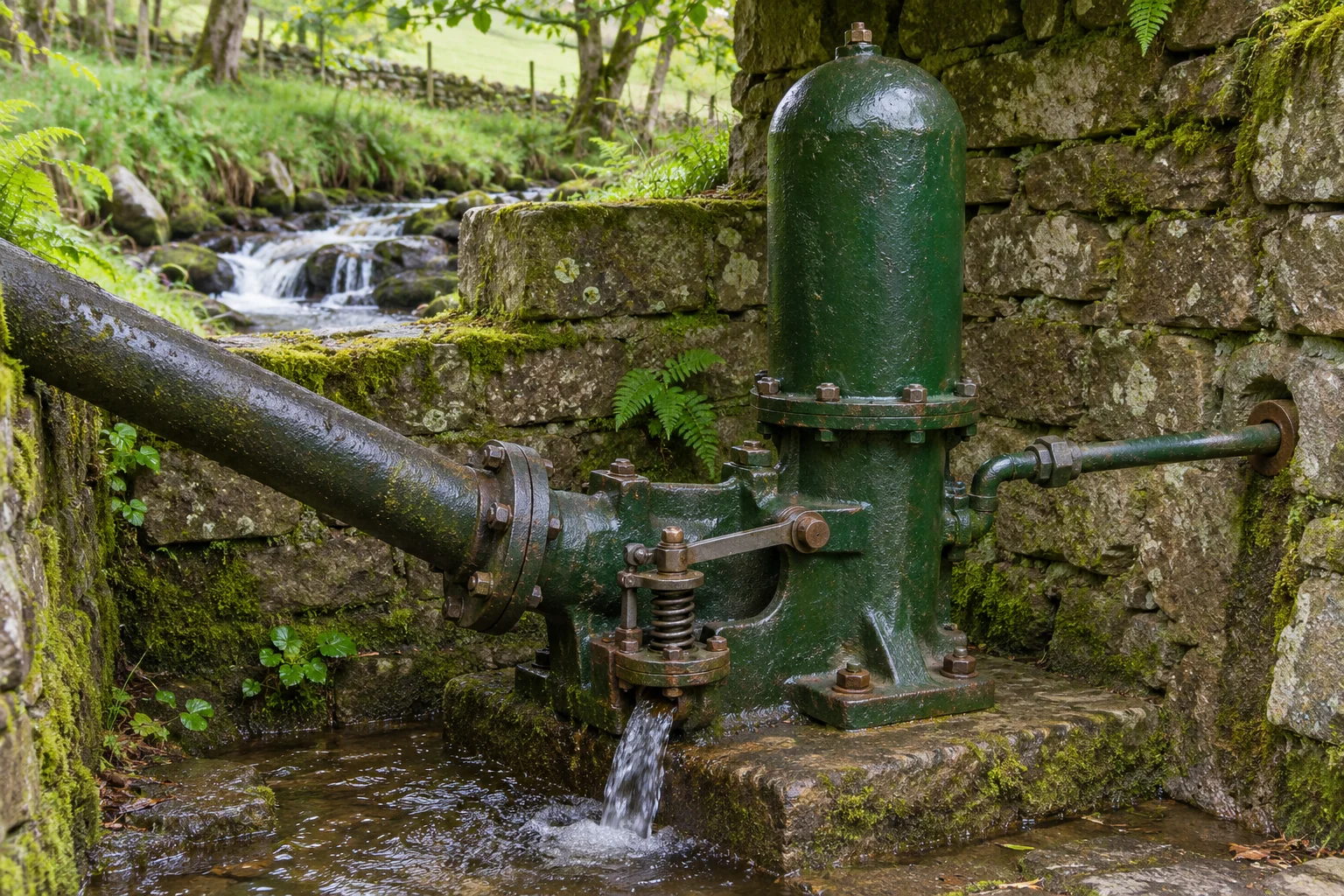
A pump beside a stream is spilling water onto the ground. It gives a sharp clack, goes quiet for a moment, then spills again. Farther up the hill a much thinner pipe is filling a storage tank. Both streams of water belong in this picture. In a hydraulic ram pump, a relatively large flow falling a short distance supplies the energy to lift a smaller flow much higher. Shut off the water escaping at the bottom and the delivery at the top soon stops too.[1, 2]
The machine needs a difference in elevation before it can do anything. Water enters a drive pipe at the upper source and travels downhill to the pump body. An outlet valve at the pump lets it run freely for part of each cycle. A separate one-way valve leads to the uphill delivery side. For a moment, those two exits put very different demands on the same moving column of water. The abrupt switch between them explains the noise.[1, 3]
What happens in the instant of the clack?
Start the story while the outlet, also called the waste or impulse valve, is open. Water running down the drive pipe escapes at the low end. As it accelerates, the flow exerts enough force to snap that valve shut. An entire pipeful of moving water is now trying to continue along a route that has just closed. Pressure at the pump rises sharply. Plumbers know the broader phenomenon as water hammer. In the ram pump that brief surge does a job.[2, 3]
For water to enter the delivery side, pressure in the pump must exceed the pressure already there. The uphill water column ordinarily pushes back too hard. During the surge, the balance reverses. The delivery valve opens and a small charge of water passes through. As the surge subsides, pressure on the delivery side shuts the one-way valve again. The water that has made it across stays on that side. The low outlet reopens and the drive pipe can pick up speed for the next stroke.[1, 3]
Timing makes the difference. Imagine replacing the abrupt closure with a gate that eased slowly shut. The downhill flow would have time to lose much of its speed as the opening narrowed. A slow change would give a much weaker pressure surge. Conversely, imagine holding the low outlet closed after one good stroke. The drive water would lose its open run downhill. There would be no fresh, fast-moving column ready for a second stroke. The unremarkable interval of spilling is when the pump gets ready to work again.[2, 3]
Why the uphill pipe can deliver between strokes
Many traditional rams have a conspicuous upright vessel attached to the pump. The upper part contains air. When a charge of water enters, it crowds the air into a smaller space. The compressed air subsequently expands and pushes water along the delivery pipe. The chamber takes a short pulse at one end and supplies a steadier flow at the other. A gauge on the pump body and a person watching the tank inlet would therefore see quite different versions of the same cycle.[1, 4]
The trapped air plays the part of a spring. Squeezing it stores some of the energy already supplied by the stream. It cannot keep pushing indefinitely once the downhill supply stops. In designs that use an air cushion in direct contact with the water, air can gradually dissolve away. Some rams admit small amounts of replacement air during operation. The valves and the cushion solve separate problems. One keeps the lifted water from running back. The other helps it continue moving forward between strokes.[3, 4]
How much of the stream reaches the tank?
Consider an idealized hillside. The intake surface is two metres above the pump, and the receiving tank is ten metres above it. Every litre through the drive pipe releases energy corresponding to a fall of two metres. Each litre sent to the tank requires energy corresponding to a rise of ten. Even before allowing for losses, five litres of drive flow can lift at most one litre to that height. The common starting level for both measurements is the pump. Measuring the lift only from the intake would give the wrong budget.[1, 2]
For this hillside, assume an overall pump efficiency of sixty percent. Actual efficiency varies with the installation. At an intake flow of ten litres a minute, the ideal delivery to that tank would be two litres a minute. Sixty percent of that is 1.2 litres a minute. If the source and the pump sustained those conditions around the clock, the tank would receive approximately 1,730 litres in a day. The trick that makes such a small stream at the inlet of the tank useful is how long it can keep running.[1]
Two hillside sites with the same stream
At the first site, water is plentiful but the ground between the intake and the pump is nearly level. At the second, the same flow drops into a gully before the delivery pipe starts its climb. The second site offers a larger fall from which to draw energy. A longer pipe laid on level ground cannot substitute for that vertical drop. Actual output also depends on the pipework and on how reliably the source feeds the pump. A drawing of the hillside therefore needs elevations as well as distances.[1, 2, 5]
The distinction is especially clear if you trace one litre. It may go straight through the waste outlet and rejoin the stream below the pump. A neighbouring litre may slip past the delivery valve and eventually reach a trough above the intake. The destination of any one litre tells you little about the energy available to the machine. The balance has to include all the water that fell and all the water that rose.[2, 5]
That clack by the stream is the instant when a flowing pipe briefly becomes a source of high pressure. A quiet visit to the storage tank would reveal very little about it. Look downhill as well, and the spill that first seemed like a fault turns out to account for the water arriving at your feet.[1, 3]
Related reading
Sources
- Province of British Columbia — Using a hydraulic ram to pump livestock water
- Food and Agriculture Organization — Water lifting devices, hydraulic ram pumps
- University of Warwick — An introduction to hydraulic ram pumps
- Rwanda Ministry of Infrastructure — Pumps in rural water supply systems
- Emergency WASH — Hydraulic ram (impulse) pump
Keep exploring.
One remarkable idea at a time—nature, science, history and beyond.
Last updated November 22, 2026.

Barnakle Editorial Team
Barnakle Editorial Team is the collective byline used for Barnakle’s editorial articles. The contributor profile explains the team identity and links to the publication’s editorial policies.
More from the editorial team →