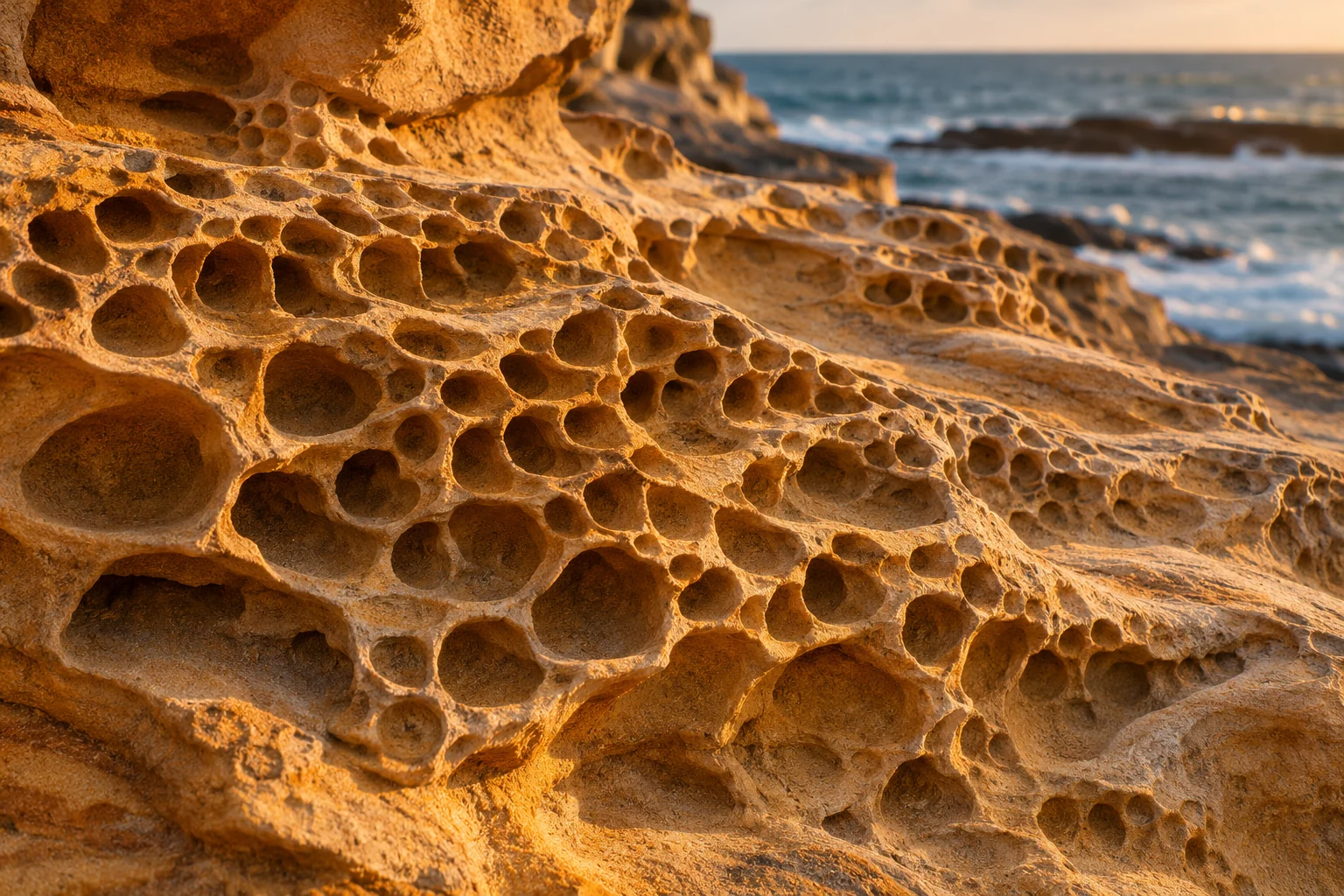
On Gabriola Island in British Columbia, sandstone can weather into ranks of little hollows separated by narrow stone ribs. From a distance they resemble the cells of a honeycomb. A wave punching holes into a cliff is an appealing explanation until you look at where some of the best examples occur. Pitted surfaces can sit well above the reach of ordinary breakers. A convincing account has to explain how grains leave those hollows and why the neighbouring ribs remain standing while that happens.[1, 4, 5]
Honeycomb weathering names the shape. It need not identify a single process wherever that shape appears. On several well-studied coasts, seawater provides salt, drying concentrates it, and repeated wetting and drying helps detach grains. Yet two hollows only centimetres apart share much the same weather. Understanding their spacing means looking closer, at the movement of water through the stone, the binding material between grains, and sometimes the film of living material on the exposed surface.[1, 2, 3]
The hole can grow one grain at a time
Sandstone is assembled from sand grains bound together by cement and other material. Water can enter connected pores, bringing dissolved salts with it. As water evaporates, salts can crystallize in confined places. Under suitable conditions crystal growth exerts stress on the surrounding material. Once grains loosen, far less force is needed to clear them away than would have been needed to knock a piece out of intact rock. A gust or a splash can carry off the products of weathering without having dug the original cavity.[1, 3]
Near Bellingham, Washington, geologist George Mustoe examined grains and weathered surfaces rather than relying on the coastline’s outline. He reported that the material broke down largely by grains parting company. The evidence did not point to wholesale chemical decomposition of the minerals. That distinction is visible in principle in a small pile of debris. If sand-sized mineral grains survive below a hollow, an explanation must account for how they lost their grip on one another, even if the grains themselves remain quite recognizable.[1]
Why would the pit wear faster than its rim?
One plausible answer is that the rim has acquired a tougher skin. Mineral cement near an exposed surface can, under some conditions, make it more resistant. Breach that skin and softer rock beneath it may retreat more rapidly. Another possibility is that the rock on either side starts out equally strong but experiences different amounts of salt growth. The two explanations predict different evidence. One directs attention to the strength of the stone. The other directs it to where water reaches a surface and evaporates.[2, 3]
A study of sandstone honeycombs in a humid climate tested those alternatives. Researchers compared the strength, drilling resistance and porosity of the ridges with those of the backs of the pits. The measurements did not support a harder rim at their sites. Dye experiments, however, showed that at low flow the evaporation front could reach the backs of the holes while the lips stayed dry. This put conditions favourable to salt weathering in the recesses. A slight difference in shape could thus influence where the next round of grain loss occurred.[2]
The distinction between wet and drying is important. Imagine two shallow dishes of salt water. In one, fresh water continually replaces what evaporates and carries the salt away. In the other, evaporation concentrates what remains. Both dishes can look wet during part of the experiment while experiencing very different conditions for crystallization. The same caution applies on a shore. A wall drenched most frequently by waves need not be the wall where salt repeatedly becomes concentrated enough to do the most work.[2, 4]
The thin walls may have help
Mustoe proposed a different contributor to the survival of some ridges in the Pacific Northwest. Films produced by microscopic algae appeared to protect parts of the exposed rock. Subsequent work compared relatively level surfaces in the intertidal zone with steep faces higher in the spray zone. On a level surface a growing hollow can retain enough seawater between tides that it seldom dries sufficiently. Encrusting organisms can also protect rock locally. A deeper pool therefore need not continue to deepen at its initial rate.[1, 4]
Research on the Tuscan coast adds another caution against treating every square metre of cliff alike. Investigators compared hundreds of cells with the properties of the rocks around them. At their sites the pits occupied particular sandstone surfaces, while nearby strongly cemented material and other rock types escaped the same pattern. A neighbouring bed can share the full supply of sea spray yet respond differently. The composition and structure of the starting rock set limits on what wetting and evaporation can accomplish.[3]
Reading a shore photograph
Look first at the faces of the hollows. Are they on a nearly horizontal bench that can retain puddles, or high on a steep wall from which water runs off? Next trace a ridge until it reaches another kind of rock or a fracture. Does the pattern stop? Finally look for loose grains, darker surface films and changes in the size of the cavities. Each observation narrows the plausible explanations a little. A photograph taken under dramatic side lighting may show the pattern beautifully while revealing almost nothing about where salt crystallizes.[1, 2, 4]
The Gabriola observations make a good final test. Local descriptions put some sculpted rock where direct surf is an infrequent visitor. That position weakens the idea that repeated blows of waves physically excavated every hollow. It leaves room for spray, for moving moisture inside the rock and for differences in the survival of ridges. The studies from other coasts suggest ways of testing those possibilities on individual outcrops. Similar-looking stone need not preserve identical histories.[2, 4, 5]
A single cell draws the eye to the material that is gone. Two cells side by side reveal the harder question, the slim wall between them. It records a difference in weathering over a very short distance. In some places the wall was better protected. In others, conditions for grain loss kept returning to the pit. That narrow strip of sandstone is often the most informative part of the hole.[1, 2, 4]
Related reading
Sources
- The origin of honeycomb weathering
- Origin of honeycombs: Testing the hydraulic and case hardening hypotheses
- Origin of honeycombs and related weathering forms in Oligocene Macigno Sandstone, Tuscan coast near Livorno, Italy
- Biogenic origin of coastal honeycomb weathering
- Nick Doe — What makes the holes in sandstone?
Keep exploring.
One remarkable idea at a time—nature, science, history and beyond.
Last updated November 22, 2026.

Barnakle Editorial Team
Barnakle Editorial Team is the collective byline used for Barnakle’s editorial articles. The contributor profile explains the team identity and links to the publication’s editorial policies.
More from the editorial team →