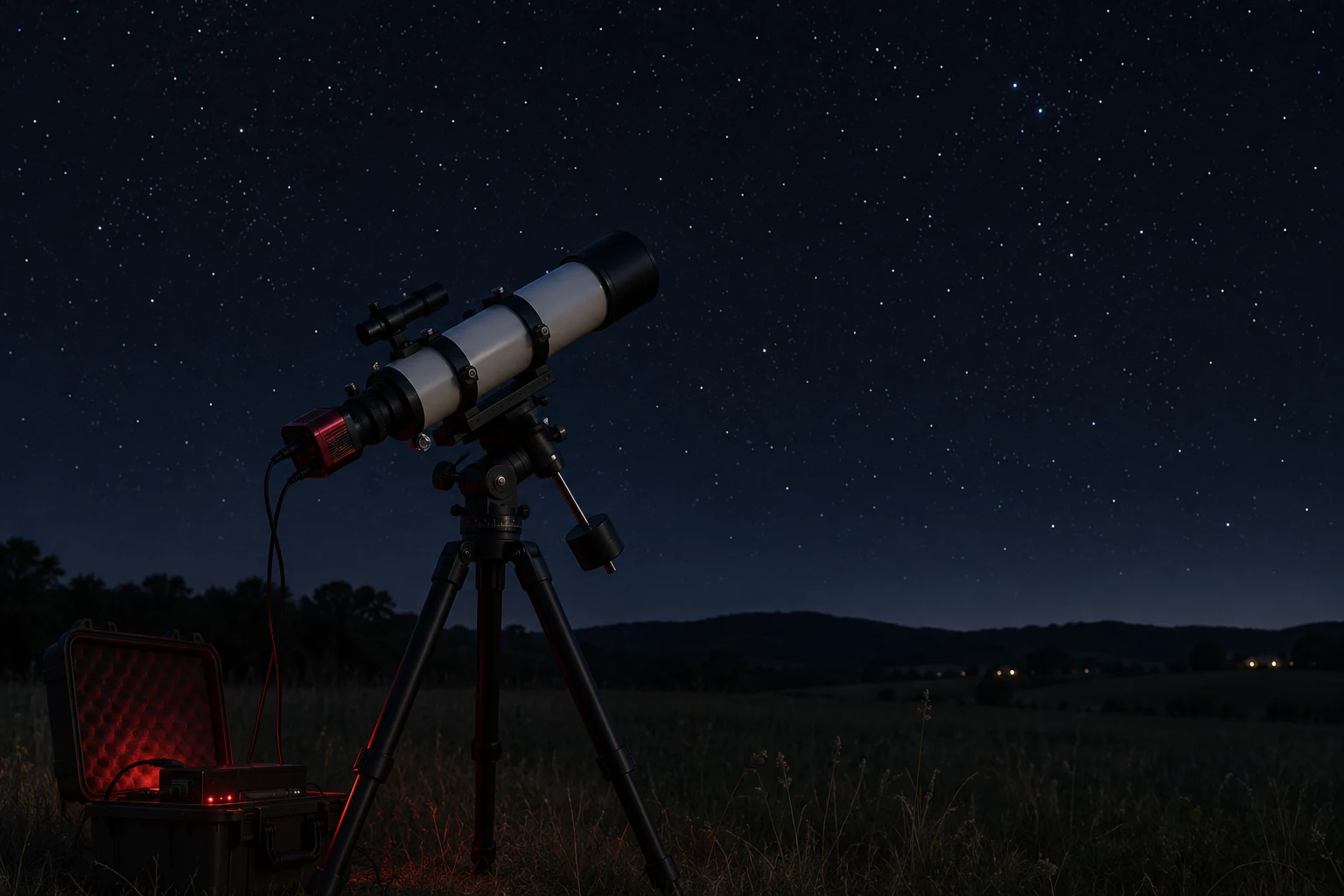
Several telescopes pointed at the same star in Nevada one night in 2021. To observers at some locations the star briefly faded as the asteroid Eurybates passed in front of it. A telescope a few kilometres away could see a shorter interruption, or no interruption at all. The astronomers had spread out on purpose. Each observer recorded the part of the asteroid’s silhouette that swept over one place on Earth. Put the observations together and a shape emerges from the timing of what looks like a star blinking out.[1, 2]
The event is a stellar occultation. For the few seconds that matter, the light source lies so far behind the asteroid that it can often be treated as a point. The asteroid intercepts the starlight and a narrow shadow crosses Earth as the bodies move relative to one another. A camera at a telescope records the star field before, during and after the predicted passage. The asteroid can be too faint to see separately and still block a measurable amount of starlight.[1, 2, 4]
Turn seconds into kilometres
Suppose the shadow crosses an observing site at twenty kilometres per second and the recorded dip lasts two seconds. Along the direction of travel, the observer has sampled a strip forty kilometres long across the projected asteroid. In geometry the segment joining the entry and exit points is called a chord. The speed in this calculation is the predicted relative speed of the shadow across the observing plane. The asteroid’s speed around the Sun by itself would be the wrong number to put into the calculation.[2, 3]
That forty kilometres is a real physical length, but its interpretation depends on where the observer stood. Draw a circle, then draw a horizontal line through its centre. Move the line towards the top of the circle while keeping its direction fixed. Progressively less of the line lies inside the outline. A short interruption can result from a small object or from crossing only the edge of a much larger one. A single chord places a lower bound on the body’s extent in that direction. It rarely supplies a unique diameter.[2, 3]
What a second telescope adds
A second observer positioned across the track samples the silhouette at a different offset. If the timing clocks agree, both chords can be placed in the same coordinate system. Their lengths tell the researchers how much of the asteroid crossed each site. Their start and end times also say where the two edges lay along the direction of motion. Two equal-length dips displaced in time could therefore trace the sides of a slanted outline. Keep only their durations and that part of the shape information disappears.[2, 3]
A row of stations lets investigators mark pairs of edge points at several offsets. Close to the middle they might see long chords. Near one side they might find a much shorter chord than expected for a circle. An ellipse or an irregular model might account for the timings better. Empty space between neighbouring observing sites still matters, however. A sketch joining measured endpoints is an interpolation across those gaps. A narrow feature that passed between two telescopes might leave no trace in the timings at either one.[1, 3, 4]
A clear miss can improve the outline
Now place one more telescope just outside the last station that saw a dip. Its uninterrupted record helps bracket the edge. A candidate shape extending across its observing line should have blocked the star there. If the signal was strong enough and the clock, location and weather are well documented, the clear miss counts against that model. The same argument cannot be made from a station covered in cloud. Seeing the star stay bright throughout the expected interval is an observation. Losing sight of the field is a gap in the data.[2, 5]
Prediction uncertainty is one reason teams spread themselves across a corridor. A small error in the estimated position of the star or the asteroid can shift the actual track on the ground. Place everyone at one promising spot and they may all get a beautiful long dip, but they will have measured almost the same chord. They may equally all miss. Distribute the stations and even observations near the edge of the predicted path can constrain where the shadow really passed.[1, 2, 5]
Why record video of a point of light?
The useful measurement is a change in brightness at a known time. A short exposure preserves sharper timing, but collects less light from a faint star. A longer exposure collects more photons and may mix the bright and faint portions of the event in one frame. A clock offset matters as well. At our illustrative speed, an error of a tenth of a second moves an endpoint two kilometres along the track. A collection of accurate observers with disagreeing clocks could produce an asteroid that appears oddly skewed.[2, 3]
An occultation also need not turn a pixel completely black. Before the event, light from both the foreground asteroid and the star can fall into the same small patch of the image. During the event the asteroid’s own reflected sunlight remains. A sequence of measurements lets observers distinguish that drop from ordinary variations affecting nearby stars, and attach an uncertainty to the times of disappearance and return. Those uncertainties accompany the chord endpoints when researchers compare them with a predicted shape.[2, 3, 4]
For NASA’s Lucy mission, the appeal of the Eurybates campaign was the opportunity to measure the size and outline of a distant target ahead of a spacecraft encounter. Even many well-measured chords reveal a projected profile at one orientation. Observe again when the asteroid has rotated or the viewing direction has changed and the new profile can test a different face of a three-dimensional model. The earlier silhouette remains valuable precisely because its date, viewing geometry and scale were recorded.[1, 3, 4]
Seen from one telescope, the event is over almost before there is time to react. Seen across the network, those seconds are distributed across a body far away in space. A longer dip here, a late return there and a star that held steady just beyond the edge give the team measured points on an outline that no single observer could have photographed that night.[1, 2]
Related reading
Sources
- Watching the Blink of a Star to Size Up Asteroids for NASA’s Lucy Mission – NASA
- How do you observe an asteroid occultation?
- Precise astrometry and diameters of asteroids from occultations – a data set of observations and their interpretation
- Occultation constraints on solar system formation models
- International Occultation Timing Association — Observing lunar and asteroidal occultations
Keep exploring.
One remarkable idea at a time—nature, science, history and beyond.
Last updated November 22, 2026.

Barnakle Editorial Team
Barnakle Editorial Team is the collective byline used for Barnakle’s editorial articles. The contributor profile explains the team identity and links to the publication’s editorial policies.
More from the editorial team →