In November 1676, a speck of light near Jupiter appeared roughly ten minutes late according to the timetable astronomers were using. It was Io, the innermost of Jupiter’s four large moons, emerging from the planet’s shadow. A late arrival is ordinarily a reason to suspect the clock or the timetable. Ole Rømer argued that this one also depended on where the observer happened to be. Earth had moved, and light from the eclipse had farther to go.[1, 2]
Io offered astronomers a repeating event they could time from another planet. Records of its eclipses showed a pattern. As the distance between Earth and Jupiter changed, successive observations could get ahead of, or fall behind, a prediction based on earlier timings. Rømer recognized that light taking time to travel across space could account for the shifts. The important quantity was the change in the journey’s length. Nobody needed to put a second clock on Io.[1, 2]
An eclipse with the roles reversed
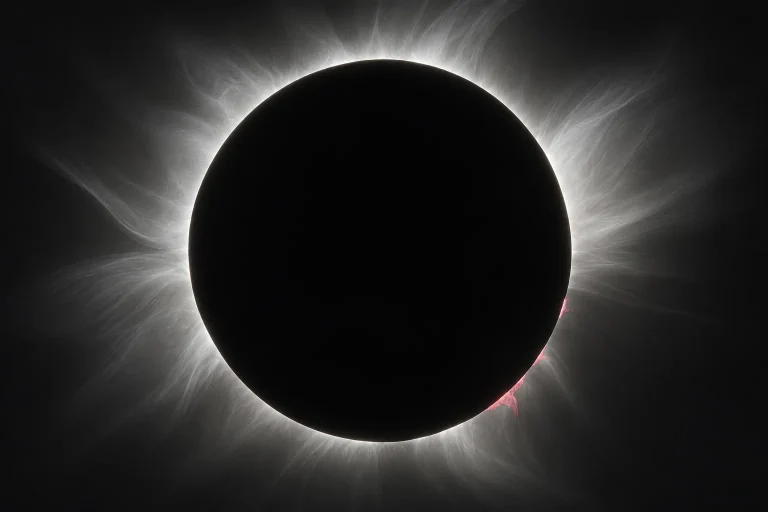
An observer on Earth sees a lunar eclipse when our Moon moves into Earth’s shadow. Substitute Jupiter for Earth and Io for our Moon and the same geometry applies. Jupiter blocks the sunlight that normally illuminates Io. Through a telescope, the moon can fade as it enters the shadow or return as it leaves. Which event can be seen from Earth depends on the arrangement of the Sun, Jupiter and the observer. The edge of Jupiter’s visible disk and the edge of its shadow needn’t coincide.[1, 3, 5]
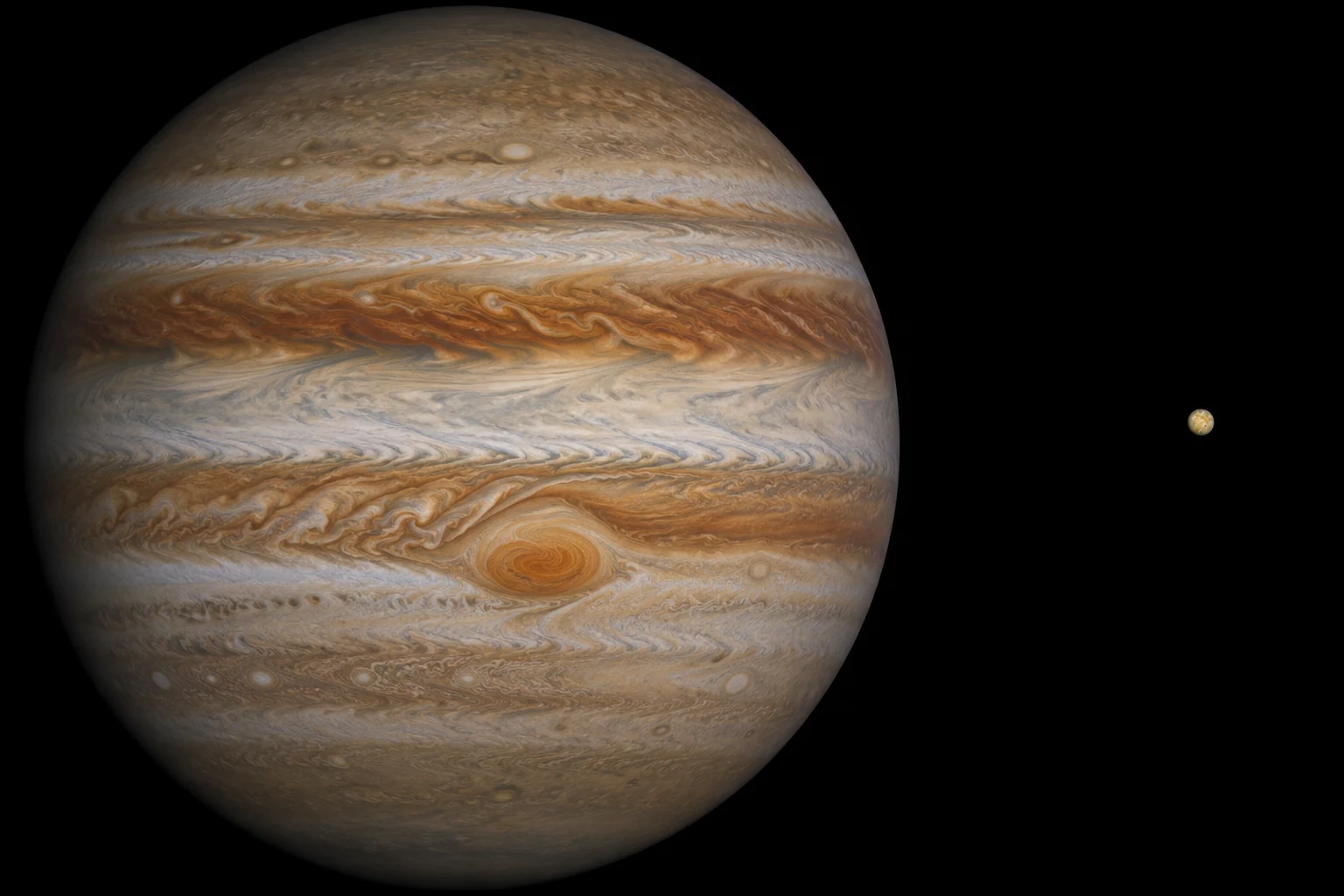
There is a useful check on that mental picture. NASA’s Juno spacecraft has photographed a dark round mark on Jupiter made by Io blocking sunlight on its way to the planet. The photograph shows Io casting a shadow. Rømer’s clock used the opposite event, when Jupiter cast the shadow and Io went dark. A dot on the bright cloud tops and a point of light winking back into view beside them can involve the same two bodies in quite different alignments.[1, 5]
Why astronomers kept such careful time
Io goes around Jupiter in about forty-two and a half hours. That gives astronomers many chances to compare one event with another in a single observing season. Tables of the eclipses also promised a practical reward. Widely separated observers able to identify the same eclipse could compare their local times of observation. Since local solar time varies with longitude, the moons could serve as a reference for comparing positions on Earth. Any persistent error in the timetable mattered for more than the study of Jupiter.[1, 2, 3]
Suppose an imaginary moon produces one flash every forty hours, and the distance to the observer stays fixed. Even if each flash takes half an hour to reach the observer, the flashes still arrive forty hours apart. Measuring the intervals alone won’t reveal the half hour. Now let the observer recede so that each new flash travels a little farther than the last. The arrivals spread apart. Reverse the motion and they draw closer together. This is why Earth’s changing position in its orbit was such a gift.[1, 2]
A small discrepancy accumulates
On the scale of one Io orbit, the change in travel time is small compared with the interval between eclipses. But astronomers needn’t judge the case on the interval between Tuesday and Thursday alone. Follow a run of eclipses while Earth recedes and a succession of small delays can add up. After several months an event can be minutes away from the time obtained by carrying an earlier schedule forward. A clock on Earth can distinguish that difference much more readily than a tiny discrepancy between two consecutive events.[1, 2]
It is tempting to interpret the late November observation as the time light needed to get all the way from Jupiter. That would give the wrong distance for the calculation. Some travel time was already present in the observations on which the prediction rested. The additional delay reflected an additional stretch of space between the planets. The principle works with a nearby flashing lamp as well, but walking to the far side of a room gives light very little extra distance to cover.[1, 4]
What Rømer put a number on
The seventeenth-century estimate associated with the work was about twenty-two minutes for light to cross a distance equal to the diameter of Earth’s orbit. That is a time for a specified astronomical distance. To turn it into a speed in familiar units, one must also know how large Earth’s orbit is in those units. Christiaan Huygens carried out that further conversion. Historians distinguish his numerical speed estimate from Rømer’s argument for a measurable travel time.[1, 2]
Modern values let you repeat the arithmetic. One astronomical unit is 149,597,870,700 metres. Light in a vacuum travels 299,792,458 metres each second. Dividing twice that distance by the speed gives just under 1,000 seconds, or about sixteen minutes and thirty-eight seconds. This uses two astronomical units as a convenient baseline. The actual separation of the planets at two particular observations depends on both orbits and on the dates. The historical estimate was imperfect, yet a delay measured in minutes was a strikingly different result from instantaneous travel.[2, 4]
A moon is a demanding clock
Io does not circle Jupiter like a gear turning at an exactly predictable rate in a watch. Its motion is influenced by the other moons, and an observer has to judge when a faint point has disappeared or returned. Cassini, who had developed eclipse tables and discussed light travel time, questioned whether the same explanation worked consistently for the other satellites. Records surviving from Paris show a longer and more interesting scientific exchange than a single observer calling the correct minute.[1, 2]
What made the idea testable was a prediction about the observer as much as about the moon. A poor eclipse table could put Io late. A poor terrestrial clock could put the whole sky late. A delay tied to whether Earth was approaching Jupiter or receding from it told astronomers where to look for a repeating pattern in the errors. Io kept passing into and out of shadow. The movement of the planet from which we watched helped turn those disappearances into a measurement of light.[1, 2]
Related reading
Sources
- American Museum of Natural History — Ole Rømer and the speed of light
- Laurence Bobis and James Lequeux — Cassini, Rømer and the velocity of light
- NASA — Io, moon over Jupiter
- NASA Jet Propulsion Laboratory — Astrodynamic parameters
- NASA — The shadow of Io
Keep exploring.
One remarkable idea at a time—nature, science, history and beyond.
Last updated November 22, 2026.

Barnakle Editorial Team
Barnakle Editorial Team is the collective byline used for Barnakle’s editorial articles. The contributor profile explains the team identity and links to the publication’s editorial policies.
More from the editorial team →