On a star chart for the summer of 2018, Mars did something odd near the end of June. Its position, marked against the stars on successive nights, had been creeping east. On June 28 it reached a turn. Through July it travelled west, and on August 28 it turned again. Anyone who plotted only the first and last stages might have missed the middle of the story. Yet during those two months, Mars continued to travel round the Sun in the same direction as Earth.[1]
The apparent reversal is called retrograde motion. What changes direction is the line from a moving observer, through a moving planet, to a background of much more distant stars. Earth follows the smaller, faster orbit. As it catches Mars and passes on the inside, the angle of that line swings back across part of the sky. The best way to see why is to keep the observer in the drawing. A diagram of Mars’s orbit alone leaves out half the motion.[1, 2]
Which movement are we measuring?
Spend one clear evening outside and you can watch Mars and nearby stars cross a substantial part of the sky together. Earth’s rotation accounts for that familiar sweep. Spend several weeks marking where Mars sits inside a recognizable pattern of stars, however, and the pattern itself becomes your measuring grid. Earth’s daily turn carries the grid and the planet across your horizon together. Mars’s slow change of position within the grid is a different observation.[2, 3]
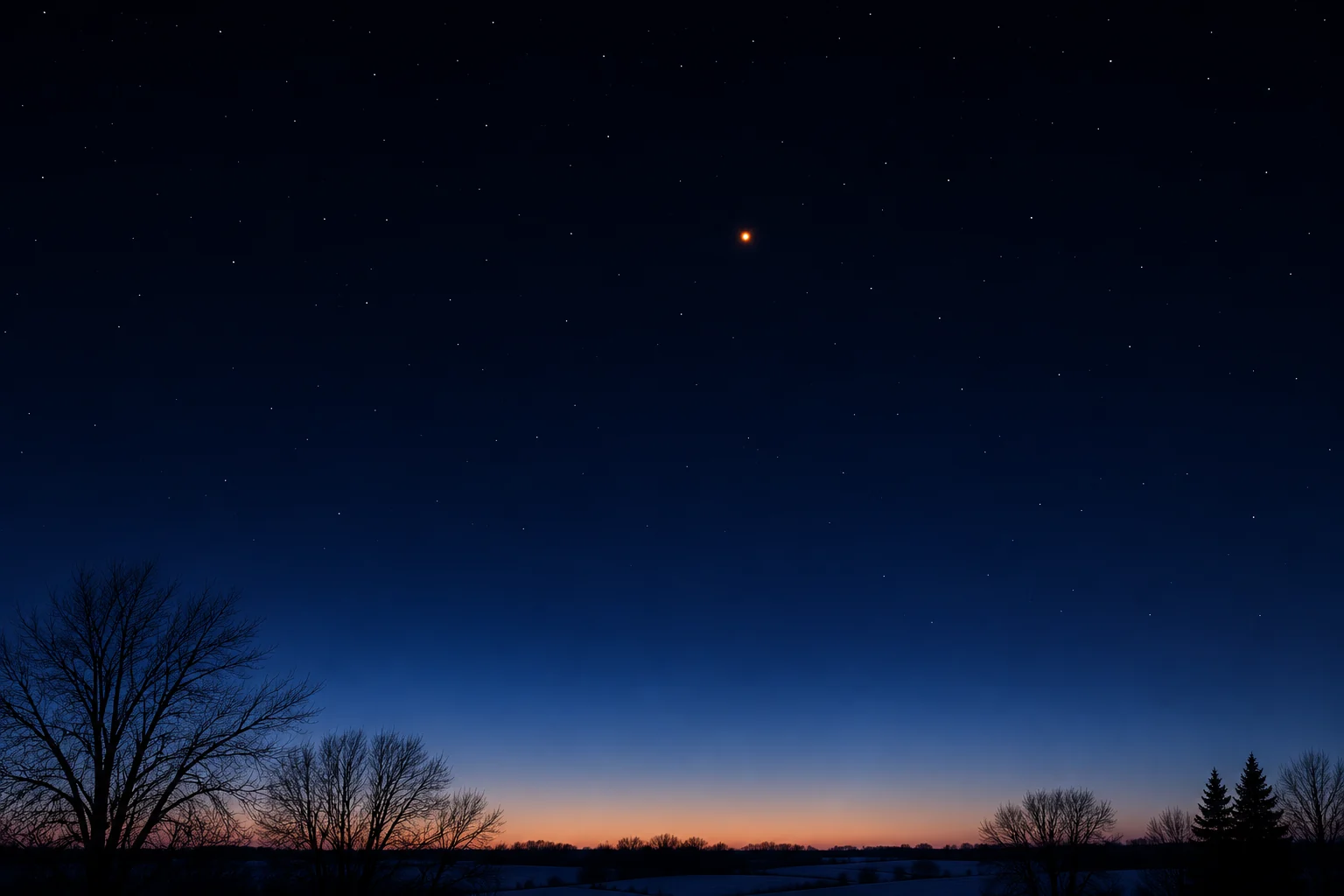
Take two stars that make the ends of an imaginary ruler. On the first evening the planet sits close to one end. A few nights later it lies nearer the middle. You can recover that relationship if the whole ruler is tilted with respect to the horizon the next time you go out. A tree in the foreground is an excellent landmark for finding your observing spot. It makes a poor reference for this particular measurement because Earth’s turning changes which stars stand above the tree from hour to hour.[2]
Draw the line all the way to the stars
Imagine a tabletop plan with the Sun at the middle, Earth on an inner track and Mars farther out. Mark the two planets for one evening. Lay a straightedge from Earth through Mars and extend its line to the far edge of the paper. That endpoint represents the direction an observer would report. Now mark both planets for a later evening, moving both forward and moving Earth through the greater orbital angle. Put the straightedge down again. Its outer end can swing in the opposite direction even though both marks advanced.[1, 2]
A passing train gives a brief version of the effect. From the window of the faster train you can watch a carriage on the next track slide backwards past a distant building. Its passengers are still going forward. The railway example works best at the moment of passing. Straight railway tracks cannot explain the eventual return to the usual eastward drift on a star chart. For that you need the curved orbits and the changing orientation of the line between the planets after Earth pulls ahead.[1, 3]
The night Mars stands opposite the Sun
Partway through the reversal, Mars reaches opposition. From Earth, the planet then lies in the opposite direction on the sky from the Sun in celestial longitude. It rises around sunset and is usually well placed for observing for much of the night. In the 2018 example, opposition fell on July 27, between the two turning dates. On that night Mars was already moving west against the stars. Opposition names the alignment. The two stationary points name the ends of the interval of reversed motion.[1, 2]
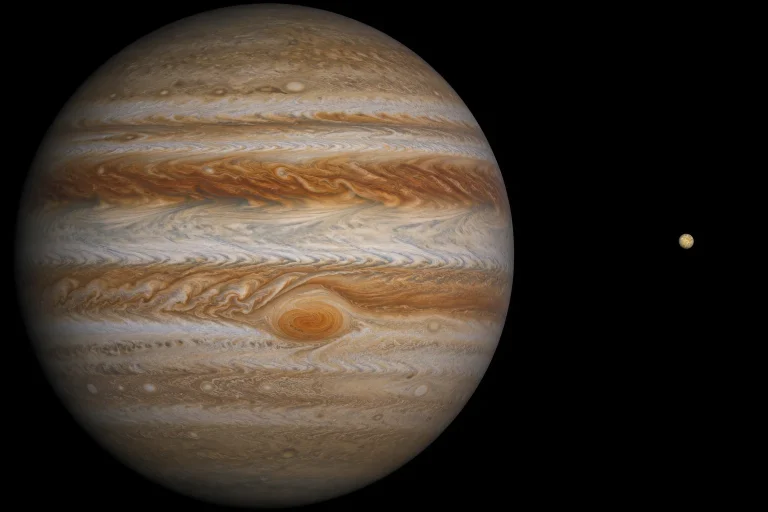
Oppositions of Mars come roughly 26 months apart. That interval measures how long Earth takes to gain a whole lap on Mars. After one Earth year our planet has returned to its former place on its orbit, but Mars has travelled a considerable way along its own path. Earth needs more time to catch it again. Nor does every encounter put the planets exactly the same distance apart. NASA’s series of Hubble images from different oppositions shows a range of apparent sizes for the same planet.[4]
Why the track can look like a loop
Retracing an eastward journey exactly would produce a line drawn twice. Mars can also shift north or south relative to the stars as the two planets move in slightly different orbital planes. Combine that sideways drift with a reversal in east-west motion and there is room for the return track to miss the outward one. A turning point in the east-west coordinate can consequently look like a bend rather than a complete halt. The word stationary needs the same reference frame as the original measurement.[1, 2, 3]
One unusually clear record was made between September 2024 and May 2025. A composite published by NASA combines photographs taken, weather permitting, five to nine days apart. Against the stars of Gemini and Cancer the planet draws a clockwise loop. Several dots separated by a week tell you at once what one brilliant dot in a single exposure cannot. Look particularly at the ends of the bends. Positions bunch along the east-west direction as Mars approaches a turn, then open out again as its apparent motion picks up.[5]
A home observer can use the same idea without making a composite photograph. Copy three or four bright stars onto a sheet, keep their arrangement fixed, and add a dated mark for Mars whenever the sky permits. Use a fresh colour or a short date label if the path crosses an earlier mark. A gap in the record simply means that a portion of the curve has to be inferred between observations. The dates are what turn a row of dots into a track with a direction.[2, 5]
The summer 2018 chart records something real about the view from Earth. A second observer looking directly down on the solar system would draw a different track and get an equally valid result. To turn one drawing into the other, put the observer back on the inner orbit, sight along the straightedge, and move its near end as well as its far one.[1, 2]
Related reading
Sources
- Loops in the sky – British Astronomical Association
- University of Glasgow — Positional astronomy and planet motions
- OpenStax Astronomy 2e — Ancient astronomy and retrograde motion
- NASA — Hubble’s visual history of Mars
- NASA Astronomy Picture of the Day — Mars in the Loop, May 30, 2025
Keep exploring.
One remarkable idea at a time—nature, science, history and beyond.
Last updated November 22, 2026.

Barnakle Editorial Team
Barnakle Editorial Team is the collective byline used for Barnakle’s editorial articles. The contributor profile explains the team identity and links to the publication’s editorial policies.
More from the editorial team →