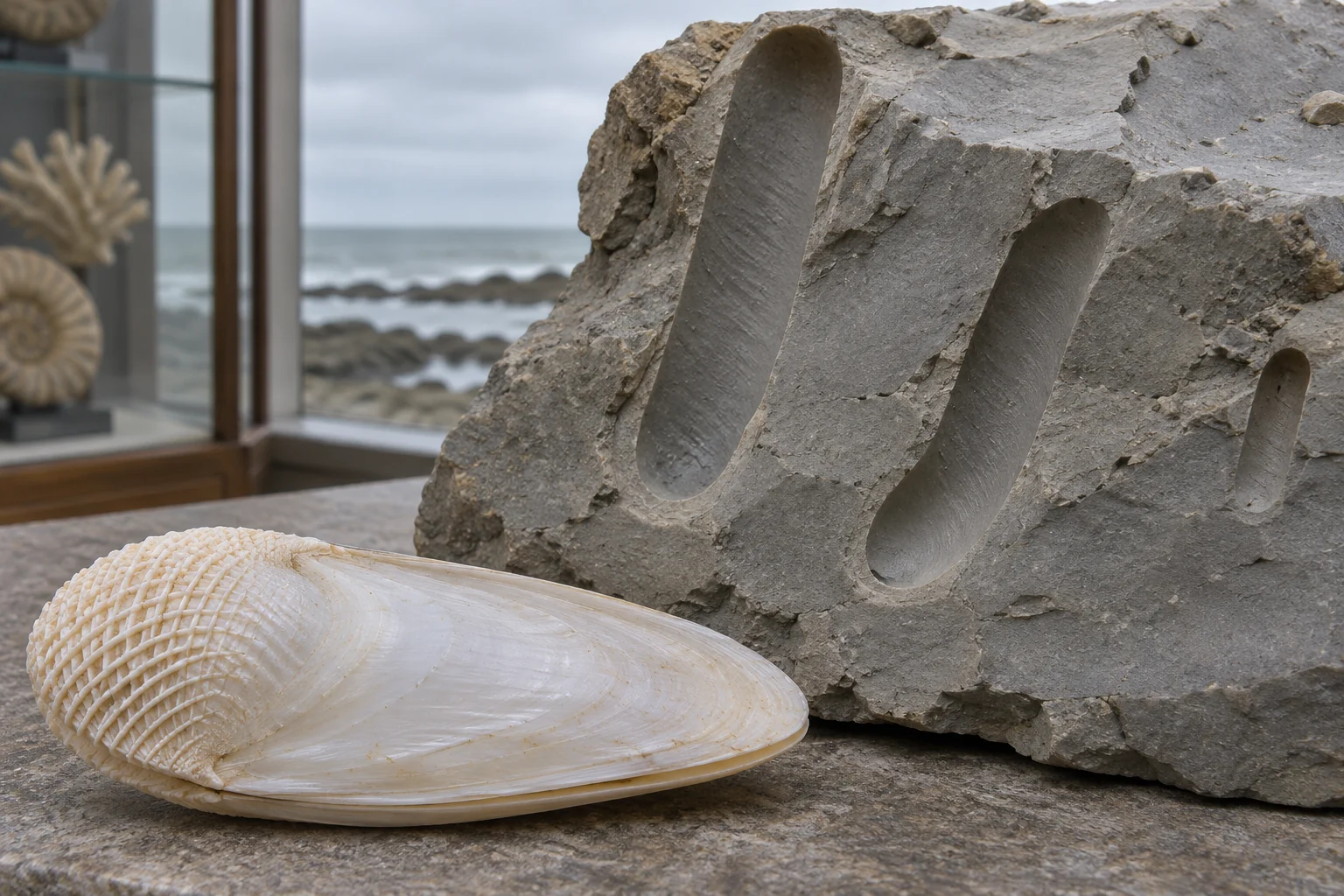
Look into a narrow hole in a block of soft coastal rock and you may be looking through the front door of a clam. A white piddock can spend its adult life inside a cavity made with its own shell. The roughened end works against the surrounding material as muscles rock the two halves of the shell through short, coordinated movements. The result can outlast the animal. A piece of shore worn open by the sea may show the narrow entrance and the much roomier chamber that once lay beyond it.[1, 2, 3]
A shell with a working end
The white piddock, Barnea candida, makes an unlikely-looking stoneworker. Its pale shell is elongated and sufficiently fragile that a collected specimen deserves delicate handling. Look closely at the outside, however, and the sculpture changes from one end to the other. Ridges and small projections make part of the surface rough. Press a textured surface against the same patch of soft material over and over and many small contacts can remove grains. An individual piddock has time to do just that. Clay and relatively soft rock offer it very different prospects from a block of hard crystalline stone.[1, 2]
The shell is also the outer boundary of a living animal. Beneath it are the muscles that position the valves, the paired halves of a bivalve shell. A familiar image of a clam shows two matching plates opening along a hinge. That is a useful starting point for understanding how an ordinary clam closes up, but it misses much of what makes the white piddock an effective excavator. To rasp a surface, the part that touches the rock has to move across it under pressure. Opening a gap between two plates is only one possible part of that motion.[1, 2]
How a clam gets a cutting stroke
Researchers who modelled the white piddock’s movements identified four muscles arranged around a pivot toward the back or dorsal side of the animal. The arrangement allows the shell halves to rock relative to each other around two axes at roughly right angles. One pair of opposing actions can change the separation near the front and rear, while another affects how the valves open or close across their lower margins. Combining rotations lets the textured part of each valve sweep across the wall of the cavity. There is no need for the animal to spin continuously like an electric drill bit.[1]
Try tracing a small arc across your palm with two bent fingers. If you first change the angle of your wrist and then make the same movement, the contact follows a different path. In the piddock the geometry is built into the animal. The position of the pivot and the locations where the muscles pull determine which part of the shell presses against the rock. An isolated valve in a display can show the rasp beautifully. It takes the paired valves, their support and a sequence of muscular pulls to explain what that rasp does.[1, 2]
Other boring clams make an instructive comparison. In experiments on the false piddock, a different species, researchers studied movement in sand and in firmer substances such as clay. Contraction of a muscle that retracts the foot drew the front shell margins down and across the bottom of the hole. Projections there acted on the substrate. The broad principle is similar: use part of a shell as a working edge. The detailed sequence described for the false piddock belongs to that species. A hole in a rock alone would tell you very little about the muscles that made it.[1, 5]
How does an animal inside rock get dinner?
For a piddock, making room for its body is only half the problem. Food and oxygen are in the seawater outside. The white piddock has a pair of siphons joined along their length, with separate openings for water entering and leaving. These soft tubes can extend several shell lengths. The animal can thus keep its shell well inside the burrow and still draw in water carrying tiny food particles. An observer watching the outside of an occupied hole may see the water openings without seeing any of the shell that cut the chamber.[2, 3]
This arrangement explains a feature of old borings. The section of a tunnel that must accommodate the growing shell can be considerably broader than the route needed by the extended siphons. Imagine a wave knocking a piece from the face of an outcrop. A chamber formerly visible only through a small opening might suddenly be exposed along its length. Two holes of strikingly different sizes on a beach fragment can therefore be different sections through similar structures. The diameter at the broken surface alone is a poor measure of the length of the animal that lived there.[2, 3, 4]
Reading a piece of perforated shore
A shell inside its own cavity is particularly good evidence. On parts of the Washington coast, Walla Walla University’s invertebrate collection documents rocks densely occupied by another piddock, Penitella penita. The photographs show how much rock can be perforated when many individuals occupy one patch. On an exposed shore, waves and abrasion can eventually remove material separating neighbouring holes. The animals create weaknesses that other processes can exploit even after the original occupants are gone.[3, 4]
An empty chamber can acquire a second tenant. Small crabs, sea anemones and other shore animals can use abandoned piddock borings as shelter. The animal peering out of a hole today can therefore be quite different from the one that excavated it. Anemone tentacles across an opening tell you something about its current occupant. The shape of the inner chamber, any surviving valve and the character of the surrounding rock tell a different part of its history.[3, 4]
On a low-tide walk, look for a naturally broken face alongside an intact one. The outside view gives you the entrance. The cross-section reveals how much the entrance conceals. Together they explain how a soft-bodied filter feeder can shape a hard-looking shore while remaining almost entirely out of sight. Its most durable trace is often the space where its fragile shell used to be.[1, 3, 4]
Related reading
Sources
- Journal of the Royal Society Interface — A biomechanical model of drilling in the white piddock
- Marine Life Information Network — White piddock
- Sussex Wildlife Trust — Piddock
- Walla Walla University — Penitella penita
- Journal of Experimental Marine Biology and Ecology — Boring and burrowing in the false piddock
Keep exploring.
One remarkable idea at a time—nature, science, history and beyond.
Last updated November 24, 2026.

Barnakle Editorial Team
Barnakle Editorial Team is the collective byline used for Barnakle’s editorial articles. The contributor profile explains the team identity and links to the publication’s editorial policies.
More from the editorial team →