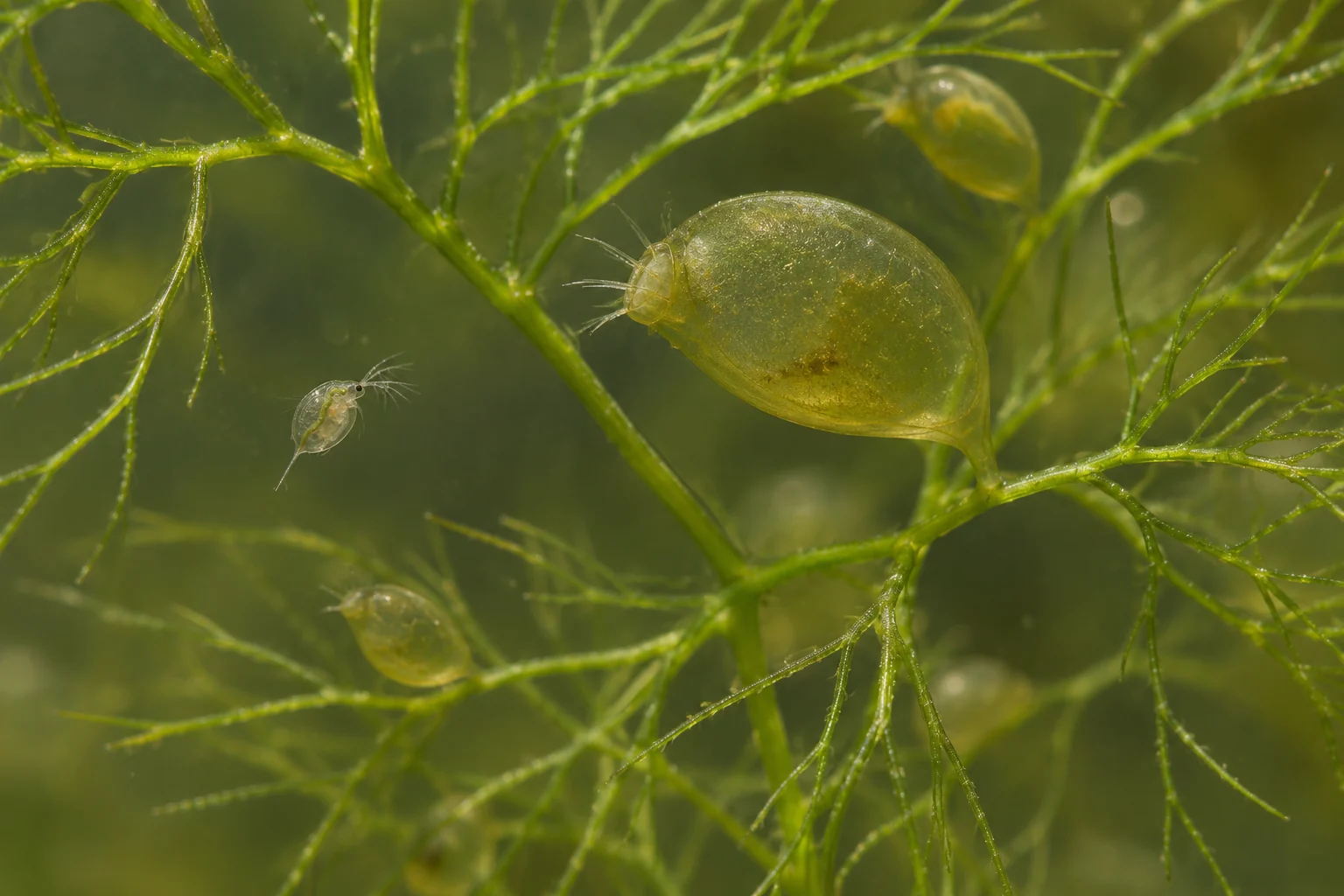
A water flea brushes the entrance of an aquatic bladderwort trap. A flexible flap buckles inward, water rushes through the opening, and the animal travels with it. The bladder can complete the capture before a camera recording at ordinary video speed has collected its next frame. The plant can act that fast because it has already done most of the work. While the door was closed, it slowly pumped water out of the trap and stored energy in its deformed walls.[1, 2, 3]
A pond plant with a pressure difference
From above the water, a common bladderwort in bloom may first attract attention with its yellow flowers. The trapping apparatus is on the submerged parts. Among the fine branching structures are small pouches, each with its own entrance. Seen in isolation, a pouch might suggest an air-filled float. An operating aquatic trap contains water. The condition that matters is a difference in pressure between water inside the bladder and water in the pond outside. The mechanism can work while both the trap and its prey are completely submerged.[1, 2, 5]
During resetting, the plant moves water out through the trap wall. With the entrance sealed, the sides bow inward. Imagine pressing the sides of a flexible bottle together, closing the opening and releasing your fingers. Its walls would tend to spring back if more fluid could enter. The bladder’s tissues create their own pressure difference and have a far more elaborate door, but the comparison explains what is stored. The working trap has both a tendency to expand and a seal preventing it from doing so freely.[1, 2, 4]
A pause separates this slow preparation from the strike. No animal has to be present during the preparation. Once an encounter finally happens, the plant does not have to transport water through living tissue fast enough to match the speed of an escaping swimmer. The outward pumping can take its time. It is the relatively sudden opening of a preloaded structure that sets the pace of capture. This separation is why the speed of the visible movement tells us so little about the rate at which the plant can prepare a trap again.[1, 2]
What happens to the door
A household door can swing while keeping much the same shape. The bladderwort door itself changes curvature. High-speed observations and mechanical models describe a flexible valve that buckles under pressure. Disturbing hairs near its entrance can initiate that change. When the lower edge slips free of the threshold, the valve gives way inward. Comparing frames taken immediately before and during opening reveals an event that two still photographs of a closed bladder would completely miss. The panel can recover its shape by the time you look again.[1, 2, 4]
A model is useful here because more than one moving part can produce a superficially similar film. You could imagine the walls expanding first and pulling open a passive lid, or the door losing stability first and releasing walls already under load. A model in which the door is allowed to buckle can be compared with the observed order and shape of the movements. Researchers have shown how a small change at the entrance can produce rapid opening under the pressure already acting on the trap.[1, 4]
Why the prey moves with the water
Water accelerates into the space made available as the bladder rounds out. A small animal near the entrance experiences that flow over its body. The trap can transport prey even though the inner wall never reaches out to grip it. In filmed experiments with southern bladderwort and small crustaceans, researchers observed animals entering from different orientations. A still picture of the final catch would reveal what ended up inside, but it would conceal the main instrument of capture: the moving water that occupied the gap between prey and plant.[1, 3]
Published measurements also answer different timing questions. In one study of Utricularia stellaris the trapdoor opened in roughly 0.3 to 0.7 milliseconds. A separate investigation of southern bladderwort reported an average of about nine milliseconds for the observed prey capture events. The shorter number concerns the door. The longer one follows an animal. Even with an identical camera and species, the time from the start of door motion to full opening would differ from the time needed to carry an entire water flea into the chamber.[2, 3]
Suppose an observer records thirty frames per second. Each frame then begins roughly thirty-three milliseconds after the last. A nine-millisecond capture could fit entirely between those instants. In one frame the animal might be beside a closed entrance and in the next it might have vanished behind a closed entrance. Inferring that the flap never moved would be an easy error. The sampling interval has hidden the very part of the event needed to explain the result.[2, 3]
A further advantage of filming the animal is that it gives the current a visible passenger. A small crustacean can turn while crossing the threshold. Looking only at the straight distance from its starting point to its resting place would miss both that rotation and the short interval in which its speed changed most sharply.[3]
A triggered trap does not always contain an animal
Mechanical experiments have documented spontaneous firing as well as firing after stimulation. A bladder can admit water with no conspicuous swimmer touching the trigger hairs at the moment it opens. That observation matters when interpreting plant material from a pond. Finding a particle or a minute organism inside a trap shows that it entered. Its presence alone cannot tell you whether it deliberately approached the door, bumped a hair in passing, or rode in during a firing brought about in another way.[1, 4]
Once the flow subsides, the door can close and the plant can begin restoring the pressure difference. Digestive activity in the chamber makes nutrients from captured organisms available to the plant. The two payoffs operate on very different schedules. Closing the door promptly retains the catch. Absorbing nutrients and getting ready for another catch take longer. A patch of finely divided green growth below a yellow flower can carry many such traps, each at a different point between preparation, release and recovery. Seen that way, the flash of the door is one brief chapter in the life of a working leaf.[1, 2, 5]
Related reading
Sources
- Vincent and colleagues — Ultra-fast underwater suction traps
- The biomechanics of fast prey capture in aquatic bladderworts
- Biomechanical analysis of prey capture in the southern bladderwort
- Mechanical model of the ultrafast underwater trap of Utricularia
- Missouri Department of Conservation — Bladderworts
Keep exploring.
One remarkable idea at a time—nature, science, history and beyond.
Last updated November 23, 2026.

Barnakle Editorial Team
Barnakle Editorial Team is the collective byline used for Barnakle’s editorial articles. The contributor profile explains the team identity and links to the publication’s editorial policies.
More from the editorial team →