Cosmic lenses
Why a galaxy can act as a lens
General relativity describes gravity through spacetime geometry. Light follows paths through that geometry, so a foreground concentration of mass changes which rays from a distant object reach an observer. The foreground galaxy need not be transparent like glass: rays can travel around it. Stars, gas, dark matter and other mass along the line of sight all contribute to the deflection.
Alignment determines the image
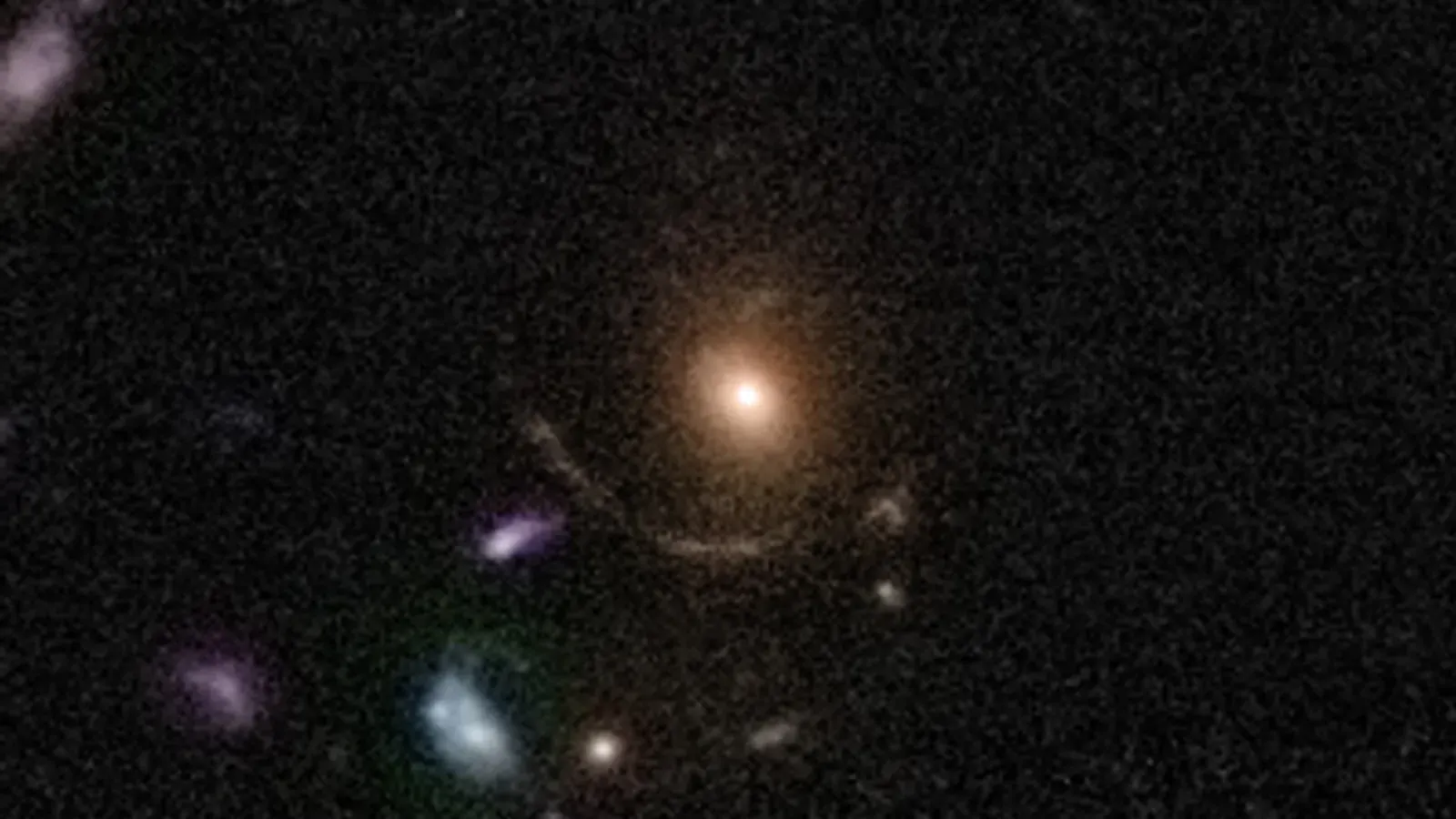
A source, foreground lens and observer rarely line up perfectly. The source position, distances and distribution of lensing mass determine whether the observer sees a modest distortion, a long arc or several images. Near-symmetry can produce an Einstein ring, but irregular mass distributions and incomplete alignment usually break the ring into less orderly shapes.
Multiple images are different routes for the same light
A sufficiently strong lens allows light from one source to reach us along several paths. The resulting images can differ in brightness, orientation and apparent shape. They are not separate copies of a galaxy created in space. Because the paths have different travel times, a changing source such as a supernova can appear at different stages in its separate images.
Strong and weak lensing answer different questions
Strong lensing produces conspicuous arcs or multiple images near a substantial foreground mass. Weak lensing usually changes a background galaxy’s shape only slightly. Researchers analyse many galaxies statistically because any one galaxy already has an unknown intrinsic shape. Both approaches depend on observations and modelling; neither turns an individual image directly into a complete mass map.
Microlensing often appears as a changing brightness
When the lens is a star or another relatively compact object, separate images may be too close together to resolve. Their combined brightness can rise and fall as the alignment changes. A planet near a lensing star can perturb that pattern. Microlensing therefore detects some objects through their gravitational influence even when the lens or planet is too faint to photograph directly.
A telescope supplied by nature has limits
Lensing can enlarge distant features and make faint sources easier to study. It does not create extra surface brightness or supply a perfectly undistorted view. Recovering a source’s size and luminosity requires a lens model. Different mass distributions can sometimes explain similar images, and matter elsewhere along the light path adds uncertainty.
How astronomers test a lensing interpretation
Astronomers combine image geometry, spectra and distance estimates with models of the foreground mass. Repeated observations can measure changing brightness and time delays. Consistent distortions across many background sources reveal patterns that ordinary galaxy shapes would not produce together. Lensing helps investigate dark matter because gravity responds to total mass, but the observations alone do not identify the particles making up that matter.
Sources and further reading
Keep exploring.
One remarkable idea at a time—nature, science, history and beyond.
Last updated October 29, 2026.

Barnakle Editorial Team
Barnakle Editorial Team is the collective byline used for Barnakle’s editorial articles. The contributor profile explains the team identity and links to the publication’s editorial policies.
More from the editorial team →