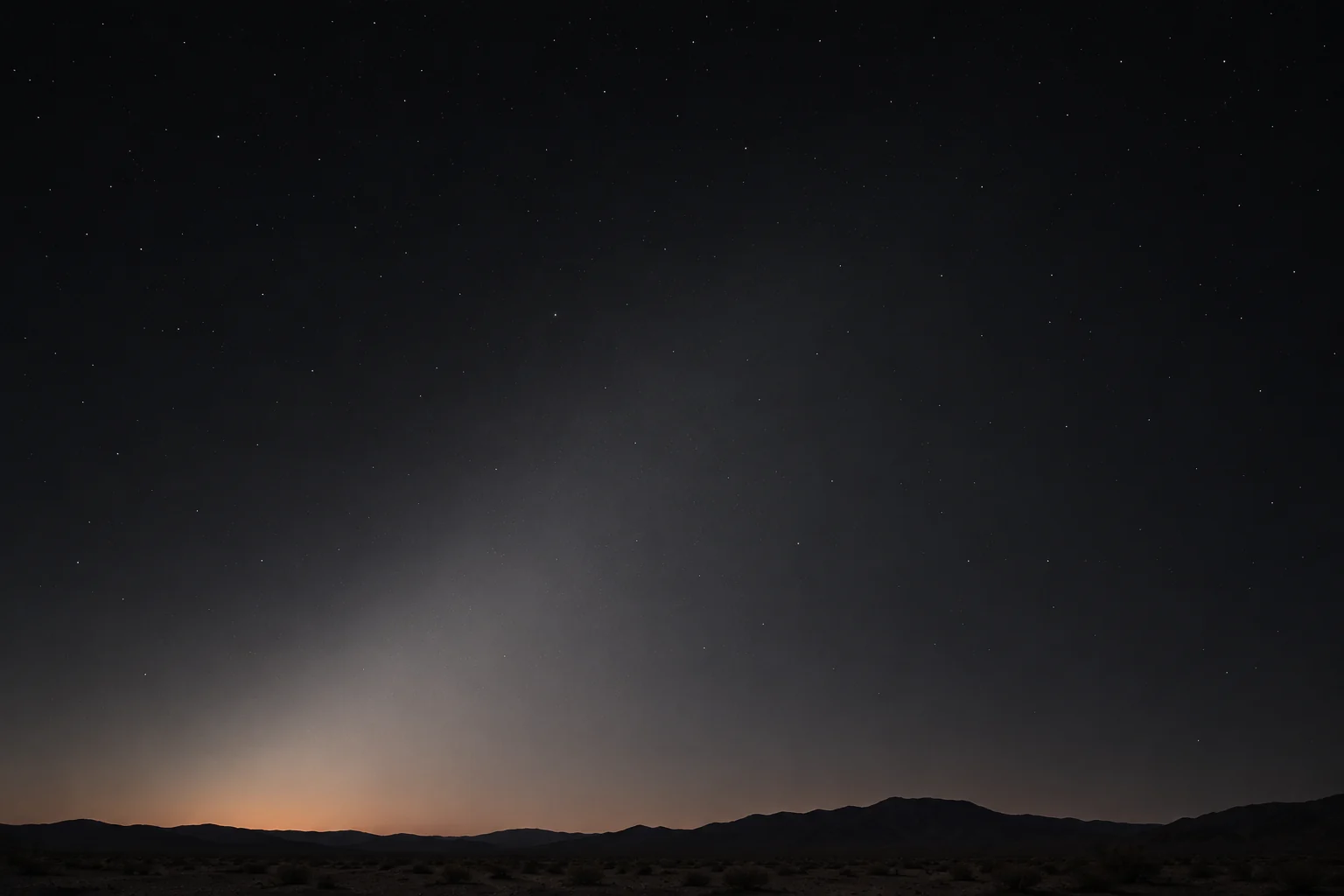
On a clear, dark evening a faint triangle can rise from the western horizon long after the brightest colours of sunset have gone. It is broad where it meets the horizon and fades to a point among the stars. This is zodiacal light, sunlight scattered by dust orbiting the Sun. The grains occupy a wide, flattened cloud through which Earth itself travels. From inside that cloud we see a particular pattern of brightness projected onto the sky. The apparent point of the triangle does not mark the end of the dust.[1, 2, 4]
Why a dust cloud looks like a wedge
Think of the solar system as a set of slightly tilted racetracks around a lamp. Dust occupies many different orbits. Taken together, many of the grains are concentrated near the plane in which Earth and the other planets travel. A sightline close to that plane passes through more of the cloud than one directed well above or below it. The grains are individually much too faint to pick out by eye. Light scattered along a whole line of sight adds up, producing a broad band that follows the path of the ecliptic across the sky.[2, 4]
Now look along the band toward the part of the sky near the Sun, while keeping the Sun below the horizon. Grains in the inner solar system are strongly illuminated. The amount and direction of light a grain scatters also depend on the angle between the Sun, the grain and the observer. The combination produces a bright region close to the Sun’s direction that becomes harder to see farther away. As the fainter sides sink below the threshold of vision, the visible part narrows. On a good evening the remaining glow looks like a tapering wedge.[1, 2, 4]
A kitchen analogy captures one piece of the geometry. Look across a thin patch of fine mist with a light beyond it, then look straight up through the same patch. The depth you see through changes with your viewing direction. Planetary dust is enormously more diffuse than kitchen mist, and its illumination varies with distance from the Sun. But the simple change of viewing direction helps explain how a broad three-dimensional distribution can produce a relatively narrow feature on the sky without a physical wall marking either side.[2, 4]
When to look from Canada
At Canadian latitudes, a good evening opportunity comes near the spring equinox. Choose a clear, moonless evening and a western horizon away from the glow of towns. Give twilight time to fade. The corresponding morning opportunity comes in autumn, before dawn in the east. Around those times the ecliptic makes a relatively steep angle with the appropriate horizon. More of the faint band rises out of the bright air near the skyline. The grains are there in other seasons too. What changes is how much of the favourable viewing direction is available in a dark sky.[1, 2]
A simple sketch can help explain why a calendar matters for seeing an apparently enduring dust cloud. Draw a line for the horizon and a bright strip of sky just above it. A pencil laid almost parallel to the line stays inside the strip for much of its length. Raise one end steeply and a much larger section reaches the dark space above. In this sketch the pencil follows the ecliptic. The real strip has no sharp upper edge, but the improvement in contrast can decide whether the outer part of the wedge is visible at all.[1, 2]
Which glow are you seeing?
Twilight follows the Sun below the horizon as sunlight scatters in Earth’s atmosphere. Zodiacal light involves sunlight too, but the scatterers are out in interplanetary space. A distant town can produce a pale dome tied to the same direction on the ground every night. The zodiacal wedge follows the ecliptic instead. A sky chart that shows that line is useful even if no bright planet happens to be visible. Check the orientation against the stars, give your eyes time away from lights, and see whether the glow follows the expected slope.[1, 2]
The Milky Way presents another possibility. It is the band of our Galaxy seen from within, and its route among the stars differs from the path of the planets. Photographs from exceptionally dark locations can show the two features crossing. A dust-scattered glow, an atmospheric glow and the light of a distant population of stars can thus share the same photograph. Colour alone is a poor way to sort them, especially in an image whose exposure and colour balance differ from what the eye saw at the site.[1, 2, 3]
The glow on the other side of the sky
The solar-system dust cloud contributes light well away from the obvious triangle. Very dark skies can reveal a faint bright patch in the part of the ecliptic directly opposite the Sun. Known as the gegenschein, or counterglow, it appears in a direction in which sunlight is scattered back toward the observer. The European Southern Observatory documents an example photographed at Paranal in Chile. If you draw a line from the Sun through Earth and extend it into the night, the far end points toward the part of the sky to inspect.[2, 3]
Where the scattering material came from is a harder question than why it shines. Asteroids can shed debris in collisions and comets release dust. Researchers have compared models of different dust populations with the distribution of light measured from spacecraft, including Clementine. Juno observations prompted another team to propose a contribution associated with Mars. Inferring a source requires more than detecting dust along a spacecraft’s path. Researchers have to explain how grains reached the observed orbits and whether the proposed distribution reproduces what instruments see in other directions.[4, 5]
That is part of the pleasure of recognizing the wedge on a spring night. With no telescope, you can see sunlight returned by material spread through the space between familiar points on a planet chart. A spacecraft can sample the cloud along one route, while an observer in a field sees light accumulated over a long line through it. The two views ask different questions of the same dust.[1, 4, 5]
Related reading
Sources
- NASA Night Sky Network — Night lights and the zodiacal light
- Swinburne University of Technology — Zodiacal light
- European Southern Observatory — The gegenschein at Paranal
- Hahn and colleagues — Clementine observations of the zodiacal light
- NASA — Juno observations and the origin of zodiacal dust
Keep exploring.
One remarkable idea at a time—nature, science, history and beyond.
Last updated November 24, 2026.

Barnakle Editorial Team
Barnakle Editorial Team is the collective byline used for Barnakle’s editorial articles. The contributor profile explains the team identity and links to the publication’s editorial policies.
More from the editorial team →