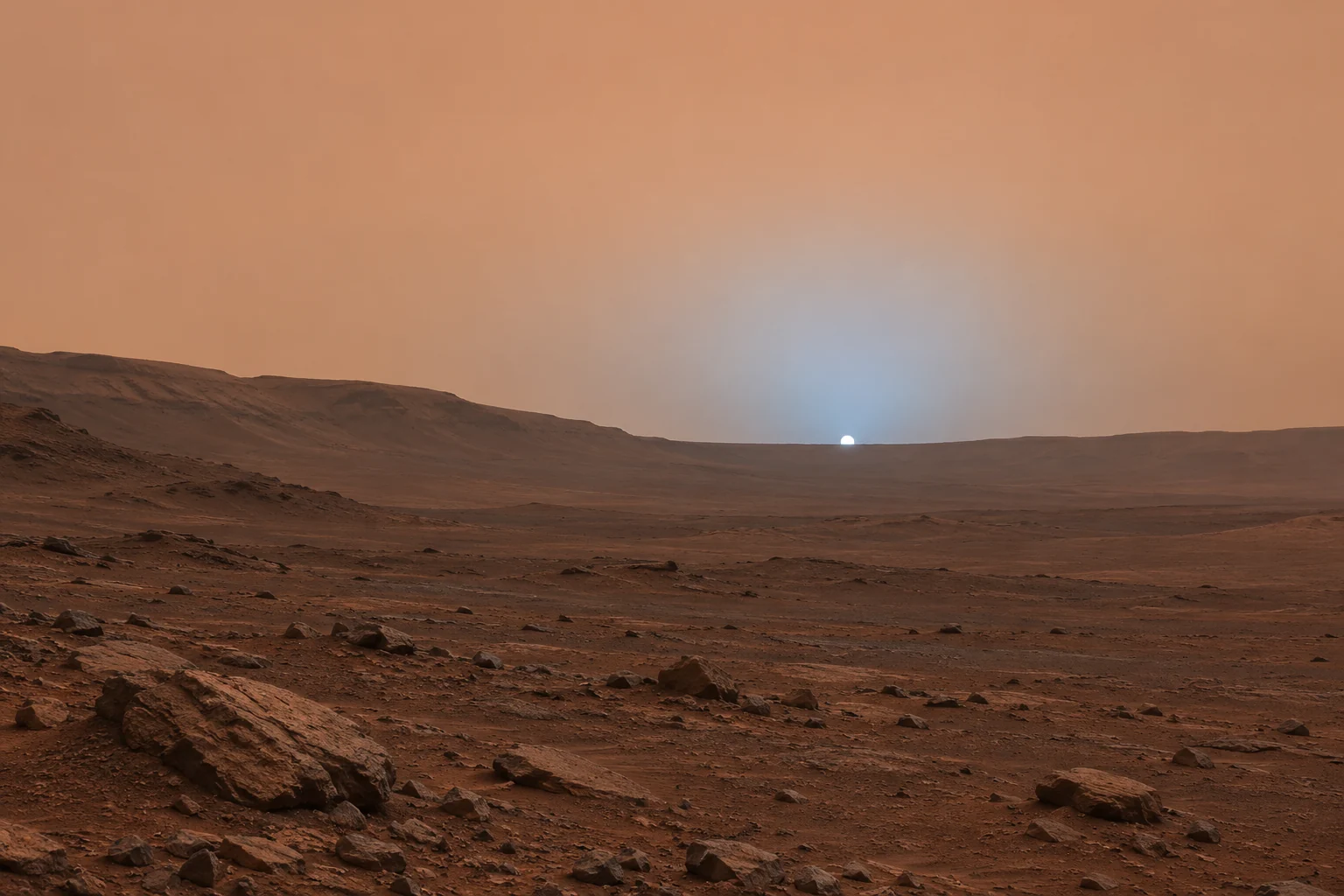
In a sequence of pictures taken at Gale crater in 2015, a small Sun sinks behind the rim and a patch of blue light gathers around it. Farther from the Sun the dusty sky has a much warmer colour. Both belong in the same Martian sunset. Fine suspended dust sends different colours of sunlight into different directions. In the narrow region around the direction the light was already travelling, the blue contribution is especially conspicuous. That is why the most informative part of the picture is the change in colour as your eye moves away from the Sun.[1, 2, 3]
What blue part of the sunset are we looking at?
Imagine placing two small circles on the image. The first fits just inside the bright solar disk. The second sits immediately beside it, in the sky. The first samples light arriving along the direct line from the Sun, altered by its passage through the atmosphere. The second looks into a piece of sky where there is no part of the solar surface. For that patch to shine, light must have been redirected toward the observer. A statement about the colour of the disk therefore needs a different explanation from one about the colour of its surroundings.[2, 3]
The halo of light around the Sun is often called an aureole. A dust particle that deflects a ray by a small angle can send it toward a camera looking nearly at the Sun. A camera pointed well away from the Sun samples light that arrived by other paths. The angles through which the particles tend to scatter light depend on wavelength. In the Martian dust cloud, near-forward scattering can give the region around the Sun more blue relative to the warmer sky outside it. The blue region is a direction on the sky, not a separate cloud of blue material.[1, 2, 3]
Why it stands out when the Sun is low
When sunlight arrives from overhead it can cross the atmosphere comparatively directly. As the Sun approaches the horizon, the rays reaching a rover take a more oblique route through dusty air. The longer path gives particles more opportunity to scatter and absorb light. A distant terrestrial hillside can fade in haze for much the same geometrical reason: the sightline passes through more intervening material. On Mars the dependence of scattering on colour and angle determines the particular pattern visible around the setting Sun.[1, 2, 5]
It can be tempting to take the familiar Earth explanation and simply swap the colours. On Earth, scattering by air molecules contributes strongly to a blue daytime sky and can leave direct sunlight looking warmer along a long sunset path. For Mars, studies have examined the optical behaviour of dust particles with sizes on the order of a micrometre. A study in Applied Optics specifically distinguishes the extinction of light from the solar disk from the scattering responsible for the blue glow beside it. Accounting only for the colours removed from a beam leaves out where the missing light goes.[2, 3]
One way to keep the distinction straight is to imagine following a single ray. If a particle turns it a few degrees, an observer on the original path loses that ray from the direct beam. An observer a little to one side may gain it instead. What looks like a loss in one measurement is part of the illumination in the other. The colour in a photograph comes from adding the many rays that make it into each direction, including those redirected into view along the way.[2, 3]
Three cameras and three ways of describing colour
Pathfinder recorded a sunset with strong colour variation early in its mission. The NASA team attributed the blue near the Sun to atmospheric dust. They also noted that this colour became especially apparent near sunrise and sunset, when the light crossed more of that dust. The observation was valuable because it connected the location of the blue to the position of the Sun. Merely finding a blue patch somewhere in an image would have been much weaker evidence about its cause.[2]
Opportunity later acquired sets of sunset images through infrared, green and violet filters. The choice gave the team a broad range of wavelengths for studying how sunlight dimmed as it approached the horizon. Infrared lies outside normal human vision. A colour composite made from those channels has to assign a visible display colour to information that a person standing beside the rover could not see. Such a picture can be excellent for comparing wavelengths while calling for care when someone asks what a human observer would experience.[4]
Curiosity’s 2015 Gale crater sequence serves that question differently. Its four views span just under seven minutes. NASA describes the left Mast Camera as having colour sensitivity close to human vision, although somewhat less sensitivity to blue. The published sequence was calibrated and white-balanced to reduce camera artefacts. A mention of image processing is therefore useful information about the observation. It tells you which instrument recorded the light and what kind of comparison the team intended the displayed picture to support.[1]
How much can one evening tell us?
The amount of suspended dust changes. NASA points out that lower dust levels can leave a sunset with more muted colour, and rover pictures also document clouds and rays illuminated near dusk. Those variations are worth preserving when comparing photographs from different evenings. A pale, unspectacular sunset and another with a strong blue aureole need not contradict each other. Consider the observing direction, the amount of dust and the filters before comparing how saturated the blue looks on a screen.[1, 4, 5]
Return to the two imaginary circles on the Gale crater picture and add a third farther out in the warm sky. Now the image contains three separate observations: light from the disk, light redirected through small angles near it, and light arriving from a more distant direction. Together they tell a more precise story than the phrase “blue sunset” alone. A rover watching the last light on the horizon is also measuring how a planet’s atmosphere redistributes sunlight across its sky.[1, 2, 3]
Related reading
Sources
- NASA — Curiosity’s sunset at Gale crater
- NASA — Pathfinder’s observations of colour variations at sunset
- Applied Optics — Blue moons and Martian sunsets
- NASA — The Sun Sets on Mars, seen by Opportunity
- NASA — What do sunrises and sunsets look like on Mars?
Keep exploring.
One remarkable idea at a time—nature, science, history and beyond.
Last updated November 23, 2026.

Barnakle Editorial Team
Barnakle Editorial Team is the collective byline used for Barnakle’s editorial articles. The contributor profile explains the team identity and links to the publication’s editorial policies.
More from the editorial team →