
An enzyme turns chemical energy into remarkably efficient living light
The short answer
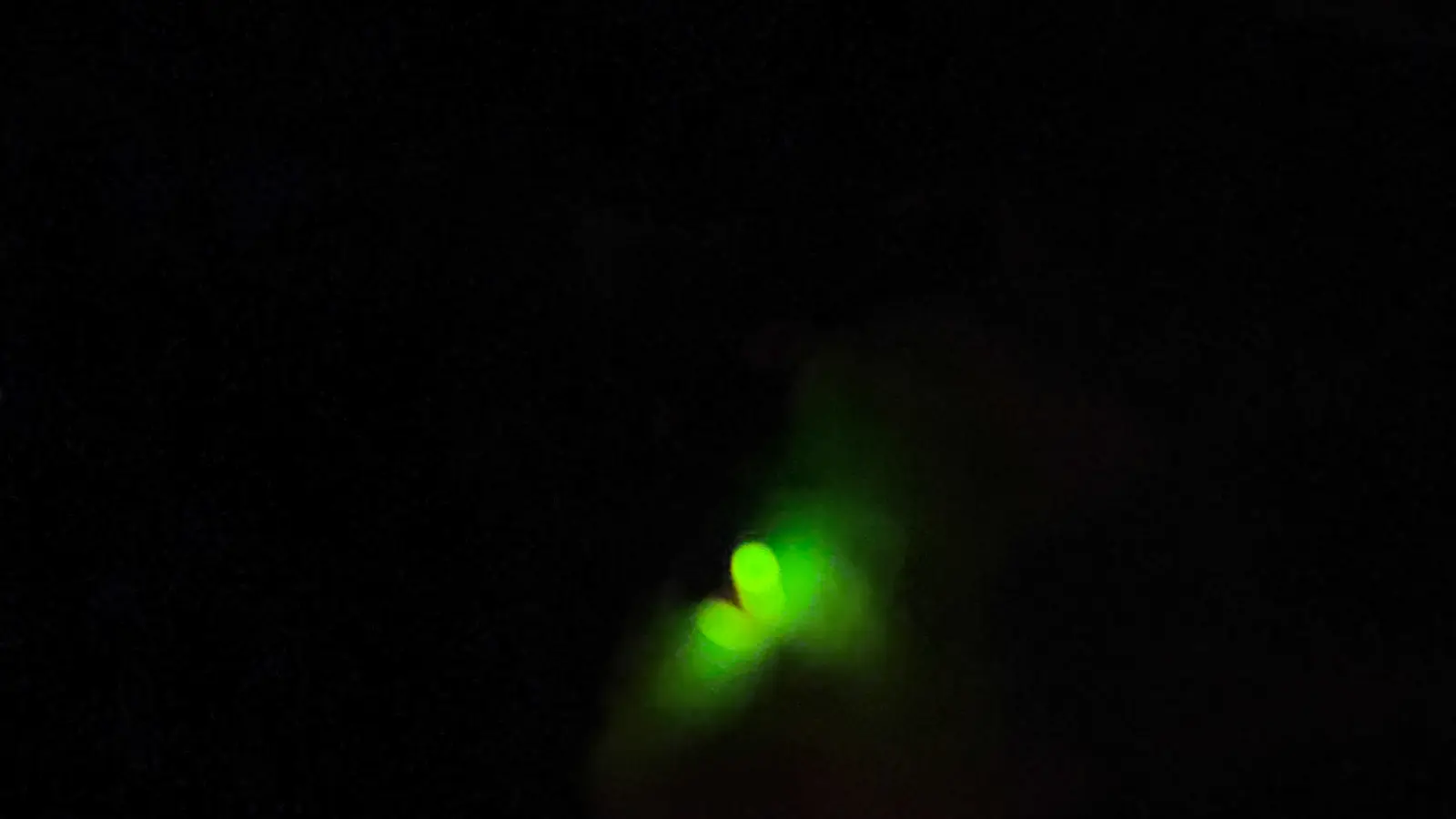
Fireflies glow through bioluminescence in specialized abdominal organs. Luciferase activates luciferin using ATP, then oxygen helps create excited oxyluciferin. As that product returns to a lower-energy state, it releases a photon. Nerves regulate flashes partly by controlling oxygen, enabling signals for courtship, warning and deception.
A firefly lantern is not a tiny hot bulb. It is living tissue arranged to supply reactants, manage oxygen and send light outward with little heat. The chemistry is efficient, but the ecological meaning is equally important: species vary in colour, rhythm, height and timing, turning a summer field into overlapping conversations.
Fireflies are beetles
Fireflies belong to the beetle family Lampyridae. More than two thousand species are described, and not all adults flash conspicuously. Many larvae glow, suggesting light served defence before becoming elaborate courtship communication.
For how fireflies glow, Fireflies are beetles is one part of a connected mechanism. Researchers separate the immediate trigger from the process that follows, measure how strongly each variable changes the result and compare cases in which the expected effect is weak or absent. That prevents a memorable explanation from becoming an absolute rule.
Evidence concerning Fireflies are beetles is strongest when independent methods agree. Field observations show what happens under natural conditions, controlled experiments isolate causes, and chemical or physical measurements identify the pathway. Each method has different limitations, so convergence is more informative than repetition of one measurement.
Scale and context for Fireflies are beetles also matter. A process demonstrated in one organism, location or laboratory setup may not operate identically everywhere. Reporting sample size, timing, environmental conditions and uncertainty lets another team reproduce the result and determine which details are general and which are local.
Lanterns contain specialized cells
Abdominal light organs contain photocytes supplied by nerves, air tubes and haemolymph. Reflective layers help direct photons through translucent cuticle. Tissue geometry affects reactant delivery and how much generated light escapes.
For how fireflies glow, Lanterns contain specialized cells is one part of a connected mechanism. Researchers separate the immediate trigger from the process that follows, measure how strongly each variable changes the result and compare cases in which the expected effect is weak or absent. That prevents a memorable explanation from becoming an absolute rule.
Evidence concerning Lanterns contain specialized cells is strongest when independent methods agree. Field observations show what happens under natural conditions, controlled experiments isolate causes, and chemical or physical measurements identify the pathway. Each method has different limitations, so convergence is more informative than repetition of one measurement.
Scale and context for Lanterns contain specialized cells also matter. A process demonstrated in one organism, location or laboratory setup may not operate identically everywhere. Reporting sample size, timing, environmental conditions and uncertainty lets another team reproduce the result and determine which details are general and which are local.
Luciferin is the substrate
Luciferin is a small organic molecule. Luciferase uses ATP and magnesium to form an activated intermediate; oxygen then participates in producing excited oxyluciferin. Relaxation releases energy as visible light.
For how fireflies glow, Luciferin is the substrate is one part of a connected mechanism. Researchers separate the immediate trigger from the process that follows, measure how strongly each variable changes the result and compare cases in which the expected effect is weak or absent. That prevents a memorable explanation from becoming an absolute rule.
Evidence concerning Luciferin is the substrate is strongest when independent methods agree. Field observations show what happens under natural conditions, controlled experiments isolate causes, and chemical or physical measurements identify the pathway. Each method has different limitations, so convergence is more informative than repetition of one measurement.
Scale and context for Luciferin is the substrate also matter. A process demonstrated in one organism, location or laboratory setup may not operate identically everywhere. Reporting sample size, timing, environmental conditions and uncertainty lets another team reproduce the result and determine which details are general and which are local.
Luciferase shapes colour
The enzyme binds reactants and stabilizes intermediates. Protein sequence, pH and chemical environment influence wavelength, allowing related beetles to emit yellow-green, orange or redder light.
For how fireflies glow, Luciferase shapes colour is one part of a connected mechanism. Researchers separate the immediate trigger from the process that follows, measure how strongly each variable changes the result and compare cases in which the expected effect is weak or absent. That prevents a memorable explanation from becoming an absolute rule.
Evidence concerning Luciferase shapes colour is strongest when independent methods agree. Field observations show what happens under natural conditions, controlled experiments isolate causes, and chemical or physical measurements identify the pathway. Each method has different limitations, so convergence is more informative than repetition of one measurement.
Scale and context for Luciferase shapes colour also matter. A process demonstrated in one organism, location or laboratory setup may not operate identically everywhere. Reporting sample size, timing, environmental conditions and uncertainty lets another team reproduce the result and determine which details are general and which are local.
ATP powers the reaction
The first step consumes ATP, the cell’s energy-coupling molecule. Oxygen and magnesium are also required. Firefly light is efficient, but it is not free; metabolism supplies and renews the system.
For how fireflies glow, ATP powers the reaction is one part of a connected mechanism. Researchers separate the immediate trigger from the process that follows, measure how strongly each variable changes the result and compare cases in which the expected effect is weak or absent. That prevents a memorable explanation from becoming an absolute rule.
Evidence concerning ATP powers the reaction is strongest when independent methods agree. Field observations show what happens under natural conditions, controlled experiments isolate causes, and chemical or physical measurements identify the pathway. Each method has different limitations, so convergence is more informative than repetition of one measurement.
Scale and context for ATP powers the reaction also matter. A process demonstrated in one organism, location or laboratory setup may not operate identically everywhere. Reporting sample size, timing, environmental conditions and uncertainty lets another team reproduce the result and determine which details are general and which are local.
The light is cold
Most usable energy emerges as photons or chemical products rather than broad thermal radiation. The lantern does not reach the damaging temperature needed to make an incandescent filament glow.
For how fireflies glow, The light is cold is one part of a connected mechanism. Researchers separate the immediate trigger from the process that follows, measure how strongly each variable changes the result and compare cases in which the expected effect is weak or absent. That prevents a memorable explanation from becoming an absolute rule.
Evidence concerning The light is cold is strongest when independent methods agree. Field observations show what happens under natural conditions, controlled experiments isolate causes, and chemical or physical measurements identify the pathway. Each method has different limitations, so convergence is more informative than repetition of one measurement.
Scale and context for The light is cold also matter. A process demonstrated in one organism, location or laboratory setup may not operate identically everywhere. Reporting sample size, timing, environmental conditions and uncertainty lets another team reproduce the result and determine which details are general and which are local.
Oxygen helps switch flashes
Tracheoles deliver oxygen directly to lantern tissue. Neural signals and nitric oxide may reduce mitochondrial oxygen use temporarily, leaving more oxygen for luciferase and enabling rapid onset.
For how fireflies glow, Oxygen helps switch flashes is one part of a connected mechanism. Researchers separate the immediate trigger from the process that follows, measure how strongly each variable changes the result and compare cases in which the expected effect is weak or absent. That prevents a memorable explanation from becoming an absolute rule.
Evidence concerning Oxygen helps switch flashes is strongest when independent methods agree. Field observations show what happens under natural conditions, controlled experiments isolate causes, and chemical or physical measurements identify the pathway. Each method has different limitations, so convergence is more informative than repetition of one measurement.
Scale and context for Oxygen helps switch flashes also matter. A process demonstrated in one organism, location or laboratory setup may not operate identically everywhere. Reporting sample size, timing, environmental conditions and uncertainty lets another team reproduce the result and determine which details are general and which are local.
Species use distinct patterns
Males of many species fly with characteristic sequences and females answer after a species-specific delay. Pulse length, interval, colour, height and habitat reduce confusion among neighbouring species.
For how fireflies glow, Species use distinct patterns is one part of a connected mechanism. Researchers separate the immediate trigger from the process that follows, measure how strongly each variable changes the result and compare cases in which the expected effect is weak or absent. That prevents a memorable explanation from becoming an absolute rule.
Evidence concerning Species use distinct patterns is strongest when independent methods agree. Field observations show what happens under natural conditions, controlled experiments isolate causes, and chemical or physical measurements identify the pathway. Each method has different limitations, so convergence is more informative than repetition of one measurement.
Scale and context for Species use distinct patterns also matter. A process demonstrated in one organism, location or laboratory setup may not operate identically everywhere. Reporting sample size, timing, environmental conditions and uncertainty lets another team reproduce the result and determine which details are general and which are local.
Temperature changes timing
As ectotherms, fireflies perform chemical and muscular processes faster in warmer conditions. Flash intervals can shorten with temperature, so timing rules are flexible rather than identical on every night.
For how fireflies glow, Temperature changes timing is one part of a connected mechanism. Researchers separate the immediate trigger from the process that follows, measure how strongly each variable changes the result and compare cases in which the expected effect is weak or absent. That prevents a memorable explanation from becoming an absolute rule.
Evidence concerning Temperature changes timing is strongest when independent methods agree. Field observations show what happens under natural conditions, controlled experiments isolate causes, and chemical or physical measurements identify the pathway. Each method has different limitations, so convergence is more informative than repetition of one measurement.
Scale and context for Temperature changes timing also matter. A process demonstrated in one organism, location or laboratory setup may not operate identically everywhere. Reporting sample size, timing, environmental conditions and uncertainty lets another team reproduce the result and determine which details are general and which are local.
Some species synchronize
Large groups of a few species adjust timing to neighbours, producing coordinated waves without a central leader. The displays offer a natural example of coupled biological oscillators.
For how fireflies glow, Some species synchronize is one part of a connected mechanism. Researchers separate the immediate trigger from the process that follows, measure how strongly each variable changes the result and compare cases in which the expected effect is weak or absent. That prevents a memorable explanation from becoming an absolute rule.
Evidence concerning Some species synchronize is strongest when independent methods agree. Field observations show what happens under natural conditions, controlled experiments isolate causes, and chemical or physical measurements identify the pathway. Each method has different limitations, so convergence is more informative than repetition of one measurement.
Scale and context for Some species synchronize also matter. A process demonstrated in one organism, location or laboratory setup may not operate identically everywhere. Reporting sample size, timing, environmental conditions and uncertainty lets another team reproduce the result and determine which details are general and which are local.
Light can warn predators
Many fireflies contain defensive chemicals. Larval glows and adult signals can advertise unpalatability, helping predators learn avoidance. Evolution later repurposed the signal for mating.
For how fireflies glow, Light can warn predators is one part of a connected mechanism. Researchers separate the immediate trigger from the process that follows, measure how strongly each variable changes the result and compare cases in which the expected effect is weak or absent. That prevents a memorable explanation from becoming an absolute rule.
Evidence concerning Light can warn predators is strongest when independent methods agree. Field observations show what happens under natural conditions, controlled experiments isolate causes, and chemical or physical measurements identify the pathway. Each method has different limitations, so convergence is more informative than repetition of one measurement.
Scale and context for Light can warn predators also matter. A process demonstrated in one organism, location or laboratory setup may not operate identically everywhere. Reporting sample size, timing, environmental conditions and uncertainty lets another team reproduce the result and determine which details are general and which are local.
Artificial light causes interference
Streetlights and landscape lighting reduce contrast between flashes and the background. Habitat loss, pesticides and changing moisture add pressure. Shielding unnecessary light protects the communication channel.
For how fireflies glow, Artificial light causes interference is one part of a connected mechanism. Researchers separate the immediate trigger from the process that follows, measure how strongly each variable changes the result and compare cases in which the expected effect is weak or absent. That prevents a memorable explanation from becoming an absolute rule.
Evidence concerning Artificial light causes interference is strongest when independent methods agree. Field observations show what happens under natural conditions, controlled experiments isolate causes, and chemical or physical measurements identify the pathway. Each method has different limitations, so convergence is more informative than repetition of one measurement.
Scale and context for Artificial light causes interference also matter. A process demonstrated in one organism, location or laboratory setup may not operate identically everywhere. Reporting sample size, timing, environmental conditions and uncertainty lets another team reproduce the result and determine which details are general and which are local.
Common misconceptions
Fireflies do not store sunlight, and their glow is not electrical or radioactive. Enzyme-catalysed chemistry uses luciferin, oxygen and ATP. Not every flash has the same meaning: signals vary by species, sex, life stage and context, and some predatory females imitate other species.
Useful shorthand should preserve the causal chain. It becomes misleading when it confuses correlation with mechanism, extends a result beyond the tested conditions or treats normal variation as a contradiction. The accurate explanation can remain clear without pretending every case is identical.
How scientists know
Biochemists purify luciferase, identify reaction products, solve protein structures and alter substrates. Physiologists record oxygen and nerve activity in lanterns. Behavioural ecologists play artificial flash patterns to wild insects, while genomic comparisons trace the origin of luciferase and field surveys measure effects of habitat and artificial light.
No single measurement carries the whole conclusion. Agreement among methods matters because observations, experiments, models and historical records fail in different ways. Disagreement can reveal an uncontrolled variable or a question that deserves a better test.
Frequently asked questions
Do both sexes glow?
In many species both sexes signal, but patterns and anatomy vary; some females are wingless and glow from vegetation.
Why yellow-green?
Luciferase structure and lantern chemistry favour those wavelengths, which transmit effectively and match firefly visual sensitivity.
Can flashes be controlled?
Nervous and oxygen-regulating mechanisms permit rapid timing, though details differ among species.
Are glow-worms fireflies?
The name can mean luminous beetle larvae or wingless females in several groups; some are lampyrid fireflies.
Why use luciferase in laboratories?
Scientists attach luciferase genes to biological processes, using emitted light as a sensitive reporter of activity.
Key takeaways
- Luciferase uses ATP and oxygen to oxidize luciferin.
- Lantern anatomy supplies reactants and directs light.
- Flash patterns carry species-specific information.
- Artificial nighttime light can disrupt communication.
Continue exploring
Sources and further reading
Keep exploring.
One remarkable idea at a time—nature, science, history and beyond.
Sources and further reading
Barnakle uses credible primary and authoritative sources wherever possible.
- Firefly luciferase review
- https://pmc.ncbi.nlm.nih.gov/articles/PMC11115821/
- Evolution of bioluminescence
- https://pmc.ncbi.nlm.nih.gov/articles/PMC7217382/
- Nitric oxide and firefly flashing
- https://pmc.ncbi.nlm.nih.gov/articles/PMC4207525/
- Smithsonian — Bioluminescence
- https://ocean.si.edu/ocean-life/fish/bioluminescence
- Smithsonian NMNH — Lights Out
- https://naturalhistory.si.edu/visit/accessibility/audio-and-visual-description/lights-out-visual-description-highlights-tour
Last reviewed October 2, 2026.

Barnakle Editorial Team
A member of the Barnakle editorial team, exploring remarkable ideas with clarity, curiosity and care.
More from this author →