
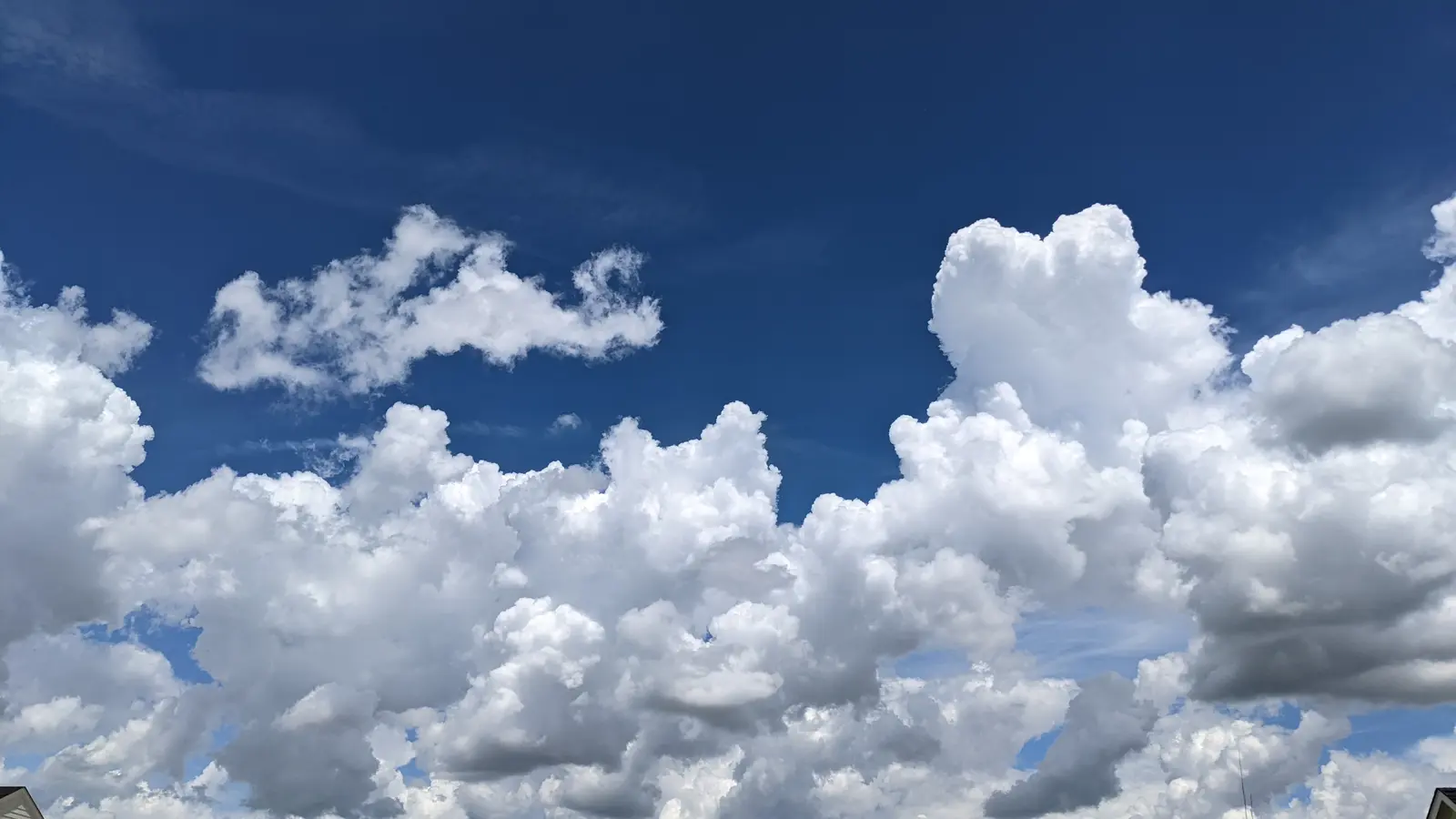
Microscopic droplets fall so slowly that rising and turbulent air can keep replenishing and suspending them
The short answer
Cloud droplets and ice crystals are heavier than air, so gravity does pull them downward. They remain aloft because individual particles are tiny and have very low terminal speeds, while rising air and turbulence continually counter their settling. A cloud is also constantly forming and evaporating rather than behaving like one permanent floating object.
A large cloud may contain hundreds of tonnes of liquid water, yet that total is spread among an immense number of microscopic droplets across many cubic kilometres. Mass alone does not determine whether the particles fall quickly; size, drag, air motion and phase changes do.
Condensation begins on tiny particles
Water vapour condenses onto cloud condensation nuclei such as sea salt, sulfate, dust or organic material. Without these surfaces, ordinary atmospheric supersaturation would often be insufficient.
Understanding Condensation begins on tiny particles requires separating the immediate mechanism from the conditions that make it stronger, weaker or easier to observe. Researchers measure those variables independently, compare natural examples and test whether the same explanation predicts new results. This turns a plausible story into an evidence-based account.
The evidence for Condensation begins on tiny particles comes from methods that fail in different ways. Direct observation establishes what occurs, instruments quantify timing or structure, experiments isolate candidate causes and models test whether known rules reproduce the pattern. Agreement across methods is more persuasive than repetition of one memorable example.
Context also matters for Condensation begins on tiny particles. Scale, species, location, temperature, geometry and measurement limits can change the result without overturning the underlying process. Careful reporting preserves that variation, states uncertainty and prevents a useful explanation from becoming an exaggerated universal rule.
A practical explanation should also answer what would change the observation. Following that question reveals the limits of the evidence and identifies the next measurement needed.
Cloud droplets are microscopic
A typical droplet is only around tens of micrometres across. Its small mass produces a low gravitational force, while air resistance is large relative to that mass.
Understanding Cloud droplets are microscopic requires separating the immediate mechanism from the conditions that make it stronger, weaker or easier to observe. Researchers measure those variables independently, compare natural examples and test whether the same explanation predicts new results. This turns a plausible story into an evidence-based account.
The evidence for Cloud droplets are microscopic comes from methods that fail in different ways. Direct observation establishes what occurs, instruments quantify timing or structure, experiments isolate candidate causes and models test whether known rules reproduce the pattern. Agreement across methods is more persuasive than repetition of one memorable example.
Context also matters for Cloud droplets are microscopic. Scale, species, location, temperature, geometry and measurement limits can change the result without overturning the underlying process. Careful reporting preserves that variation, states uncertainty and prevents a useful explanation from becoming an exaggerated universal rule.
A practical explanation should also answer what would change the observation. Following that question reveals the limits of the evidence and identifies the next measurement needed.
Terminal speed can be tiny
A falling particle accelerates until drag balances weight. Small cloud droplets may settle only centimetres per second in still air, easily offset by weak upward motion.
Understanding Terminal speed can be tiny requires separating the immediate mechanism from the conditions that make it stronger, weaker or easier to observe. Researchers measure those variables independently, compare natural examples and test whether the same explanation predicts new results. This turns a plausible story into an evidence-based account.
The evidence for Terminal speed can be tiny comes from methods that fail in different ways. Direct observation establishes what occurs, instruments quantify timing or structure, experiments isolate candidate causes and models test whether known rules reproduce the pattern. Agreement across methods is more persuasive than repetition of one memorable example.
Context also matters for Terminal speed can be tiny. Scale, species, location, temperature, geometry and measurement limits can change the result without overturning the underlying process. Careful reporting preserves that variation, states uncertainty and prevents a useful explanation from becoming an exaggerated universal rule.
A practical explanation should also answer what would change the observation. Following that question reveals the limits of the evidence and identifies the next measurement needed.
Updrafts supply support
Warm buoyant air rises as a parcel cools toward saturation. Continued ascent can carry droplets upward faster than they settle and condense additional water.
Understanding Updrafts supply support requires separating the immediate mechanism from the conditions that make it stronger, weaker or easier to observe. Researchers measure those variables independently, compare natural examples and test whether the same explanation predicts new results. This turns a plausible story into an evidence-based account.
The evidence for Updrafts supply support comes from methods that fail in different ways. Direct observation establishes what occurs, instruments quantify timing or structure, experiments isolate candidate causes and models test whether known rules reproduce the pattern. Agreement across methods is more persuasive than repetition of one memorable example.
Context also matters for Updrafts supply support. Scale, species, location, temperature, geometry and measurement limits can change the result without overturning the underlying process. Careful reporting preserves that variation, states uncertainty and prevents a useful explanation from becoming an exaggerated universal rule.
A practical explanation should also answer what would change the observation. Following that question reveals the limits of the evidence and identifies the next measurement needed.
Turbulence mixes particles
Eddies move droplets in many directions, sometimes keeping them within a cloudy layer and sometimes transporting them into drier air where they evaporate.
Understanding Turbulence mixes particles requires separating the immediate mechanism from the conditions that make it stronger, weaker or easier to observe. Researchers measure those variables independently, compare natural examples and test whether the same explanation predicts new results. This turns a plausible story into an evidence-based account.
The evidence for Turbulence mixes particles comes from methods that fail in different ways. Direct observation establishes what occurs, instruments quantify timing or structure, experiments isolate candidate causes and models test whether known rules reproduce the pattern. Agreement across methods is more persuasive than repetition of one memorable example.
Context also matters for Turbulence mixes particles. Scale, species, location, temperature, geometry and measurement limits can change the result without overturning the underlying process. Careful reporting preserves that variation, states uncertainty and prevents a useful explanation from becoming an exaggerated universal rule.
A practical explanation should also answer what would change the observation. Following that question reveals the limits of the evidence and identifies the next measurement needed.
A cloud is a process
Individual droplets form, grow, collide, freeze and evaporate. The visible shape persists only while airflow and humidity keep creating particles in roughly the same region.
Understanding A cloud is a process requires separating the immediate mechanism from the conditions that make it stronger, weaker or easier to observe. Researchers measure those variables independently, compare natural examples and test whether the same explanation predicts new results. This turns a plausible story into an evidence-based account.
The evidence for A cloud is a process comes from methods that fail in different ways. Direct observation establishes what occurs, instruments quantify timing or structure, experiments isolate candidate causes and models test whether known rules reproduce the pattern. Agreement across methods is more persuasive than repetition of one memorable example.
Context also matters for A cloud is a process. Scale, species, location, temperature, geometry and measurement limits can change the result without overturning the underlying process. Careful reporting preserves that variation, states uncertainty and prevents a useful explanation from becoming an exaggerated universal rule.
A practical explanation should also answer what would change the observation. Following that question reveals the limits of the evidence and identifies the next measurement needed.
Cloud edges mark humidity boundaries
At an edge, mixing with unsaturated air evaporates droplets and makes the boundary appear sharp or ragged. The air itself continues moving across that visual border.
Understanding Cloud edges mark humidity boundaries requires separating the immediate mechanism from the conditions that make it stronger, weaker or easier to observe. Researchers measure those variables independently, compare natural examples and test whether the same explanation predicts new results. This turns a plausible story into an evidence-based account.
The evidence for Cloud edges mark humidity boundaries comes from methods that fail in different ways. Direct observation establishes what occurs, instruments quantify timing or structure, experiments isolate candidate causes and models test whether known rules reproduce the pattern. Agreement across methods is more persuasive than repetition of one memorable example.
Context also matters for Cloud edges mark humidity boundaries. Scale, species, location, temperature, geometry and measurement limits can change the result without overturning the underlying process. Careful reporting preserves that variation, states uncertainty and prevents a useful explanation from becoming an exaggerated universal rule.
A practical explanation should also answer what would change the observation. Following that question reveals the limits of the evidence and identifies the next measurement needed.
Droplets eventually grow
Collision and coalescence can build larger drops in warm clouds. In cold clouds, ice crystals grow at the expense of supercooled droplets and may aggregate.
Understanding Droplets eventually grow requires separating the immediate mechanism from the conditions that make it stronger, weaker or easier to observe. Researchers measure those variables independently, compare natural examples and test whether the same explanation predicts new results. This turns a plausible story into an evidence-based account.
The evidence for Droplets eventually grow comes from methods that fail in different ways. Direct observation establishes what occurs, instruments quantify timing or structure, experiments isolate candidate causes and models test whether known rules reproduce the pattern. Agreement across methods is more persuasive than repetition of one memorable example.
Context also matters for Droplets eventually grow. Scale, species, location, temperature, geometry and measurement limits can change the result without overturning the underlying process. Careful reporting preserves that variation, states uncertainty and prevents a useful explanation from becoming an exaggerated universal rule.
A practical explanation should also answer what would change the observation. Following that question reveals the limits of the evidence and identifies the next measurement needed.
Rain begins when settling wins
Once particles become large enough, their terminal speeds exceed supporting air currents. They fall as precipitation, though some evaporates before reaching the ground.
Understanding Rain begins when settling wins requires separating the immediate mechanism from the conditions that make it stronger, weaker or easier to observe. Researchers measure those variables independently, compare natural examples and test whether the same explanation predicts new results. This turns a plausible story into an evidence-based account.
The evidence for Rain begins when settling wins comes from methods that fail in different ways. Direct observation establishes what occurs, instruments quantify timing or structure, experiments isolate candidate causes and models test whether known rules reproduce the pattern. Agreement across methods is more persuasive than repetition of one memorable example.
Context also matters for Rain begins when settling wins. Scale, species, location, temperature, geometry and measurement limits can change the result without overturning the underlying process. Careful reporting preserves that variation, states uncertainty and prevents a useful explanation from becoming an exaggerated universal rule.
A practical explanation should also answer what would change the observation. Following that question reveals the limits of the evidence and identifies the next measurement needed.
Ice crystals need support too
Small crystals have low fall speeds and remain in cirrus or mixed-phase clouds. Shape, density and orientation change their drag and optical effects.
Understanding Ice crystals need support too requires separating the immediate mechanism from the conditions that make it stronger, weaker or easier to observe. Researchers measure those variables independently, compare natural examples and test whether the same explanation predicts new results. This turns a plausible story into an evidence-based account.
The evidence for Ice crystals need support too comes from methods that fail in different ways. Direct observation establishes what occurs, instruments quantify timing or structure, experiments isolate candidate causes and models test whether known rules reproduce the pattern. Agreement across methods is more persuasive than repetition of one memorable example.
Context also matters for Ice crystals need support too. Scale, species, location, temperature, geometry and measurement limits can change the result without overturning the underlying process. Careful reporting preserves that variation, states uncertainty and prevents a useful explanation from becoming an exaggerated universal rule.
A practical explanation should also answer what would change the observation. Following that question reveals the limits of the evidence and identifies the next measurement needed.
Clouds can contain strong vertical motion
Thunderstorms sustain large droplets, ice and hail in powerful updrafts. When those currents weaken or particles grow too heavy, precipitation descends rapidly.
Understanding Clouds can contain strong vertical motion requires separating the immediate mechanism from the conditions that make it stronger, weaker or easier to observe. Researchers measure those variables independently, compare natural examples and test whether the same explanation predicts new results. This turns a plausible story into an evidence-based account.
The evidence for Clouds can contain strong vertical motion comes from methods that fail in different ways. Direct observation establishes what occurs, instruments quantify timing or structure, experiments isolate candidate causes and models test whether known rules reproduce the pattern. Agreement across methods is more persuasive than repetition of one memorable example.
Context also matters for Clouds can contain strong vertical motion. Scale, species, location, temperature, geometry and measurement limits can change the result without overturning the underlying process. Careful reporting preserves that variation, states uncertainty and prevents a useful explanation from becoming an exaggerated universal rule.
A practical explanation should also answer what would change the observation. Following that question reveals the limits of the evidence and identifies the next measurement needed.
Cloud weight is spread through air
A cloud’s liquid-water content is often only a fraction of a gram per cubic metre. Multiplying by huge volume gives a large total without creating a compact falling mass.
Understanding Cloud weight is spread through air requires separating the immediate mechanism from the conditions that make it stronger, weaker or easier to observe. Researchers measure those variables independently, compare natural examples and test whether the same explanation predicts new results. This turns a plausible story into an evidence-based account.
The evidence for Cloud weight is spread through air comes from methods that fail in different ways. Direct observation establishes what occurs, instruments quantify timing or structure, experiments isolate candidate causes and models test whether known rules reproduce the pattern. Agreement across methods is more persuasive than repetition of one memorable example.
Context also matters for Cloud weight is spread through air. Scale, species, location, temperature, geometry and measurement limits can change the result without overturning the underlying process. Careful reporting preserves that variation, states uncertainty and prevents a useful explanation from becoming an exaggerated universal rule.
A practical explanation should also answer what would change the observation. Following that question reveals the limits of the evidence and identifies the next measurement needed.
Common misconceptions
Clouds are not weightless, hollow or supported by a mysterious atmospheric surface. Water droplets continuously settle, but slowly. Updrafts, turbulence and ongoing condensation maintain the visible cloud, while particles that grow large enough become rain or snow.
A concise explanation is useful only when it preserves the causal chain. It becomes misleading when it substitutes a familiar label for a mechanism, confuses association with cause or extends evidence beyond the conditions actually studied.
How scientists know
Meteorologists sample droplets with aircraft probes, radar and lidar, measure humidity and vertical wind, and track cloud development from satellites. Laboratory cloud chambers control aerosols and supersaturation, while numerical models couple microphysics with turbulent airflow.
No single measurement carries the conclusion. Observations, experiments, physical theory and repeated records provide independent checks, while disagreement points to an uncontrolled variable or a question that still needs a better test.
Frequently asked questions
How much does a cloud weigh?
A cumulus may contain hundreds of tonnes of liquid water, spread through a vast volume of air.
Why do dark clouds not fall faster?
Darkness mainly reflects thickness and light scattering, not one solid mass of water.
Why does rain suddenly start?
Droplets or crystals cross growth thresholds and falling particles collect others on the way down.
Can a cloud touch the ground?
Yes. A cloud at ground level is called fog.
Are clouds warmer or colder than the air?
Temperature varies by cloud and altitude; formation depends on saturation relative to the surrounding conditions.
Key takeaways
- Cloud particles are heavy but extremely small.
- Air drag gives droplets low terminal speeds.
- Updrafts and turbulence counter settling.
- Clouds persist through continuous formation and evaporation.
Continue exploring
Sources and further reading
Keep exploring.
One remarkable idea at a time—nature, science, history and beyond.
Sources and further reading
Barnakle uses credible primary and authoritative sources wherever possible.
- NOAA JetStream — Cloud formation
- https://www.noaa.gov/jetstream/clouds/cloud-formation
- NASA Earth Observatory — Clouds
- https://earthobservatory.nasa.gov/features/Clouds
- UCAR Center for Science Education — Clouds
- https://scied.ucar.edu/learning-zone/clouds/how-clouds-form
- NOAA National Weather Service — Cloud physics
- https://www.weather.gov/source/zhu/ZHU_Training_Page/clouds/cloud_development/clouds.htm
Last reviewed October 6, 2026.

Barnakle Editorial Team
A member of the Barnakle editorial team, exploring remarkable ideas with clarity, curiosity and care.
More from this author →