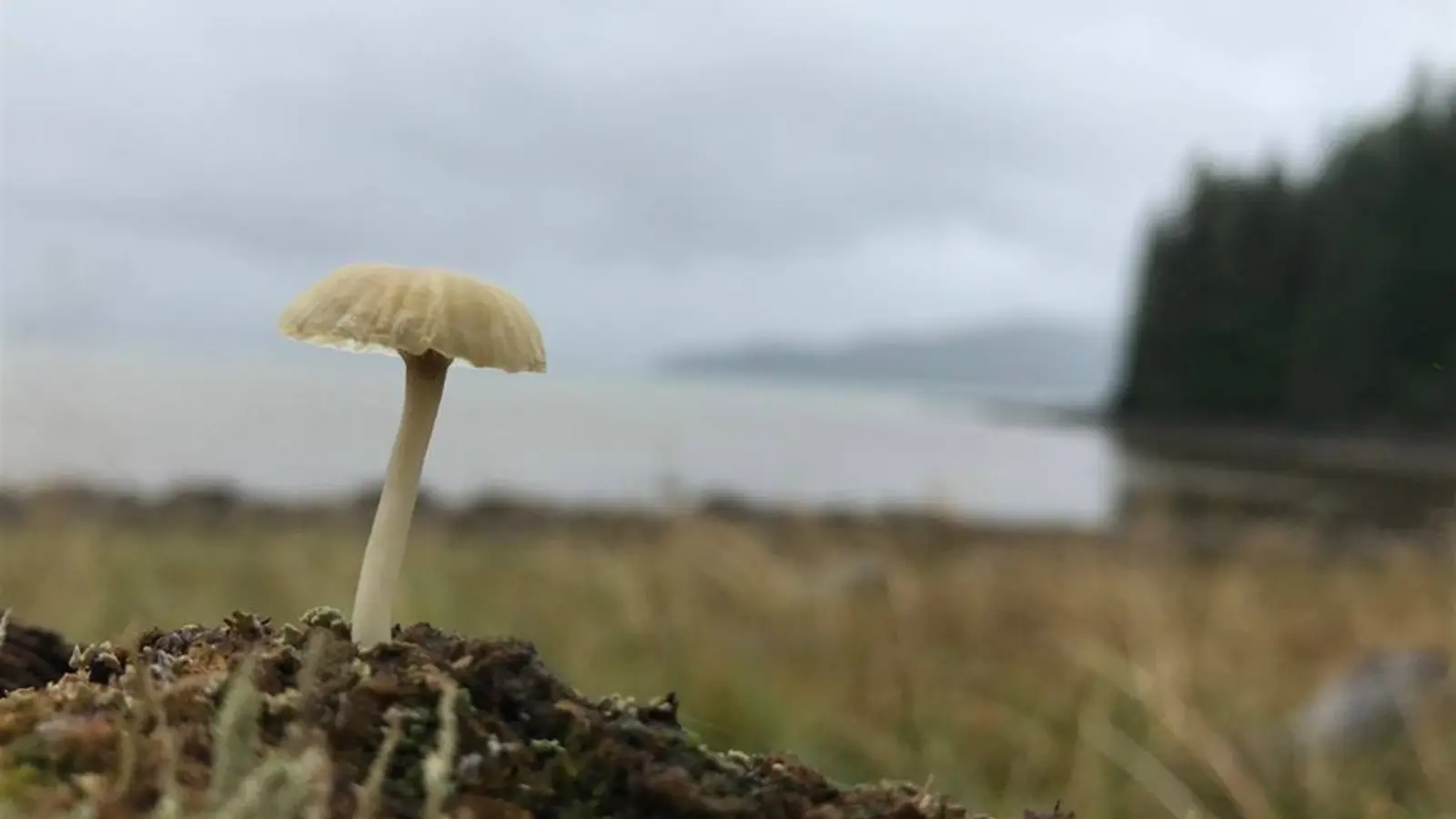
Fruit bodies release microscopic spores while the larger fungal organism grows as hidden threads
The short answer
The cap visible above soil or wood is only a temporary reproductive structure. Most of the organism persists as mycelium: a branching network of hyphae that explores its substrate, digests material externally and absorbs nutrients. Reproduction links this hidden network with an enormous dispersal system.
The mushroom is a fruit body
Many fungi build mushrooms only when moisture, temperature, nutrition and development align. The structure elevates or exposes spore-producing tissue.
Spores are not seeds
A fungal spore is usually a single cell or small group without a plant embryo or food-rich seed. It is adapted for dispersal and dormancy.
Gills multiply surface area
Thin plates beneath many caps pack a large hymenial surface into a small space. Other species use pores, teeth, folds or enclosed sacs.
Meiosis creates sexual spores
In basidiomycete mushrooms, nuclei ultimately fuse and undergo meiosis in club-shaped basidia, producing genetically varied basidiospores.
Spores launch into moving air
Tiny changes in water condensation and surface tension can propel basidiospores away from gills. Air currents then carry them farther.
Germination produces hyphae
A suitable spore absorbs water and extends a microscopic filament. Repeated branching creates a mycelial network through soil, wood or another substrate.
Compatible hyphae can fuse
Many fungi have mating types rather than male and female individuals. Compatible cells exchange nuclei and establish the long-lived reproductive mycelium.
Mycelium acquires resources
Fungi release enzymes outside their bodies and absorb small molecules. Some decompose dead material; others form partnerships or live as pathogens.
Fungi also reproduce asexually
Fragments, budding cells, conidia and other spores can create descendants without meiosis. Life cycles vary widely across the fungal kingdom.
Common misconceptions
The visible mushroom is not the entire fungus, and every spore does not grow into a new mushroom. Most land in unsuitable places or are eaten and damaged. Fungi are also not plants: they lack chlorophyll, digest food externally and belong to their own evolutionary kingdom.
How scientists know
Mycologists make spore prints, use microscopes to examine basidia and spores, culture hyphae, sequence DNA and track labelled nuclei. Environmental sampling and genomic methods reveal mycelia and species that rarely form obvious fruit bodies.
How many spores can one mushroom release?
Large fruit bodies can release millions or billions, though output varies enormously.
Why are gills underneath?
They protect and expand the spore-producing surface while allowing spores to fall into air.
Can a mushroom grow from a fragment?
Mycelium can sometimes regrow from viable fragments, depending on species and conditions.
Are all spores airborne?
No. Water, insects, mammals and active mechanisms also disperse fungal spores.
Is picking a mushroom like killing a plant?
It removes a fruit body; much mycelium may remain, though trampling and overharvesting can still damage habitat.
Key takeaways
- Mushrooms are temporary reproductive structures.
- Gills and pores produce microscopic spores.
- Spores germinate into hyphae and mycelium.
- Fungal sexual and asexual cycles are diverse.
Continue exploring
Sources and further reading
Keep exploring.
One remarkable idea at a time—nature, science, history and beyond.
Last updated October 30, 2026.

Barnakle Editorial Team
Barnakle Editorial Team is the collective byline used for Barnakle’s editorial articles. The contributor profile explains the team identity and links to the publication’s editorial policies.
More from the editorial team →