
Hydrogen bonds hold ordinary ice in an open crystal structure that occupies more volume than liquid water
The short answer
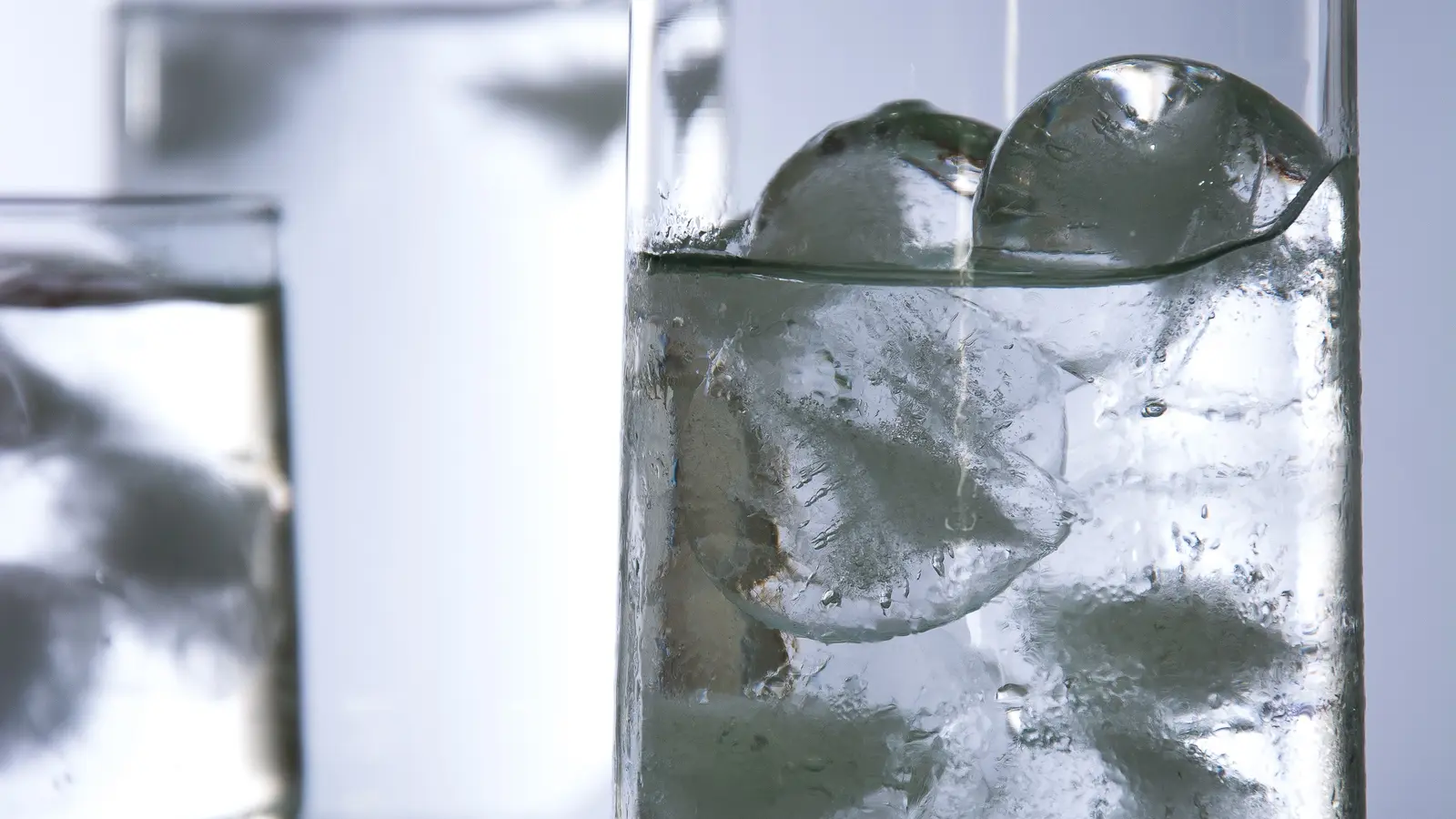
Ice floats because ordinary solid water is less dense than liquid water. As water freezes under everyday pressure, hydrogen bonds organize molecules into an open hexagonal crystal network. The same number of molecules therefore occupies more volume than in the liquid. A floating piece sinks only until it displaces water equal to its own weight, leaving roughly one-tenth of freshwater ice above the surface.
Most substances become denser when they solidify, but water behaves unusually near its freezing point. Its directional hydrogen bonding favours a roomy solid lattice. That microscopic structure explains ice cubes at the top of a drink, lake ice forming from the surface and the much larger hidden portion of an iceberg.
Density compares mass with volume
Two objects can have the same mass but different volumes. The one spreading that mass through a larger volume has lower density and experiences a different balance of weight and buoyancy in water.
Understanding Density compares mass with volume means separating the immediate mechanism from the conditions that change its strength, timing or visibility. Researchers measure those variables independently, compare natural examples and test whether the explanation predicts new observations. That turns a plausible story into an evidence-based account.
The evidence comes from methods that fail in different ways. Direct observation establishes what occurs, instruments quantify structure or timing, experiments isolate candidate causes and models test whether known physical rules reproduce the pattern. Agreement among methods is stronger than repetition of one memorable example.
Context also matters. Scale, material, temperature, geometry, environment and measurement limits can change an outcome without overturning the underlying process. Accurate reporting preserves this variation, states uncertainty and avoids turning a useful explanation into a universal rule.
A practical explanation should identify what would change the observation. Following that question reveals the limits of present evidence and the next measurement needed.
This mechanism connects a reader-level question with a broader scientific principle. Following matter, energy or information through each stage shows where the explanation is established, where natural variation enters and why a superficially similar event may have another cause.
Scientists also test alternatives rather than stopping at the first plausible account. A strong explanation predicts several linked observations, survives controlled comparison and specifies where it should fail. That approach keeps a clear answer accurate without hiding complexity.
Water molecules form hydrogen bonds
The uneven distribution of electric charge in H2O lets the hydrogen side of one molecule interact with the oxygen side of another. These bonds constantly form and break in liquid water.
Understanding Water molecules form hydrogen bonds means separating the immediate mechanism from the conditions that change its strength, timing or visibility. Researchers measure those variables independently, compare natural examples and test whether the explanation predicts new observations. That turns a plausible story into an evidence-based account.
The evidence comes from methods that fail in different ways. Direct observation establishes what occurs, instruments quantify structure or timing, experiments isolate candidate causes and models test whether known physical rules reproduce the pattern. Agreement among methods is stronger than repetition of one memorable example.
Context also matters. Scale, material, temperature, geometry, environment and measurement limits can change an outcome without overturning the underlying process. Accurate reporting preserves this variation, states uncertainty and avoids turning a useful explanation into a universal rule.
A practical explanation should identify what would change the observation. Following that question reveals the limits of present evidence and the next measurement needed.
This mechanism connects a reader-level question with a broader scientific principle. Following matter, energy or information through each stage shows where the explanation is established, where natural variation enters and why a superficially similar event may have another cause.
Scientists also test alternatives rather than stopping at the first plausible account. A strong explanation predicts several linked observations, survives controlled comparison and specifies where it should fail. That approach keeps a clear answer accurate without hiding complexity.
Freezing builds an open lattice
In common ice, molecules settle into an ordered network with more empty space than the closely rearranging liquid. Volume increases while mass remains essentially unchanged.
Understanding Freezing builds an open lattice means separating the immediate mechanism from the conditions that change its strength, timing or visibility. Researchers measure those variables independently, compare natural examples and test whether the explanation predicts new observations. That turns a plausible story into an evidence-based account.
The evidence comes from methods that fail in different ways. Direct observation establishes what occurs, instruments quantify structure or timing, experiments isolate candidate causes and models test whether known physical rules reproduce the pattern. Agreement among methods is stronger than repetition of one memorable example.
Context also matters. Scale, material, temperature, geometry, environment and measurement limits can change an outcome without overturning the underlying process. Accurate reporting preserves this variation, states uncertainty and avoids turning a useful explanation into a universal rule.
A practical explanation should identify what would change the observation. Following that question reveals the limits of present evidence and the next measurement needed.
This mechanism connects a reader-level question with a broader scientific principle. Following matter, energy or information through each stage shows where the explanation is established, where natural variation enters and why a superficially similar event may have another cause.
Scientists also test alternatives rather than stopping at the first plausible account. A strong explanation predicts several linked observations, survives controlled comparison and specifies where it should fail. That approach keeps a clear answer accurate without hiding complexity.
Liquid water is densest near four degrees Celsius
Cooling liquid water initially packs molecules more closely, but expanding hydrogen-bond structure becomes increasingly important below about 4°C. Colder freshwater can therefore remain above slightly warmer dense water.
Understanding Liquid water is densest near four degrees Celsius means separating the immediate mechanism from the conditions that change its strength, timing or visibility. Researchers measure those variables independently, compare natural examples and test whether the explanation predicts new observations. That turns a plausible story into an evidence-based account.
The evidence comes from methods that fail in different ways. Direct observation establishes what occurs, instruments quantify structure or timing, experiments isolate candidate causes and models test whether known physical rules reproduce the pattern. Agreement among methods is stronger than repetition of one memorable example.
Context also matters. Scale, material, temperature, geometry, environment and measurement limits can change an outcome without overturning the underlying process. Accurate reporting preserves this variation, states uncertainty and avoids turning a useful explanation into a universal rule.
A practical explanation should identify what would change the observation. Following that question reveals the limits of present evidence and the next measurement needed.
This mechanism connects a reader-level question with a broader scientific principle. Following matter, energy or information through each stage shows where the explanation is established, where natural variation enters and why a superficially similar event may have another cause.
Scientists also test alternatives rather than stopping at the first plausible account. A strong explanation predicts several linked observations, survives controlled comparison and specifies where it should fail. That approach keeps a clear answer accurate without hiding complexity.
Buoyancy balances weight
An object in a fluid experiences an upward force equal to the weight of displaced fluid. Ice settles until displaced water weighs as much as the ice, then floats in equilibrium.
Understanding Buoyancy balances weight means separating the immediate mechanism from the conditions that change its strength, timing or visibility. Researchers measure those variables independently, compare natural examples and test whether the explanation predicts new observations. That turns a plausible story into an evidence-based account.
The evidence comes from methods that fail in different ways. Direct observation establishes what occurs, instruments quantify structure or timing, experiments isolate candidate causes and models test whether known physical rules reproduce the pattern. Agreement among methods is stronger than repetition of one memorable example.
Context also matters. Scale, material, temperature, geometry, environment and measurement limits can change an outcome without overturning the underlying process. Accurate reporting preserves this variation, states uncertainty and avoids turning a useful explanation into a universal rule.
A practical explanation should identify what would change the observation. Following that question reveals the limits of present evidence and the next measurement needed.
This mechanism connects a reader-level question with a broader scientific principle. Following matter, energy or information through each stage shows where the explanation is established, where natural variation enters and why a superficially similar event may have another cause.
Scientists also test alternatives rather than stopping at the first plausible account. A strong explanation predicts several linked observations, survives controlled comparison and specifies where it should fail. That approach keeps a clear answer accurate without hiding complexity.
Most floating ice remains submerged
Because freshwater ice has roughly nine-tenths the density of liquid water, approximately nine-tenths of its volume lies below the waterline. Shape and trapped air change the exact fraction.
Understanding Most floating ice remains submerged means separating the immediate mechanism from the conditions that change its strength, timing or visibility. Researchers measure those variables independently, compare natural examples and test whether the explanation predicts new observations. That turns a plausible story into an evidence-based account.
The evidence comes from methods that fail in different ways. Direct observation establishes what occurs, instruments quantify structure or timing, experiments isolate candidate causes and models test whether known physical rules reproduce the pattern. Agreement among methods is stronger than repetition of one memorable example.
Context also matters. Scale, material, temperature, geometry, environment and measurement limits can change an outcome without overturning the underlying process. Accurate reporting preserves this variation, states uncertainty and avoids turning a useful explanation into a universal rule.
A practical explanation should identify what would change the observation. Following that question reveals the limits of present evidence and the next measurement needed.
This mechanism connects a reader-level question with a broader scientific principle. Following matter, energy or information through each stage shows where the explanation is established, where natural variation enters and why a superficially similar event may have another cause.
Scientists also test alternatives rather than stopping at the first plausible account. A strong explanation predicts several linked observations, survives controlled comparison and specifies where it should fail. That approach keeps a clear answer accurate without hiding complexity.
Lake ice forms at the surface
Surface water cools, eventually freezes and remains above the denser liquid. The floating layer also slows heat transfer, allowing water and aquatic habitats to persist below.
Understanding Lake ice forms at the surface means separating the immediate mechanism from the conditions that change its strength, timing or visibility. Researchers measure those variables independently, compare natural examples and test whether the explanation predicts new observations. That turns a plausible story into an evidence-based account.
The evidence comes from methods that fail in different ways. Direct observation establishes what occurs, instruments quantify structure or timing, experiments isolate candidate causes and models test whether known physical rules reproduce the pattern. Agreement among methods is stronger than repetition of one memorable example.
Context also matters. Scale, material, temperature, geometry, environment and measurement limits can change an outcome without overturning the underlying process. Accurate reporting preserves this variation, states uncertainty and avoids turning a useful explanation into a universal rule.
A practical explanation should identify what would change the observation. Following that question reveals the limits of present evidence and the next measurement needed.
This mechanism connects a reader-level question with a broader scientific principle. Following matter, energy or information through each stage shows where the explanation is established, where natural variation enters and why a superficially similar event may have another cause.
Scientists also test alternatives rather than stopping at the first plausible account. A strong explanation predicts several linked observations, survives controlled comparison and specifies where it should fail. That approach keeps a clear answer accurate without hiding complexity.
Sea ice changes the surrounding ocean
Freezing seawater rejects much of its salt into nearby liquid, raising that water’s salinity and density. Brine channels, snow and trapped air make sea ice more complex than a pure cube.
Understanding Sea ice changes the surrounding ocean means separating the immediate mechanism from the conditions that change its strength, timing or visibility. Researchers measure those variables independently, compare natural examples and test whether the explanation predicts new observations. That turns a plausible story into an evidence-based account.
The evidence comes from methods that fail in different ways. Direct observation establishes what occurs, instruments quantify structure or timing, experiments isolate candidate causes and models test whether known physical rules reproduce the pattern. Agreement among methods is stronger than repetition of one memorable example.
Context also matters. Scale, material, temperature, geometry, environment and measurement limits can change an outcome without overturning the underlying process. Accurate reporting preserves this variation, states uncertainty and avoids turning a useful explanation into a universal rule.
A practical explanation should identify what would change the observation. Following that question reveals the limits of present evidence and the next measurement needed.
This mechanism connects a reader-level question with a broader scientific principle. Following matter, energy or information through each stage shows where the explanation is established, where natural variation enters and why a superficially similar event may have another cause.
Scientists also test alternatives rather than stopping at the first plausible account. A strong explanation predicts several linked observations, survives controlled comparison and specifies where it should fail. That approach keeps a clear answer accurate without hiding complexity.
Pressure creates other ice structures
Water has numerous solid phases under extreme pressure and temperature. Some high-pressure ices can be denser than liquid water, so the familiar rule belongs to ordinary environmental conditions.
Understanding Pressure creates other ice structures means separating the immediate mechanism from the conditions that change its strength, timing or visibility. Researchers measure those variables independently, compare natural examples and test whether the explanation predicts new observations. That turns a plausible story into an evidence-based account.
The evidence comes from methods that fail in different ways. Direct observation establishes what occurs, instruments quantify structure or timing, experiments isolate candidate causes and models test whether known physical rules reproduce the pattern. Agreement among methods is stronger than repetition of one memorable example.
Context also matters. Scale, material, temperature, geometry, environment and measurement limits can change an outcome without overturning the underlying process. Accurate reporting preserves this variation, states uncertainty and avoids turning a useful explanation into a universal rule.
A practical explanation should identify what would change the observation. Following that question reveals the limits of present evidence and the next measurement needed.
This mechanism connects a reader-level question with a broader scientific principle. Following matter, energy or information through each stage shows where the explanation is established, where natural variation enters and why a superficially similar event may have another cause.
Scientists also test alternatives rather than stopping at the first plausible account. A strong explanation predicts several linked observations, survives controlled comparison and specifies where it should fail. That approach keeps a clear answer accurate without hiding complexity.
Common misconceptions
Ice does not float because air is always trapped inside it, although bubbles can lower density further. Nor is the visible tip a fixed ten percent for every iceberg. Salinity, temperature, snow cover, impurities and geometry alter densities and the exact waterline.
Clear shorthand is valuable only when it preserves the causal chain. It becomes misleading when it substitutes a label for a mechanism, confuses association with cause or extends evidence beyond tested conditions.
How scientists know
Scientists measure mass and volume, use X-ray and neutron diffraction to resolve crystal structure, track lake temperature profiles and analyse sea-ice salinity and brine. Laboratory pressure cells reveal alternative ice phases, while buoyancy measurements test displaced-fluid predictions directly.
No single measurement carries the conclusion. Observations, experiments, theory and repeated records provide independent checks, while disagreement can reveal an uncontrolled variable or a question requiring a better test.
Frequently asked questions
How much of an iceberg is underwater?
Often close to nine-tenths, but the precise fraction depends on ice and seawater density.
Why does water expand when frozen?
Hydrogen bonds organize molecules into an open crystalline network.
Why do lakes freeze from the top?
Ice is buoyant and the densest liquid freshwater settles below colder surface water.
Does salt make ice float higher?
Denser saltwater generally provides greater buoyancy for the same ice.
Can any ice sink?
High-pressure phases or heavy-water ice can be denser than ordinary liquid water.
Key takeaways
- Ordinary ice has lower density than liquid water.
- Hydrogen bonding creates an open crystal lattice.
- Buoyancy equals the weight of displaced water.
- Floating surface ice strongly affects lakes, oceans and climate.
Continue exploring
Sources and further reading
Keep exploring.
One remarkable idea at a time—nature, science, history and beyond.
Sources and further reading
Barnakle uses credible primary and authoritative sources wherever possible.
- USGS — Water density
- https://www.usgs.gov/water-science-school/science/water-density
- NOAA — Sea water and freezing
- https://www.noaa.gov/jetstream/ocean/sea-water
- NOAA PMEL — How Arctic sea ice forms and decays
- https://www.pmel.noaa.gov/arctic-zone/essay_wadhams.html
- NIST — Thermophysical properties of water
- https://webbook.nist.gov/cgi/cbook.cgi?ID=C7732185&Mask=4
Last reviewed October 9, 2026.

Barnakle Editorial Team
A member of the Barnakle editorial team, exploring remarkable ideas with clarity, curiosity and care.
More from this author →