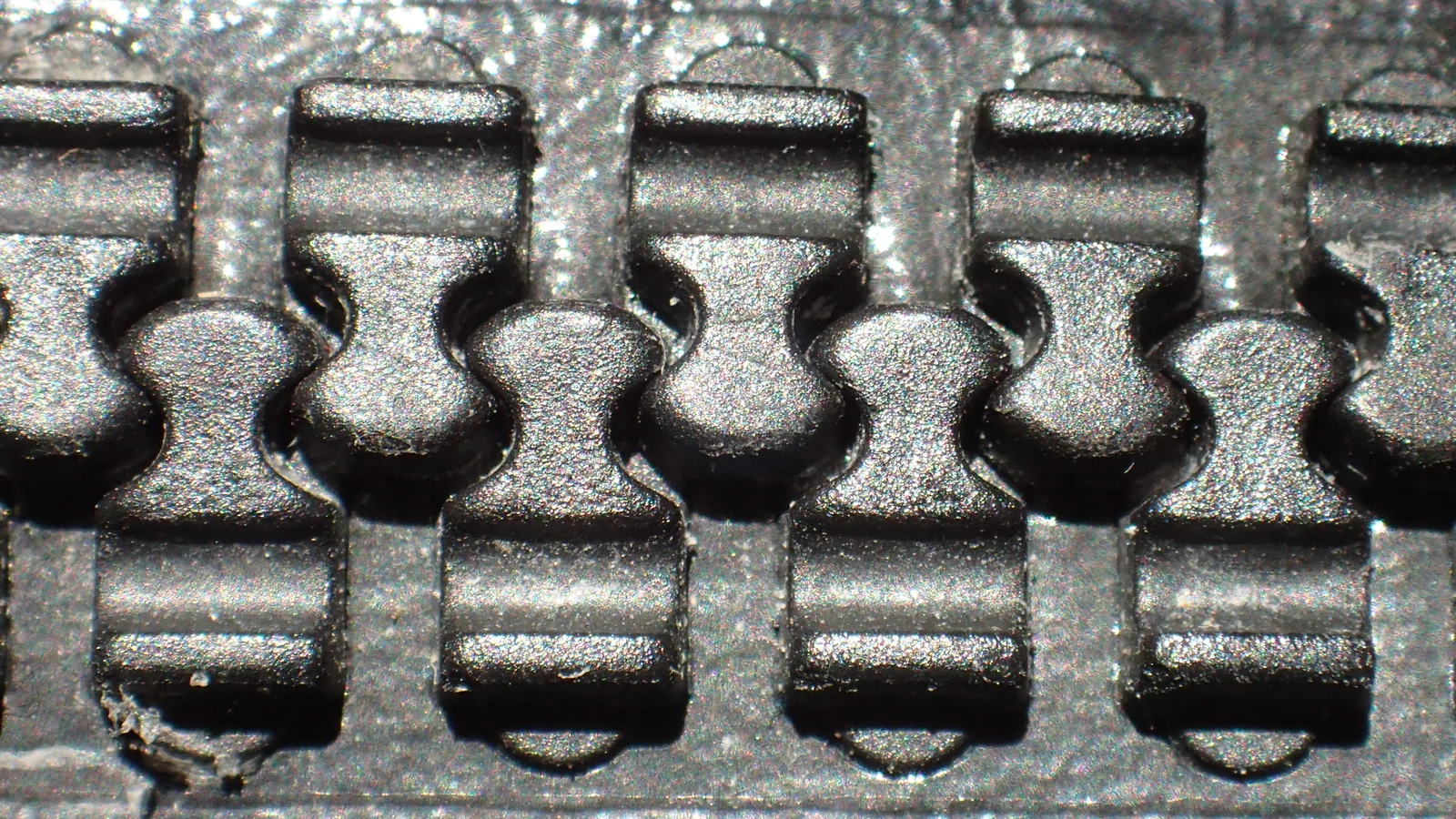
A wedge-shaped slider bends two rows of interlocking teeth into or out of engagement
A zipper closes a long opening with a short movement of the hand. The slider does not fasten the entire length at once. It repeats a small geometrical operation, guiding successive elements into engagement as it travels. Once that distinction is visible, the slider, teeth, tapes and stops each acquire a clear job.
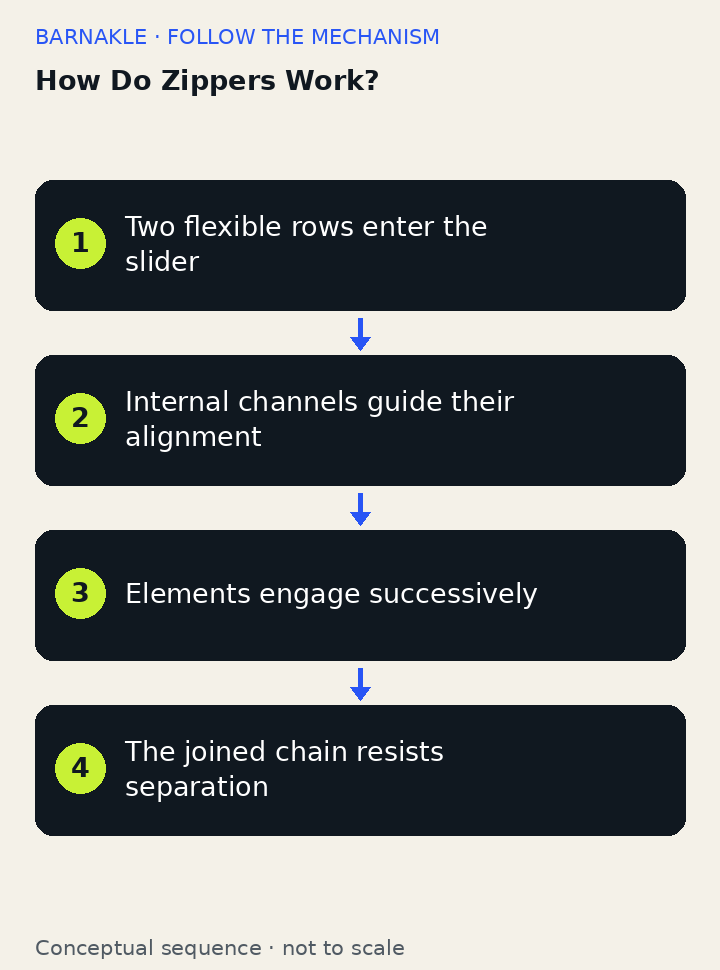
The chain distributes a sideways load
A conventional zipper has two fabric tapes, each carrying a row of moulded teeth, metal elements or a continuous nylon coil. The rows are flexible enough to turn through the slider but regular enough to engage repeatedly.
On a conventional toothed zipper, shaped elements on opposing rows engage to create a flexible chain. Continuous-coil zippers use a different element geometry to achieve guided engagement. In both cases, the joined structure resists forces trying to separate the opening.
Stitches attach woven tapes to the garment or bag. Those tapes distribute tension across many elements; a sound chain can still fail if stitching, surrounding fabric or the bottom box is damaged.
A button concentrates fastening at separated points. A zipper joins two edges through many repeated elements. The tapes connect that chain to the surrounding material, so the strength of a complete closure depends on more than the teeth. Stitching, fabric condition and the particular zipper design all form part of the path carrying the load.
Sources: [1]
The slider makes alignment happen in sequence
Inside the slider, a central wedge divides or combines two pathways. Pulling toward the closed end guides both rows around the wedge and into one narrow exit where their pitch and height match.
The stringers enter at an angle. Slider flanges constrain them while the wedge changes their path, allowing successive elements to tilt, overlap and settle into the interlocked position.
The slider's internal channels constrain the two rows as they enter and leave. That guidance makes engagement repeatable while the chain remains flexible enough to curve with a garment or bag. Individual metal or moulded teeth and continuous coils achieve their engagement with different shapes; the principle is controlled guidance, not one tooth profile shared by every zipper.
Sources: [2]
Opening and locking are different operations
When the slider travels the other way, the central wedge enters the joined chain and forces the two rows into diverging channels. The teeth disengage sequentially instead of being torn apart all at once.
Top stops prevent the slider running off. Closed-end zippers use a bottom stop, while separating jackets use a pin and box that align both sides before the slider can join them.
Many garment sliders contain a small pawl connected to the pull tab. When the tab lies flat, the pawl enters the teeth or coil; lifting the tab withdraws it so the slider can move.
A slider can separate the chain while moving one way and join it while moving the other. A locking mechanism addresses a different question: whether the slider can move unintentionally once released. Some use a pawl or pin; others have no such lock. YKK's examples show why the pull tab can operate a lock as well as supply a handle.
Sources: [2]
Why a small worn part can spoil the whole closure
Bent teeth, worn slider flanges, fabric caught in the channel, a damaged insertion pin or unequal tension can prevent engagement. Forcing the pull may worsen a repairable problem.
If a zipper opens behind a slider, the slider may no longer guide engagement correctly, or the elements may be damaged. Pulling harder is not a diagnosis. It adds force to the same geometry and can damage tapes or fabric. Manufacturer-specific repair advice is preferable to assuming that every apparent jam requires the same lubricant or adjustment.
Sources: [2]
Why teeth stay joined after the slider passes
Close a zipper slowly and look just behind the slider. The joined chain stays engaged after the slider has left that point. That observation identifies the division of work: the slider organizes engagement, while the interlocking elements maintain the closure. A slider lock prevents travel; it does not individually clamp every tooth along the zipper.
Elements, slider and slider lock
| Term or component | What it means here |
|---|---|
| Elements | Maintain engagement along the joined chain. |
| Slider | Guides joining or separation as it travels. |
| Slider lock | Can resist unintended movement of the slider itself. |
More pulling force does not fix zipper geometry
The slider does not glue or magnetize the two sides, and lubricating every stuck zipper is not automatically safe for its fabric or coating. A zipper that opens behind the slider often has worn slider geometry or damaged elements rather than teeth that simply need to be pulled harder.
How zipper engagement and strength are tested
Mechanical engineers examine tooth profiles, slider forces, lateral chain strength, fatigue, abrasion and repeated opening cycles. High-speed imaging and sectioned sliders reveal how elements rotate and engage, while product standards test strength under controlled loads.
Zipper questions
Why does a zipper split after closing?
Worn slider flanges may no longer press the rows into full engagement, or individual elements may be damaged.
Are coil and toothed zippers the same?
They use the same guided interlocking principle but form the engaging elements differently.
What does the pull tab do?
It provides leverage and can operate a locking pawl; the slider body controls the teeth.
The slider guides a closure that the elements maintain
The zipper's economy comes from repeating one guided movement across many elements. Flexible tapes carry the chain, the slider organizes it and stops keep the mechanism within its intended path. A small object that looks simple from outside is successful because several separate geometries cooperate every time it opens and closes.
Continue exploring
Sources and further reading
Keep exploring.
One remarkable idea at a time—nature, science, history and beyond.
Last updated November 6, 2026.

Barnakle Editorial Team
Barnakle Editorial Team is the collective byline used for Barnakle’s editorial articles. The contributor profile explains the team identity and links to the publication’s editorial policies.
More from the editorial team →