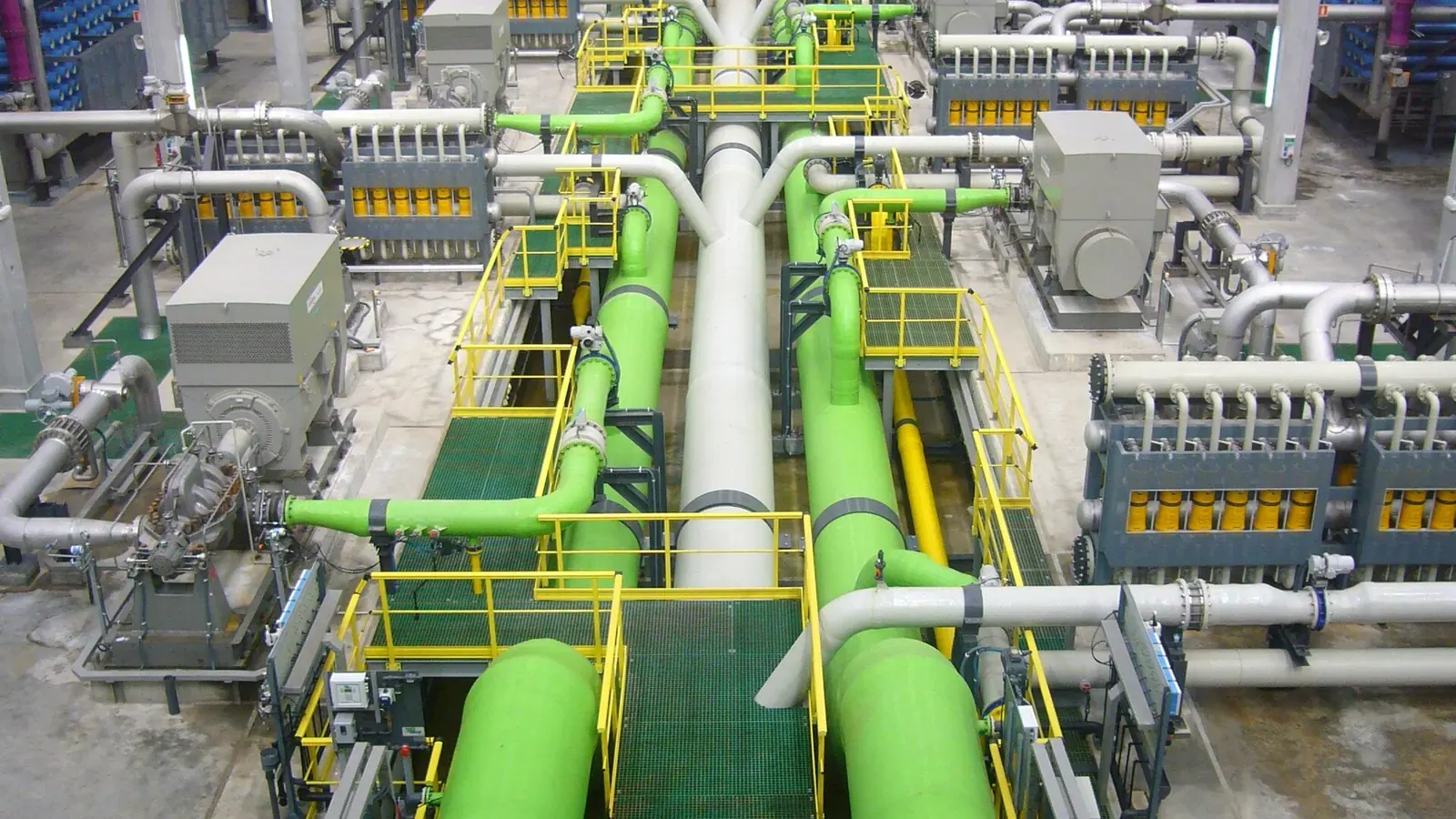
Desalination removes dissolved salts from saline water. It can turn seawater or brackish water into a useful supply, but it is a separation process with energy demands and a concentrated remainder. The salt does not vanish when fresh water comes out of a plant.
Two important approaches are reverse osmosis and thermal desalination. They reach the same broad goal through different physical processes.
Why an ordinary filter is not enough
A screen can intercept particles larger than its openings, but dissolved salts are present as ions in water. Removing them requires more than trapping visible sand. Desalination membranes and thermal systems address that dissolved component.
A plant also needs to manage suspended material and other constituents before the main separation step. Treating the intake water helps protect equipment and maintain performance rather than turning the central separator into a universal solution to every water-quality problem.
Reverse osmosis uses pressure
In ordinary osmosis, water tends to move across a suitable semipermeable membrane towards the more concentrated solution. Reverse osmosis applies sufficient pressure on the saline side to drive water in the opposite direction through the membrane.
Agriculture and Agri-Food Canada's explanation makes this pressure reversal explicit. The process produces a lower-salinity water stream and a more concentrated stream. Real membranes are selective rather than perfectly magical barriers, so performance depends on the membrane, operating conditions and condition of the system.
Thermal systems separate by evaporation
In thermal desalination, water is evaporated and the vapour is condensed into a separate liquid stream. Most dissolved salts remain behind. This uses heat rather than relying solely on pressure across a membrane.
The Department of Energy describes several thermal approaches and notes their energy requirements. Whether a system is appropriate depends on the source water, available energy and required output, including situations where very high salinity challenges membrane treatment.
Freshly separated water still needs preparation
Desalinated product water may require conditioning and disinfection before distribution. The treatment train is designed around the intended use and applicable water-quality requirements. A successful salt-removal step alone is not a complete assessment of finished drinking water.
The USGS overview presents desalination within the wider context of water supply. It is one option among approaches such as conservation, reuse and management of existing freshwater resources.
The concentrated stream needs management
Brine contains the salts left behind, often along with other constituents from the intake or treatment process. Its disposal requires attention to the receiving environment and the design of the discharge or other management method.
Comparing projects therefore means considering energy, source-water conditions, environmental effects and reliable operation together. Desalination can expand usable supplies, but its value is best judged across the full process rather than from the clear appearance of the product water.
Explore a related question
Sources and further reading
Keep exploring.
One remarkable idea at a time—nature, science, history and beyond.
Last updated October 27, 2026.

Barnakle Editorial Team
Barnakle Editorial Team is the collective byline used for Barnakle’s editorial articles. The contributor profile explains the team identity and links to the publication’s editorial policies.
More from the editorial team →