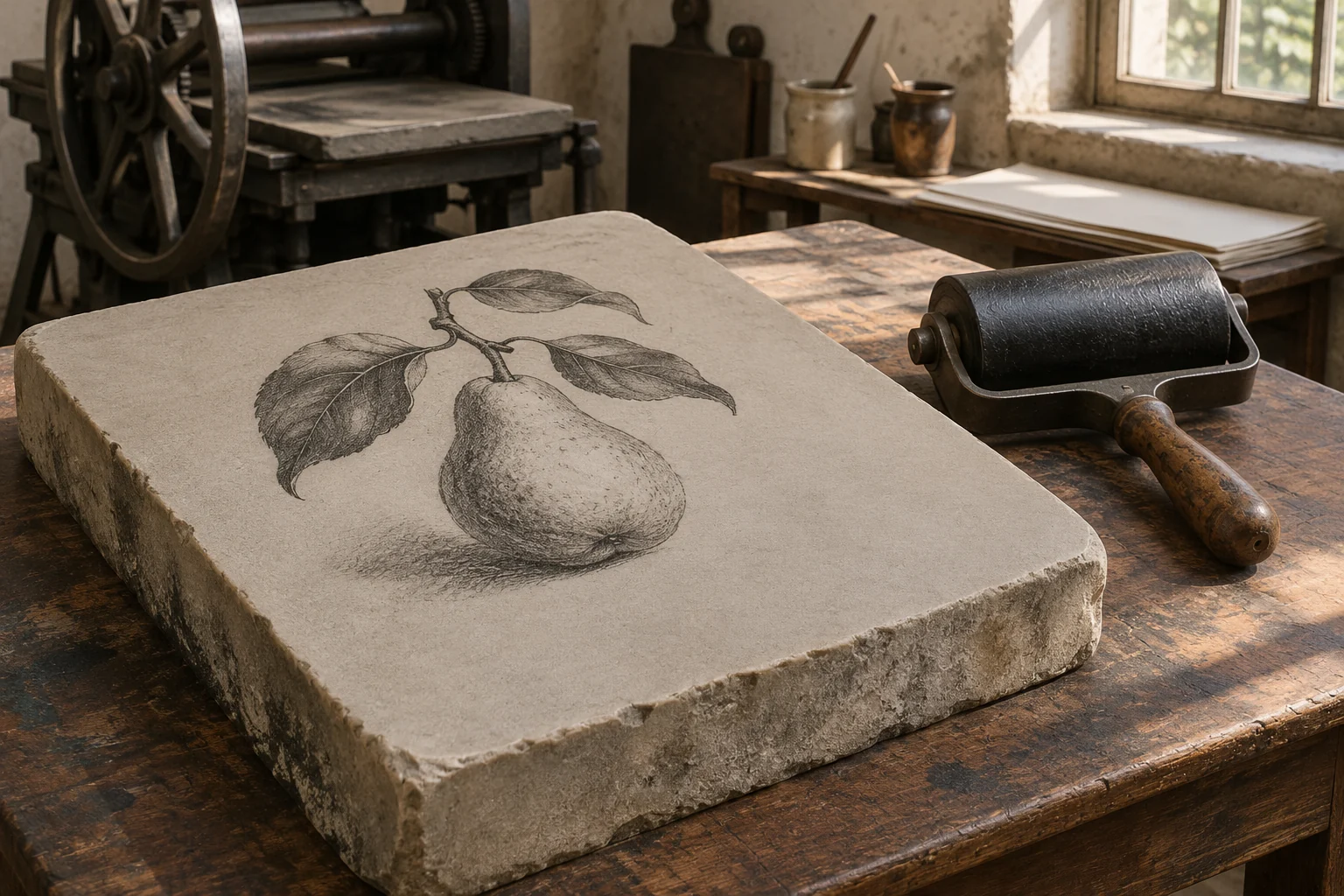
In a stone lithography studio, the printer can wipe away an artist's visible drawing and still print it. The feat depends on what the drawing has done to the limestone. After treatment, the drawn marks accept oily printing ink. The surrounding stone holds a film of water that keeps that ink away. A roller can cross a leaf, its outline and the empty margin in one pass, leaving ink only where the image belongs. The drawing and the blank paper around it are decided on the same flat surface. [1, 2, 3]
The pear on the stone
Picture an artist drawing a pear with a lithographic crayon. A firm line establishes one side of the fruit. A light sweep of the crayon shades the other. The artist lifts the point to leave a highlight near the stem. In the eventual print, the outline and the shadow might both be made with exactly the same black ink. The difference lies in how much of each small area the crayon marked and how much stone it left open between the marks. [1, 2, 3]
Traditional lithographic limestone needs a carefully prepared face. Grinding makes it flat and gives it a surface suited to the intended marks. Fine grain can catch the crayon much as textured drawing paper does. Under magnification a grey shadow can resolve into dark specks separated by gaps. Seen from the usual distance, the paper showing between those specks contributes to the apparent grey. The artist can also use a greasy drawing liquid called tusche to introduce brush marks and washes with a different character. [1, 3, 5]
The flatness matters for a reason you can appreciate by imagining an ordinary rubber stamp. On a stamp the design stands high enough to meet the ink pad while the hollows stay clear. A lithographic stone offers no comparable step around the pear. A finger crossing the outline would find no ridge capable of keeping a roller out of the white highlight. Lithographers call this family of printing methods planographic. The word identifies the problem the printer has to solve: selecting where ink goes when the printing and nonprinting areas are on one plane. [1, 3]
How the stone remembers
The drawing material contains grease. Once the drawing is finished, the printer treats the surface so that the two kinds of area will behave differently during printing. Museum and workshop demonstrations show powders including rosin and talc, followed by a preparation containing gum arabic. Printers call one treatment an etch. Here the point is to establish and stabilize the image and the water-receptive background. The line does not have to be bitten down into a trench to carry a reservoir of ink. [1, 2]
The distinction becomes visible when the original drawing is washed out. For a moment only a faint trace of what looked like a finished picture may remain. Yet the treated stone still has the spatial pattern that matters to the printer. Think of two versions of the pear. The first is the black material the artist put down and could see. The second is a distribution of microscopic places that will accept ink when the stone is damp. Washing away the first need not erase the second. [1, 2]
When the printer moistens the stone, water spreads over the prepared blank areas. An inked roller then crosses the entire surface. The oily ink adheres to the receptive marks while moisture protects the background. The ink on the stone now is fresh printing ink. One sheet might consume much of the visible ink on the outline of the pear without exhausting the image, since the surface can be dampened and rolled again before the next sheet enters the press. [1, 2, 3]
What the first proof can tell the printer
A sheet of paper goes over the inked face. In a traditional lithographic press, a pressure bar acts through a protective covering as the stone travels through. The assembly needs to transfer delicate marks as reliably as broad dark areas. After lifting the sheet, the printer can inspect a proof. Did the white sliver beside the stem survive? Do the fine dots of the shadow remain distinct? A drawing that looked right on limestone has to pass these tests in ink on paper. [1, 2]
There is a further difference between the drawing and its impression: direct printing reverses the image left to right. A stem leaning left on the stone will lean right on the sheet. An isolated pear might look perfectly convincing either way, but letters on a fruit label would immediately give the reversal away. An artist working directly can plan for that reversal before drawing. This is one reason to examine the finished proof in its own right instead of judging it entirely by a glance at the stone. [1, 2]
Adding a yellow field behind the black pear introduces a second problem. In a conventional colour lithograph, a separate stone or plate generally carries each colour. The printer has to place the sheet accurately for each pass. If the paper shifts, the yellow may creep into the white highlight or leave a narrow white fringe where it should meet the black outline. The chemical distinction between image and background works independently on each stone. Registration is what makes their impressions agree on the sheet. [2, 3]
A drawing that can outlive its stone
The museum Escher in The Palace describes M. C. Escher taking his drawn stones to a specialist printer and staying to oversee the printing. Its collection offers landscapes in which rocks, buildings and distant surfaces separate into different greys. Looking at one of these lithographs, pick a transition from a deep shadow to open sky. The subtle passage is an artistic decision made with drawing materials, sustained through the printer's work and visible on a surface neither artist nor printer had to carve. [3, 4]
After an edition, a stone can be ground down and prepared for a different image. The sheet retains a record that its heavy limestone parent may no longer carry. That possibility gives the printer's brief act of washing out the drawing an interesting counterpart. One operation removes the visible drawing while preserving the ability to print it. The other removes the prepared surface itself. By then, the pear can survive on every successful sheet even as another artist begins a completely different drawing on the same stone. [1, 4, 5]
Related reading
- How Does a Mezzotint Printmaker Work From Black to Light?
- How Do Japanese Woodblock Printers Line Up Different Colours?
Sources
- The Metropolitan Museum of Art — Lithograph
- Tamarind Institute — The hand lithography process
- Museum of Modern Art — What Is a Print?
- Escher in The Palace — Lithograph
- National Galleries of Scotland — Lithography
Keep exploring.
We’ll email you when the first edition is ready.
Last updated November 26, 2026.

Barnakle Editorial Team
Barnakle Editorial Team is the collective byline used for Barnakle’s editorial articles. The contributor profile explains the team identity and links to the publication’s editorial policies.
More from the editorial team →