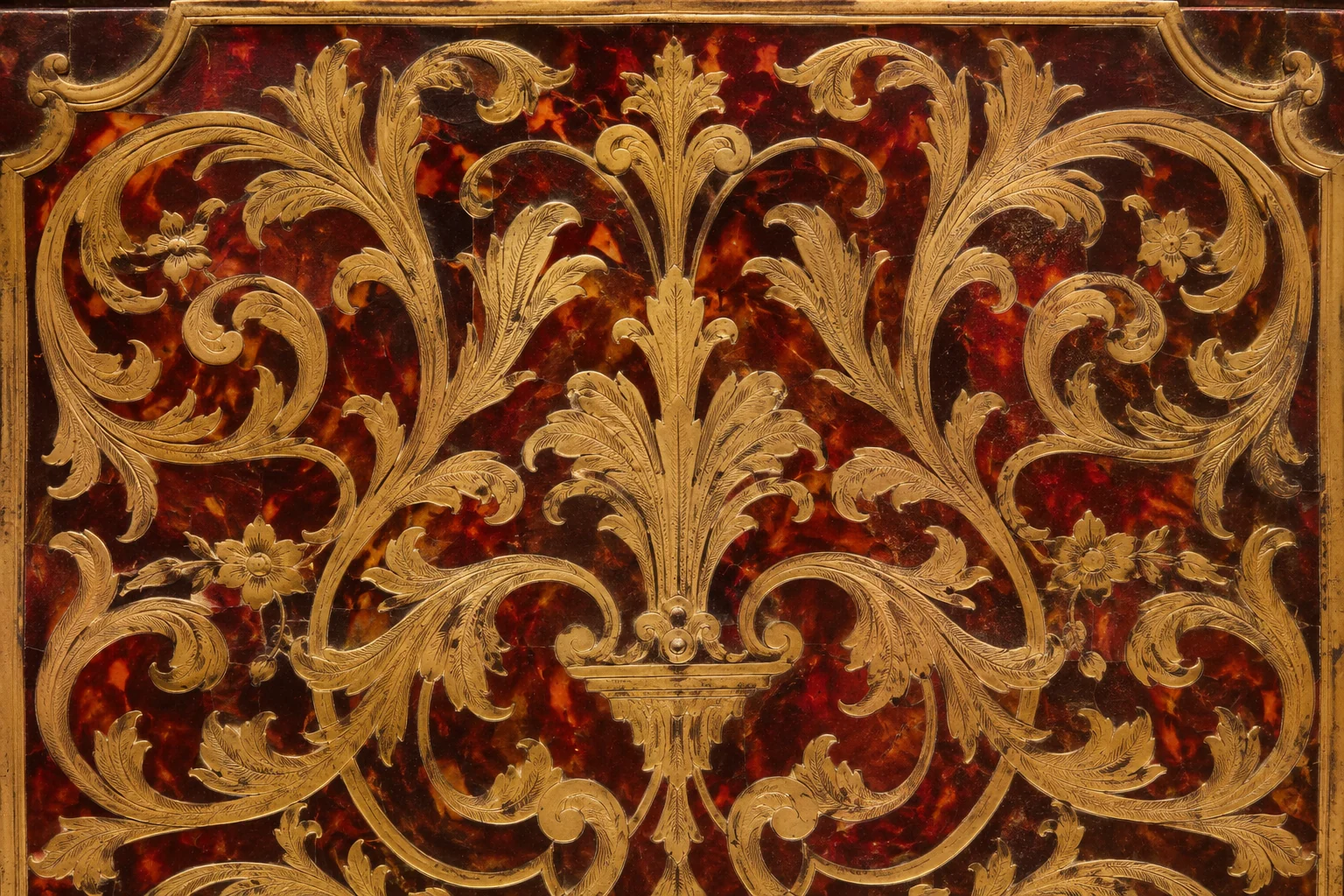
A thin brass leaf curls across the door of a French cabinet. Imagine lifting that leaf out and finding, at the next bench, a whole brass panel with a leaf-shaped opening exactly where it belongs. In Boulle marquetry those pieces could come from the same cut. A craftsperson stacked sheets of contrasting material, cut a design through them together, then exchanged the shapes between sheets. One pass along an intricate outline supplied the pieces for two versions of the ornament. You can see both colour arrangements on a single cabinet at the Metropolitan Museum of Art.[1, 2]
What comes out of the cut?
Start with two paper rectangles to see the idea more clearly. Make one yellow and one brown. Place the yellow sheet over the brown one, line up the edges and imagine cutting out a leaf through both. You now have four pieces to keep track of: a yellow leaf, a brown leaf and two rectangular backgrounds with matching openings. Set the yellow leaf into the brown background and the brown leaf into the yellow background. The point on each leaf faces the same way. What has reversed is the relationship between figure and ground.[1, 2]
That last detail matters when you see a photograph described as showing a pair of panels. Exchanging cut pieces gives two colour versions of a design. A mirror image, by comparison, would turn a leaf pointing left into one pointing right. The exchange itself never does that. A maker could plan a symmetrical arrangement of doors as a separate design decision. To work out which relationship you are seeing, look for a small asymmetric feature, such as a bent twig or a bird looking over one shoulder, and compare its direction as well as its colour.[1, 2]
Now multiply the paper leaf into a long tendril with many smaller leaves and islands of background enclosed within loops. Every island must go back in the appropriate opening. Cutting both materials at once means each turn of the saw transfers to both sheets, even where a curve wanders a little from the drawing. There is still a physical cut of finite width, and a very thin pointed piece is still fragile. Matching outlines solve one demanding part of construction. They leave the handling, assembly and finishing of many small pieces in the maker’s hands.[1, 2, 4]
Reading the two colour arrangements
André Charles Boulle was a cabinetmaker who worked for Louis XIV in France. Versailles credits him with refining a technique already in existence. On furniture associated with him, the dark, often mottled material can be historical tortoiseshell, while the warm reflective metal is commonly brass. In the arrangement called première partie, the brass ornament appears against the shell ground. In contre-partie, the corresponding ornament is shell against metal. Those terms describe the distribution of materials. You can identify it in a detail without knowing which bench assembled the piece or who subsequently owned it.[1, 2, 3]
The cabinet at the Met offers a particularly good exercise for the eye. In the centres of the doors you can pick out the light metal against a darker field. Look at the surrounding border and the relationship changes. The two treatments on the same object make for a more instructive comparison than photographs taken in different rooms under different lighting. The museum suggests that a cabinet with the reverse arrangement may once have accompanied it. That is an inference from the technique and the object. A complementary design can survive on a door even when the whereabouts of a possible partner are unknown.[1, 4]
A side table is hardly a prerequisite for studying the pattern. The Met also holds a small French dressing casket dated 1700–1715. Its première partie decoration includes tiny people, animals and birds woven among the scrolls. On something this size, the curve you first read as a line in a drawing can turn out to be one edge of a narrow brass piece. Looking for an animal among the strapwork is a good excuse to switch between the overall design and the physical seams that make it possible.[3]
Three kinds of line on a cabinet door
A line on an ornate piece of furniture can come from a cut through two sheets, a mark engraved into the surface of a single piece, or the edge of a metal mount standing proud of the panel. Follow a brass leaf from its outside edge to its central vein. The outer contour can be a meeting between shell and metal while the inner mark can remain entirely within the brass. Engraving gives a leaf or a bird’s wing detail without requiring the maker to cut and fit a separate sliver for each vein or feather.[1, 4]
A projecting ornament has yet another job. On the Met cabinet, gilt-bronze mounts at the corners depict wind gods. They give depth to the ornament and help protect the veneered surface. At the Getty, two coffers attributed to Boulle have dolphins whose tails frame the keyholes. Imagine moving a light sideways across a door. A raised mount can cast a moving shadow across a panel. An engraved line can catch the light inside the metal. The boundary between two flat contrasting pieces stays readable by colour even as the light moves.[1, 5]
What time does to a paired design
Inside and outside a museum case, the materials remain physically different. The wood beneath the veneer and the inlaid metal respond differently to changing conditions. Over time, sections of a surface can lift or need attention. Historical smoothing could also remove some depth from engraved lines. A catalogue entry that mentions both worn engraving and surviving outlines is describing two independent kinds of evidence. A brass leaf might retain its recognizable silhouette long after the fine lines once visible within it have become difficult to see.[4]
The most revealing detail on such a cabinet may be a tiny loop of ornament that nearly escapes notice. Follow the metal around the loop, then consider the small patch of shell enclosed by it. On the complementary panel, each would take the other’s place. An extravagant-looking surface thus preserves an unexpectedly economical idea: the portion removed to make room for one ornament already has a job waiting for it in another.[1, 2]
Related reading
- How Does a Silverpoint Stylus Leave a Drawing on Paper?
- How Does a Mezzotint Printmaker Work From Black to Light?
Sources
- The Metropolitan Museum of Art — Cabinet attributed to André Charles Boulle
- Palace of Versailles — André Charles Boulle
- The Metropolitan Museum of Art — French toilet casket, 1700–1715
- The Metropolitan Museum of Art — European Furniture, Highlights of the Collection
- Getty Museum — The Sun King Illuminated
Keep exploring.
We’ll email you when the first edition is ready.
Last updated November 26, 2026.

Barnakle Editorial Team
Barnakle Editorial Team is the collective byline used for Barnakle’s editorial articles. The contributor profile explains the team identity and links to the publication’s editorial policies.
More from the editorial team →