A tiny scrap of woven wool from the Timna Valley has plain threads running one way and pink-purple threads running across them. The surviving piece is barely longer than a centimetre. It came from a copper-working site in the desert, far from the Mediterranean shore. Yet the colour in that scrap began inside a marine snail. Researchers could identify its origin some three thousand years after somebody wove those threads together.[1]
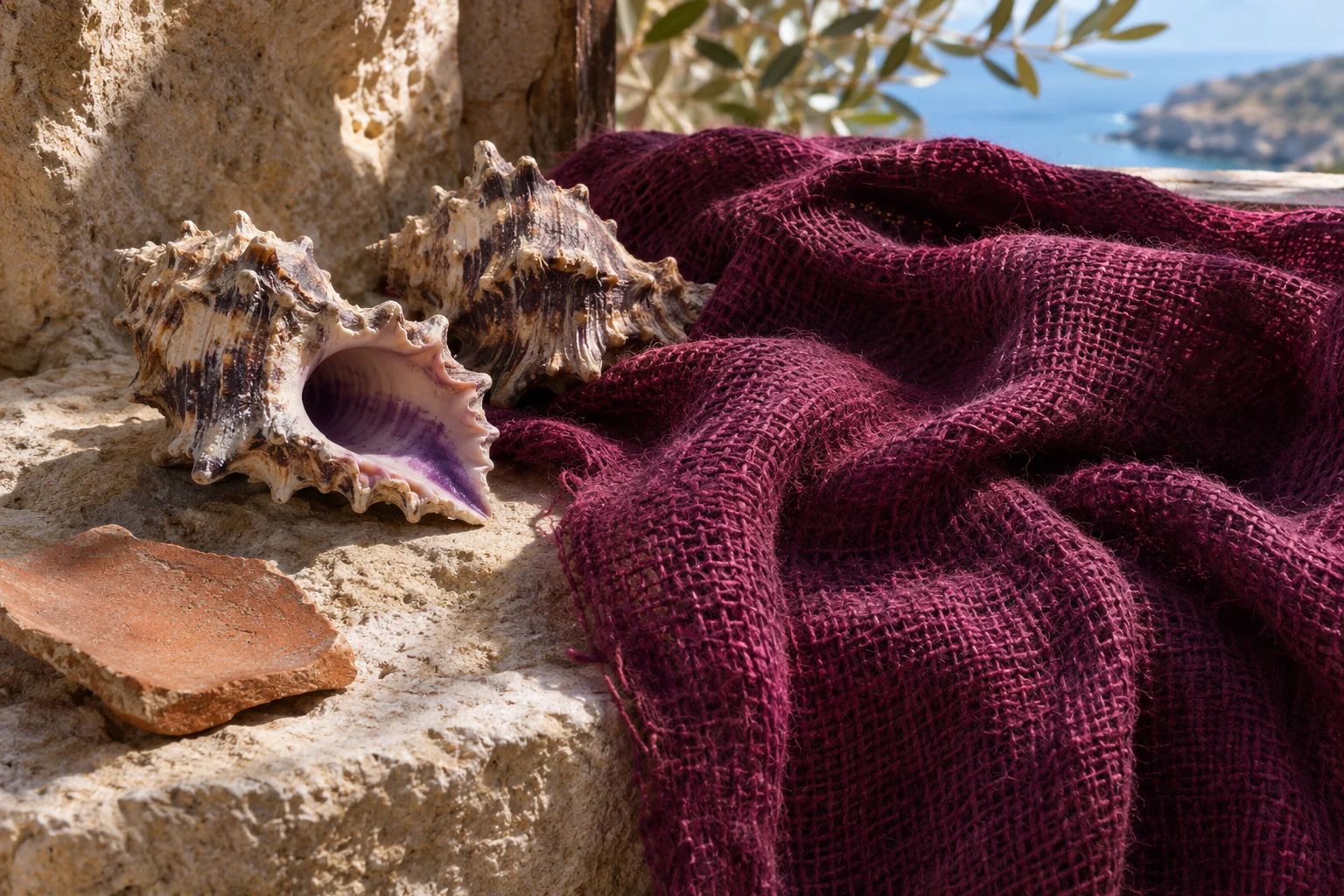
Tyrian purple was made from material in a gland of certain sea snails. Producing a quantity of dyed wool meant gathering shellfish, reaching that small gland and managing a dyeing process whose result could range from reddish purple to a bluer shade. Its name recalls the Phoenician city of Tyre, but workshops elsewhere around the Mediterranean also made shellfish purple. Pieces of wool, broken vats and heaps of shells preserve quite different parts of the trade.[1, 2, 3]
Where the colour hides
A murex shell makes a poor colour chart. The outside may be pale, striped or encrusted. The material a dyer wanted lay inside the animal, in what biologists call the hypobranchial gland. Several Mediterranean species furnished colour, among them the banded dye-murex and the spiny dye-murex. The gland supplies chemical precursors from which the colour develops. Grinding the empty shell itself would miss the most valuable part of the catch.[2, 3]
That simple anatomical fact changes the economics of a purple thread. Each animal provided a small amount of useful material and left behind a much more conspicuous shell. A shop that handled large quantities of snails had to acquire them, open them and dispose of what it didn’t use. Archaeologists can sometimes recover the leftovers of that labour in a space where an entire bolt of finished cloth would long since have decayed. The size of the rubbish pile is easier to establish than the exact length of fabric it once helped to colour.[2, 3]
A Bronze Age workshop on Aegina
At Cape Kolonna on the Greek island of Aegina, excavators found a workshop dating to the sixteenth century BCE. The evidence included fragments of pottery with pigment, tools suitable for crushing shells and a place for disposing of waste. Researchers identified the shells and analysed the colouring material. The banded dye-murex accounted for almost all the shellfish used. A general story about ancient Mediterranean purple became a much more local one about a particular group of workers using a particular species.[3]
A heap of shells by itself presents a problem. People living on a coast have plenty of reasons to collect shellfish, including eating them. A vessel that looks purple presents a different problem. Its colour alone tells you little about what produced it. At Aegina the finds can be checked against one another. The tools and debris show where animals were opened, the chemistry identifies the colourant, and the building connects them. An excavation that kept only the most attractive coloured sherd would lose much of that argument.[2, 3]
A stain on a vat can outlast the business
At Tel Shiqmona on the eastern Mediterranean coast, a study identified 176 objects associated with producing the dye or dyeing with it. Among them were fragments of the heavy clay basins the workers used. The team took 28 samples of stained material for chemical analysis and found evidence of shellfish purple across the sampled objects. Successive phases at the site document a specialist operation over centuries, roughly between 1100 and 600 BCE.[4]
The difference between a vat fragment and a length of wool is worth dwelling on. Find a dyed textile in a settlement and you know somebody there could obtain the product. They could have bought it already dyed. Find groups of stained working vessels in a workshop, followed by evidence of similar work in later buildings, and you have a case for production on the spot. The two finds answer different questions about the same industry. Tracking where something was worn and where it was made calls for different evidence.[1, 4]
Following a thread inland
At Timna the desert helped preserve wool that would have vanished in many wetter places. The team found three samples containing the shellfish dye. In the woven fragment, the coloured weft passed across an undyed warp. Another sample was a short plied string with a pink-purple edge. A decorative fringe is one possible use for it. Enough survived to describe how the thread was put together, though assigning it to a particular garment or owner would go further than the evidence permits.[1]
Identifying the dye took more than matching the thread to a modern swatch. Researchers separated its chemical components using liquid chromatography. Certain blue colouring compounds occur in plants as well as shellfish. The team looked for bromine-containing compounds characteristic of the marine dye and compared the results with reference material. That is why they could trace an inland scrap to a marine source even though its visible shade might equally suggest a mixture of other colours to the eye.[1, 3]
Was Tyrian purple always the same purple?
Even a careful reconstruction needn’t yield a single correct swatch. The species of snail matters, and the composition of the material varies. How the dyer handled it could affect the result as well. A dark reddish cloth and a thread with a bluer cast can belong to the same broad family of marine colours. The word “purple” is useful for naming the craft. It is less helpful as a prediction of exactly what one merchant would have unfolded for a customer.[1, 2]
Cloth wasn’t the only surface that received the colour. Researchers have identified shellfish purple in Bronze Age Aegean wall paintings, including examples from Thera and Rhodes. In that setting a painter needed a pigment that could form part of a painted surface. The discovery of purple material in a container doesn’t settle what the maker ultimately coloured. The surrounding workshop and the object carrying the finished colour help answer that last question.[3, 5]
Return to the small Timna fragment and the choice of design becomes easier to appreciate. The weaver put the precious colour into selected threads. A narrow band could carry it across a textile, catch someone’s eye and survive as evidence long after the rest of the piece was lost. The person who chose those threads is beyond our reach. A little of what they chose, down to the sea creature that supplied it, is still there to see.[1]
Related reading
- How Archaeologists Identify the Colours of the Ancient World
- How Do Punched Cards Guide a Jacquard Loom?
Sources
- Sukenik and colleagues, PLOS ONE — Purple-dyed wool from the Timna Valley
- The Colourant Mapping Project — Evidence from three Aegean islands
- Berger and colleagues, PLOS ONE — Bronze Age purple production on Aegina
- Shalvi and colleagues, PLOS ONE — Iron Age dye workshops at Tel Shiqmona
- Heritage — Shellfish purple in Aegean wall paintings
Keep exploring.
One remarkable idea at a time—nature, science, history and beyond.
Last updated November 25, 2026.

Barnakle Editorial Team
Barnakle Editorial Team is the collective byline used for Barnakle’s editorial articles. The contributor profile explains the team identity and links to the publication’s editorial policies.
More from the editorial team →