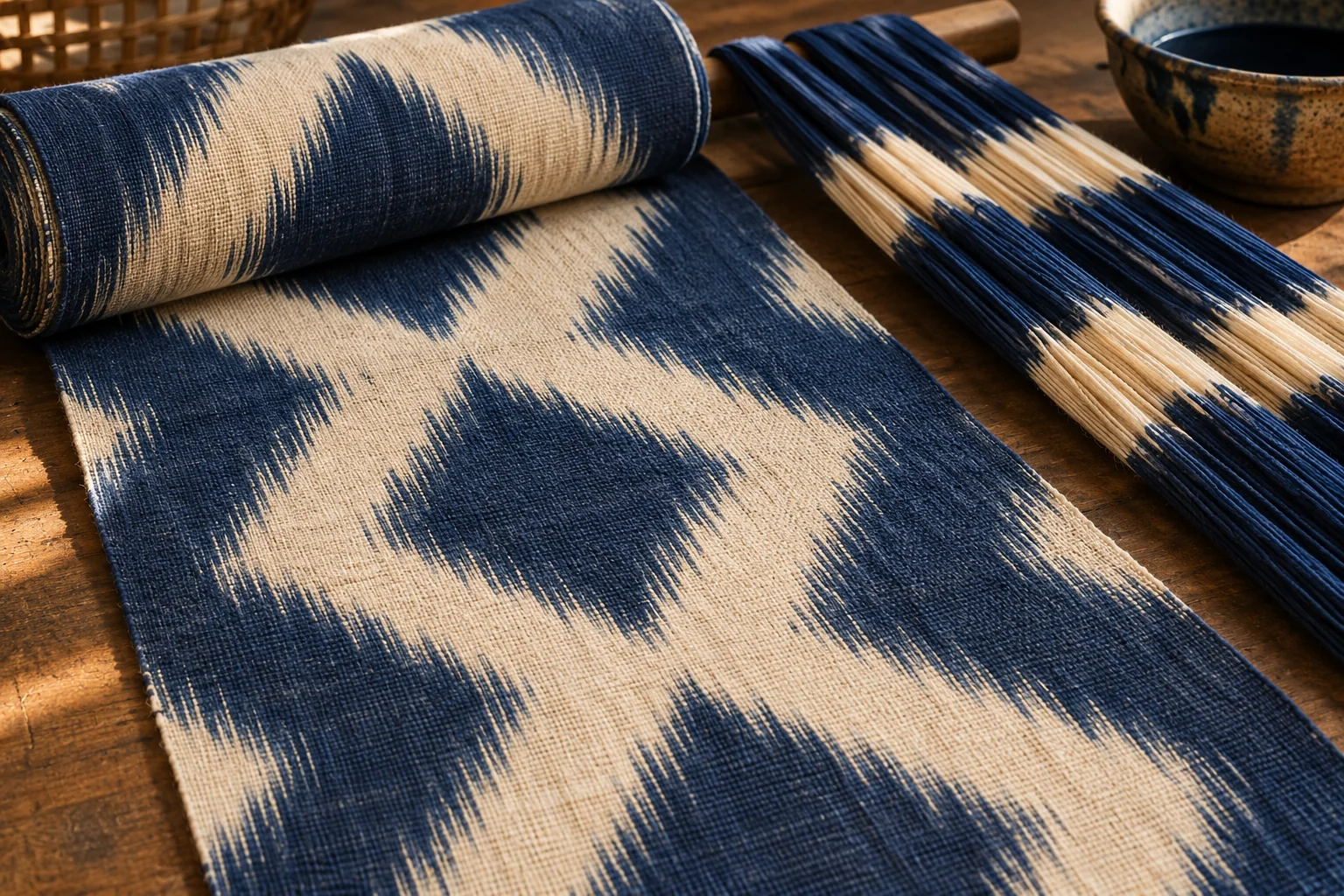
Look closely at the edge of an ikat diamond. A blue point on one thread may end just ahead of the blue point beside it. From across a room, the two marks read as a single sloping line. At arm’s length you can see the decisions that went into making it. The weaver had to put the blue in the right places while the picture was still a set of loose yarns.
Ikat makers bind selected lengths of yarn to keep dye away, colour the exposed stretches, then arrange the yarns for weaving. A thread seen on its own may look like an irregular succession of dashes. Put it back among its neighbours and those dashes can become part of a diamond, a stripe or a figure. The Malay-Indonesian name recalls the binding that makes this possible.[1, 2]
A diamond planned one thread at a time
Imagine laying nine white cords side by side on a table. On the middle cord, mark a short length to stay white. Mark slightly shorter lengths on the cords either side. Make the reserved sections shorter again as you work outward, keeping their midpoints in line. If everything outside the marks becomes blue, the white lengths together form a diamond. No single cord contains anything that looks like one.
Now gather the cords and put them in a bath. A pencil mark will do nothing to stop dye reaching the fibre. An ikat maker needs a physical resist. Tight bindings protect the chosen lengths, with several yarns often handled together as a bundle. Once the bath is finished and the bindings come away, the protected areas differ in colour from the exposed ones. The example uses one pale shape and one bath. A real pattern may require many bundles whose reserved areas begin and end at different places.[1, 3]
A second colour introduces a scheduling problem. Some lengths may need to retain their original colour through both baths. Others may need the colour of the first bath only. Still others will be exposed again. The maker can remove some bindings, retain others and add new ones between baths. The sequence matters because a yarn entering the second bath already carries the results of the first. A finished textile compresses all of those decisions into a surface you can take in at a glance.[1, 2]
Which way does the pattern run?
On a loom, the warp is the set of threads held lengthwise under tension. The weft travels across them, passing over and under according to the weave. In warp ikat the lengths of colour are arranged on the warp yarns. Set up those yarns in order and the motif can already be visible across the open warp, before the first crossing thread makes it into cloth. Extend the warp in your mind beyond the woven edge and the design continues in the waiting threads.[1, 3]
The crossing yarn still matters. It holds the lengthwise yarns together, and its own colour may show between them. In a warp-faced fabric the warp dominates the visible surface. Consider a wall hanging from Bukhara dated 1800–1825 in the Smithsonian’s National Museum of Asian Art. The museum identifies its patterned yarn as silk warp and its undyed crossing yarn as cotton. Two fibres share the structure, but someone tracing the design with a finger is primarily following the coloured silk.[4]
In weft ikat, the patterned yarn travels across the cloth. A coloured run has to come into position as the weaver lays each pass. Picture one pass ending with the blue segment a thread’s width farther to the right than intended. The next pass could restore the line, or carry that offset forward. In double ikat, both sets carry parts of the planned pattern. Where a pale area on the warp should meet a pale area on the weft, getting either set into position solves only half the problem.[1, 5]
Where the feathered edges come from
Return to the nine cords and pull the middle one towards you. The tip of the white diamond changes position even though you have added no dye. Move three neighbouring cords by slightly different amounts and a smooth diagonal becomes a set of fine steps. Yarn is flexible. It moves when bundles are separated and when the warp is stretched on the loom. Adjusting individual threads gives the maker some control over those steps. The Pusaka Collection shows this work in progress on Indonesian warps.[3]
A soft edge by itself cannot authenticate a piece of cloth. A printer can draw a feathery boundary, too. The better question is where the colour lives. Can you follow a particular yarn from blue into cream? Does the same shift recur on adjacent yarns in a way that builds the motif? A museum’s technique description adds evidence you cannot obtain from the front of a cushion in an online photograph. At a distance, very different ways of making a surface can look much alike.
What a museum label lets you see
One Indonesian example in the Textile Museum of Canada is catalogued as a twentieth-century Ende cotton textile from Flores. The description records warp ikat, a warp-faced weave and fringe. Each term answers a separate question. Warp ikat locates the patterned dye in the lengthwise yarn. Warp-faced tells you which yarn dominates the surface after weaving. Fringe describes the edge. Calling the piece simply “ikat” would leave two of those observations out.[2]
Set that Flores textile beside the Bukhara wall hanging, at least in imagination. Both have colour arranged along the warp. The cotton cloth and the silk-and-cotton hanging nonetheless have different materials, places of manufacture and histories. Double ikat introduces further local traditions, including gringsing textiles associated with Tenganan in Bali. The name of a process can link these works while the object records preserve who made and used particular kinds of cloth and where they belonged.[2, 4, 5]
Next time you see a length of ikat, pick a single corner of the design. Follow one thread through its change of colour, then step back far enough for the diamond or figure to return. The first view shows where the dye went. The second shows what the maker could already see when the cloth still lay in bundles.
Keep exploring
A Jacquard loom puts pattern instructions in cards. Surviving pigments present a different challenge when the maker’s colours must be reconstructed.
- How Do Punched Cards Guide a Jacquard Loom?
- How Archaeologists Identify the Colours of the Ancient World
Sources and further reading
- Australian Museum — Making ikat
- Textile Museum of Canada — Ende cotton warp ikat from Flores, T86.0345
- Pusaka Collection — An illustrated account of the ikat process
- National Museum of Asian Art — Bukhara wall hanging, S2006.23
- Australian Museum — Ikat design, warp, weft and double ikat
Keep exploring.
One remarkable idea at a time—nature, science, history and beyond.
Last updated November 20, 2026.

Barnakle Editorial Team
Barnakle Editorial Team is the collective byline used for Barnakle’s editorial articles. The contributor profile explains the team identity and links to the publication’s editorial policies.
More from the editorial team →