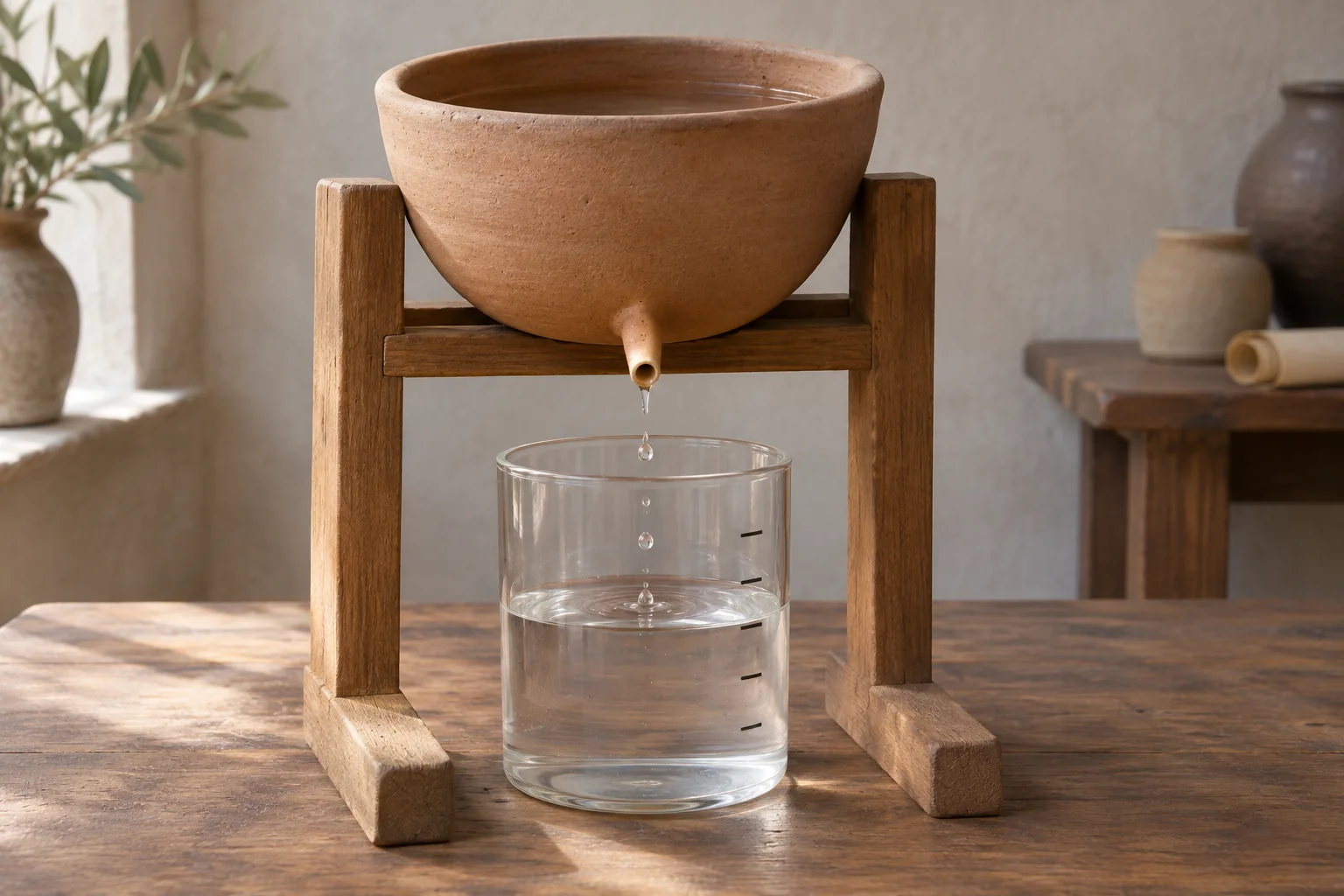
A water clock measures time by tracking water flowing into or out of a vessel. If the flow is predictable, the changing level can be compared with a scale. More elaborate versions use floats, gears or other mechanisms to turn water movement into a visible display or an audible signal. [1, 7]
Often called a clepsydra, this kind of clock does not need direct sunshine to work. Its central difficulty is different from a sundial's: water must move at a known rate, or its changing behavior must be allowed for in the scale. A leaking bowl becomes a clock only when its changes carry a reliable meaning. [1, 2]
What does a simple outflow clock measure?
Imagine a vessel filled to a starting mark, with a small outlet near its bottom. As water escapes, the level falls. Marks inside the vessel indicate how much time has elapsed since it was filled. The user is reading a changing quantity of water rather than following a rotating hand. [1]
The Science Museum Group's cast of an Egyptian water clock represents an alabaster original found at Karnak. Its account describes a small lower outlet and scales inside the vessel. Such an object connects a physical process, the falling water level, with an agreed way of dividing time. [5]
Not every ancient object identified with a water clock was necessarily a practical everyday instrument. The Metropolitan Museum describes its baboon-shaped example as a model, likely intended as a temple offering. Its drain hole illustrates the principle, while the museum's interpretation cautions against assuming every surviving object had the same use. [8]
Why does the water stop flowing at the same rate?
In a plain draining container, the height of water above the outlet decreases. That changes the pressure driving the flow. Under idealized conditions, Torricelli's theorem relates the exit speed to the square root of that height: v = √(2gh), where g is gravitational acceleration and h is the height difference. [3]
The equation explains why simply putting equally spaced marks on an arbitrary draining vessel need not produce equally spaced time intervals. A lower water level can mean slower discharge. The marks have to match the actual behavior, or the design has to address the changing driving conditions. [3, 4]
Real outlets also introduce resistance, so the ideal equation is an explanatory starting point rather than a calibration certificate. A narrow opening, a particular vessel shape and the actual liquid conditions form one physical system. Its observed timing matters more than assuming an ideal formula describes every detail. [3]
How do you turn a water level into a scale?
Calibration establishes what a reading means. Science World's educational activity uses a reference timer to mark the level reached in a receiving container at regular intervals. Once the starting conditions are reproduced, those marks can be used to estimate elapsed time in another run. [2]
This separates two questions: whether a level can be seen and whether it represents the intended interval. A clear container solves the first problem. Comparing the changing level with a known reference helps solve the second. Attractive markings alone cannot establish the clock's timing. [2]
Ancient divisions of time could also differ from today's equal hours. The Science Museum Group explains that the Karnak clock's internal scales corresponded to months, reflecting the division of changing periods of daylight and darkness into twelve hours each. Reading a historical scale requires understanding its intended convention. [5]
How can a reservoir make the flow steadier?
One approach is to keep the water level above an outlet approximately constant. Oxford's account describes an upper reservoir supplied faster than water leaves for the clock. Excess water overflows, maintaining the level. The lower receiving vessel then fills from a supply with a steadier driving pressure. [4]
The extra water is doing something useful even though it is not all being counted. It helps maintain a boundary condition: the height of the supplying water surface. Rather than accepting the changing head of a draining bowl, the arrangement continuously restores it. [4]
Historical engineering research also describes feedback arrangements in water-powered clocks. These systems address the broader problem of regulating a process as conditions change. A display can be elaborate, but its usefulness still depends on the behavior of the mechanism supplying the time signal. [7]
How does a float move a pointer?
A rising water level can lift a float. That motion can be transmitted to a display, avoiding the need to peer directly into the receiving vessel. Oxford's explanation describes floats driving geared indicators, converting a vertical change in water level into another readable movement. [4]
A 2021 engineering study examines historical designs with floats, ropes, weights and waterwheels. It distinguishes the power-transmission arrangements from mechanisms that display or report time. This distinction matters: what moves the machinery and what regulates its timing are related questions, but they are not identical. [7]
Can a clock work by sinking instead of draining?
Yes. A bowl with a small hole in its base can be placed on water and allowed to fill slowly. As water enters, the bowl sinks lower until it submerges. The repeated event can mark an interval without a hand sweeping around a dial. [6]
The Science Museum Group holds a copper sinking-bowl clock from Sri Lanka with a tiny, gold-bushed hole. Its collection record describes a submergence interval of approximately twenty-four minutes. That timing belongs to the recorded object, not to every perforated bowl placed in water. [6]
The example shows why water clocks need not all look alike. A falling level, a rising level and a sinking vessel can each provide an observable change. What unites them is the attempt to relate controlled water movement to a repeatable measure of elapsed time. [1, 6]
Why were water clocks eventually surpassed?
Maintaining a reliable liquid flow is difficult. Historical designs added regulation and increasingly elaborate displays, but NIST's account emphasizes flow control as a persistent limitation. Complexity in the figure or dial does not automatically improve the process that determines when a minute has passed. [1]
Water clocks nevertheless make the basic idea of timekeeping visible. A physical process changes, a mechanism or scale tracks that change, and calibration connects it with a time interval. The vessel is memorable, but the deeper invention is the attempt to make a natural process regular enough to measure. [1, 2]
Keep exploring
Compare time read from a shadow with time measured by flowing water, then explore the pressure differences that sustain a siphon.
Sources and further reading
Water-clock principles checked November 17, 2026, using museum object records, institutional explanations and a historical engineering study. The illustration is a generic demonstration, not a reconstruction of a named artifact.
- NIST — A Walk Through Time: Early Clocks (archived historical account)
- Science World — Water Clock: calibration activity
- OpenStax, College Physics — Applications of Bernoulli’s Equation and Torricelli’s theorem
- University of Oxford, Cabinet — Water clocks and constant-head supply
- Science Museum Group — Egyptian Water Clock: cast of the Karnak original
- Science Museum Group — Sinking Bowl Water Clock
- Mechanical Sciences — Historical development of water-powered mechanical clocks (2021)
- The Metropolitan Museum of Art — Clepsydra or water clock with squatting baboon
Keep exploring.
One remarkable idea at a time—nature, science, history and beyond.
Last updated November 20, 2026.

Barnakle Editorial Team
Barnakle Editorial Team is the collective byline used for Barnakle’s editorial articles. The contributor profile explains the team identity and links to the publication’s editorial policies.
More from the editorial team →