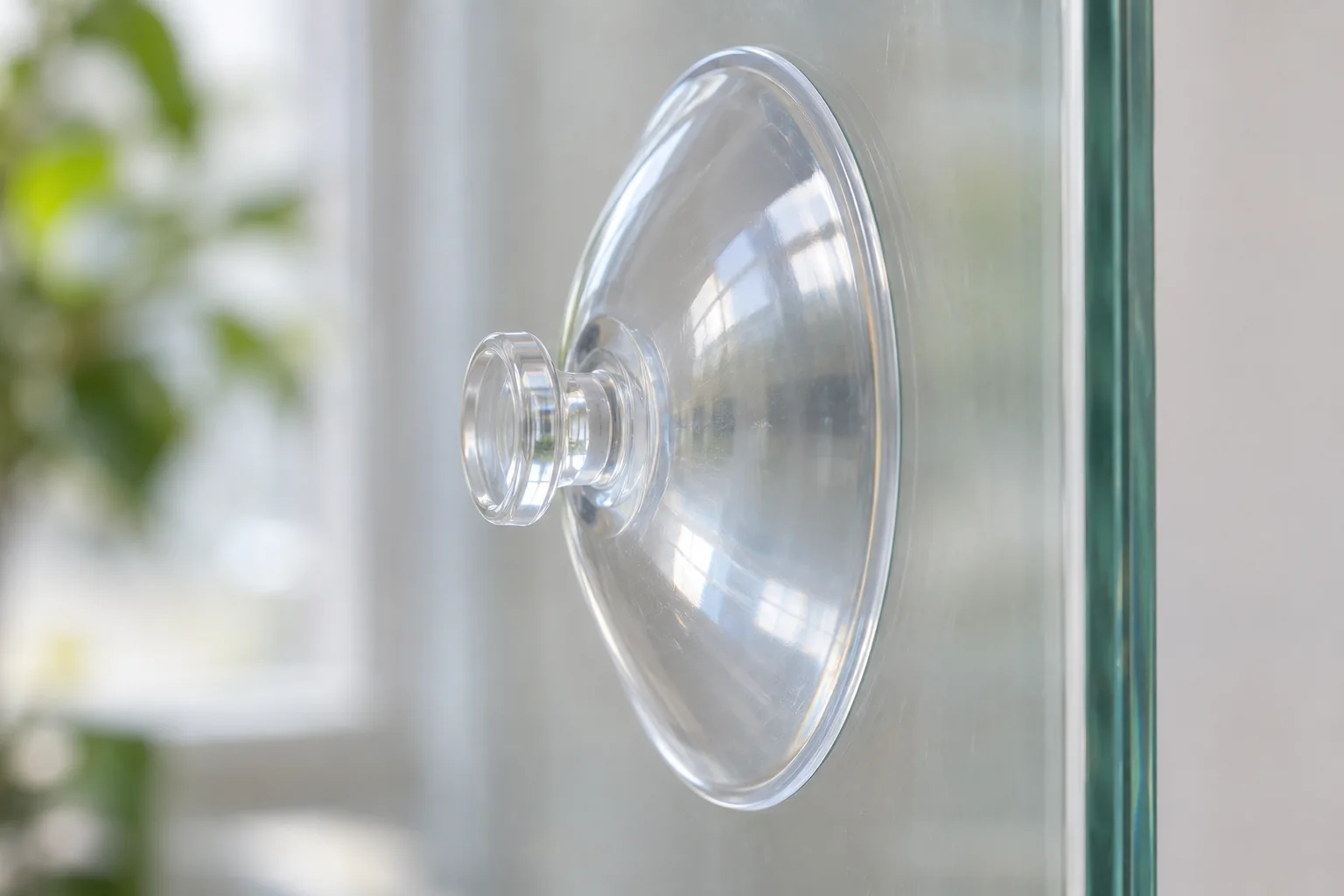
A suction cup sticks because pressure outside it is greater than pressure in the sealed space beneath it. That pressure difference presses the cup against the surface. A soft, conforming rim keeps air from immediately entering and erasing the difference. The cup therefore needs both a lower-pressure cavity and an effective seal. [1, 2]
The word “suction” can make the process sound like an invisible hand pulling from inside. Comparing the forces on the two sides gives a clearer explanation. The surrounding air is doing useful work because its pressure is no longer balanced by an equal pressure beneath the cup.
What happens when you press the cup?
Pressing a simple flexible cup flattens its dome and drives some air out from beneath it. Once the rim seals, the elastic cup tends to recover some of its shape. The trapped gas occupies a larger space than it did at the compressed stage, and the pressure inside can fall below ambient pressure. [1]
The final shape reflects a balance among the cup’s elasticity, the pressure difference and any applied load. A cup does not have to return to its original unloaded dome to work. Nor does it need to contain absolutely no air: a partial vacuum is enough to produce a pressure difference.
A useful sequence is therefore: deform the cup, let air escape, make a seal and allow elastic recovery to lower the enclosed pressure. Leaving out the sealing step would let surrounding air flow back in as the cup changed shape.
Why the rim must be soft
Even apparently smooth surfaces have small irregularities. An elastic rim can deform around some of them, increasing contact and restricting the paths through which air can enter. A rigid edge with gaps would struggle to isolate the cavity, regardless of how convincingly cup-shaped the object looked. [1, 4]
This is a contact problem as well as a pressure problem. The lip has to match the surface closely enough around a continuous boundary. A piece of dust, a groove or an unsuitable curve can interrupt that boundary. The whole visible face of the cup need not touch the surface, but its sealing region must do its job.
Imagine a circular fence intended to stop water. A single open gate can matter more than the total length of the intact fence. The analogy is imperfect, but it captures why a small local defect can determine the performance of a much larger cup.
How pressure and area set the ideal force
For a simple pressure model, the normal holding force is the pressure difference multiplied by the effective sealed area: F = Δp × A. Here Δp means outside pressure minus inside pressure. The relevant area is the effective area under vacuum, not necessarily every square millimeter of the cup’s outer footprint. [2]
Consider a hypothetical effective area of 10 square centimeters, equal to 0.001 square meters. If the pressure difference is 40,000 pascals, the ideal pressure force is 40 newtons. This is a calculated example, not a rating for the pictured cup or permission to suspend a particular object.
If that pressure difference stays constant, doubling the effective area doubles the modeled force. Doubling the diameter of a circular effective area would quadruple its area. Real changes in cup size can also change stiffness, deformation and sealing, so actual performance need not follow a single geometric comparison perfectly.
Why hanging a load on a wall is different
The pressure force chiefly holds the cup against the surface. A load hanging down a vertical wall introduces a force along that surface, known as shear. Friction and the detailed contact mechanics then matter. Schmalz lists suction force and shear force separately in its technical data for this reason. [3]
A protruding hook can also apply a turning effect that tends to lift an edge. The same weight positioned differently can therefore challenge a seal differently. A normal-force calculation alone does not describe every way a mounted cup might detach.
This separation is useful well beyond suction cups. “How strongly does it press against the wall?” and “How much downward sliding can it resist?” are related questions, but they are not interchangeable measurements.
Why do cups fall off later?
A seal can be good enough to hold initially while still allowing slow leakage. As air enters, the enclosed pressure rises, reducing the pressure difference. Eventually the available holding force may no longer balance the applied forces, or an edge may peel and allow a much larger leak. [4, 5]
A 2019 study tested soft PVC suction cups against roughened plastic surfaces and modeled airflow through narrow interfacial passages. Its results emphasize that surface roughness, cup stiffness, volume and material behavior can influence attachment lifetime. The finding is more detailed than simply saying that rubber gradually “loses its stickiness.” [4]
Time is therefore part of performance. An attachment that survives a brief tug has not necessarily demonstrated that it will remain sealed for hours. The initial pressure difference and its rate of loss both contribute to the outcome.
Why glass usually works better than rough wood
Smooth, nonporous glass often allows a continuous seal with little air passing through the material. Rough or porous surfaces can provide leakage paths around the edge or through the object itself. In industrial handling, a vacuum source may keep removing incoming air to compensate for some leakage. [5]
That active system differs from a small household cup that has only the pressure difference established when it was pressed into place. The industrial cup is connected to continuing energy input and airflow. Its success on a challenging surface does not demonstrate that an unpowered cup will behave the same way.
Research on hybrid cups adds materials such as a sealing gel to improve conformity on difficult surfaces. Such designs combine suction with other interfacial effects rather than making roughness cease to matter. [6]
Does water make suction cups work?
Water can change sealing and contact behavior, but it is not a universal substitute for a sound rim. Research on engineered wet microcups shows that liquid, elasticity and interfacial forces can work together in ways more complex than the simplest dry pressure model. Ordinary cups and specialized underwater structures should not be assigned one identical mechanism. [7]
This also sets a boundary on the familiar atmospheric-pressure calculation. A submerged system has surrounding water pressure and may involve additional liquid behavior. A result for a specialized wet adhesive is not automatically a performance claim for a transparent bathroom cup.
Why lifting the edge releases the cup
Peeling a small section of the lip opens a route between the cavity and its surroundings. Air can then flow into the lower-pressure region, allowing the pressures to approach equality. The large holding force can disappear without separating the entire rim simultaneously. [1, 5]
Other attachment methods rely on different physical interactions. Compare why glue sticks things together and how geckos walk on walls to see why two objects can both “stick” without using the same mechanism.
Questions about suction cups
Does the cavity need a perfect vacuum?
No. The important quantity is a pressure difference. Removing all gas is not required for an ordinary cup to hold. [2]
Would ordinary air-pressure suction work in an external vacuum?
With no useful outside gas pressure, the usual dry atmospheric-pressure mechanism has no comparable pressure difference available. Other adhesive interactions would be a separate question. [2, 7]
Why is an edge tab effective?
It helps break the seal locally, allowing pressure equalization instead of requiring a direct pull against the full normal holding force. [1]
What matters most?
A pressure difference creates the force, a conforming boundary preserves it, and the direction of the load determines how that force can be used.
Sources and further reading
Sources checked November 15, 2026. Abstracts and research syntheses are identified below where used; restricted full texts are not represented as fully reviewed.
- Japan Society of Mechanical Engineers, Fluids Engineering Division — Secret of Suction Cups
- Schmalz — Vacuum Suction Cups, pressure difference and effective area
- Schmalz — Technical Data of Suction Cups, suction and shear forces
- Tiwari and Persson (2019) — Physics of suction cups — research abstract
- COVAL — Suction Cup Performance, leakage and vacuum handling
- Soft Hybrid Suction Cup Capable of Sticking to Various Objects and Environments (2021) — research article
- Water as a glue: Elasticity-enhanced wet attachment of biomimetic microcup structures (2022) — research article
Keep exploring.
One remarkable idea at a time—nature, science, history and beyond.
Last updated November 16, 2026.

Barnakle Editorial Team
Barnakle Editorial Team is the collective byline used for Barnakle’s editorial articles. The contributor profile explains the team identity and links to the publication’s editorial policies.
More from the editorial team →