Conductive metal, a perforated screen, tuned seals and interlocks contain centimetre-scale electromagnetic waves
A microwave door lets you watch the food without offering the cooking waves an equally easy route out. The trick is scale. The viewing window includes conductive metal with openings that are small compared with microwave wavelengths but large compared with visible-light wavelengths. The window is only one part of the enclosure: the door edges and safety interlocks matter too.
A conductive enclosure redirects the field
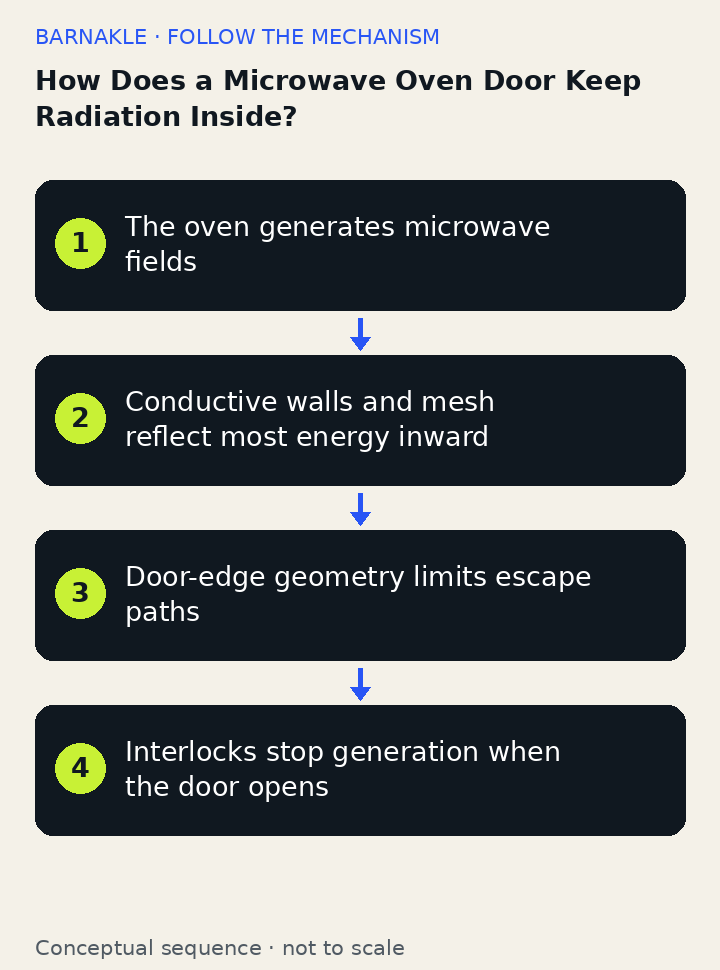
Conductive walls force electric charges to rearrange in response to the microwave field. The resulting currents largely reflect the energy inward, creating standing and travelling field patterns used to heat food.
Microwaves are non-ionizing electromagnetic radiation. In food, the oscillating field drives polar and ionic responses whose losses convert electromagnetic energy into heat. This does not make food radioactive. Spatial field patterns, moisture and other material properties help explain uneven heating.
An electromagnetic wave drives charge motion in a conductor. The resulting response strongly affects the field at the metal boundary and reflects much of the microwave energy into the cavity. This is a wave-and-material interaction, not a claim that a door screen can stop every possible form of radiation under every condition.
Sources: [1]
The window separates two very different wavelength scales
Domestic ovens operate near a frequency of 2.45 gigahertz, corresponding to a free-space wavelength of roughly twelve centimetres. Visible-light wavelengths are hundreds of nanometres, more than one hundred thousand times shorter.
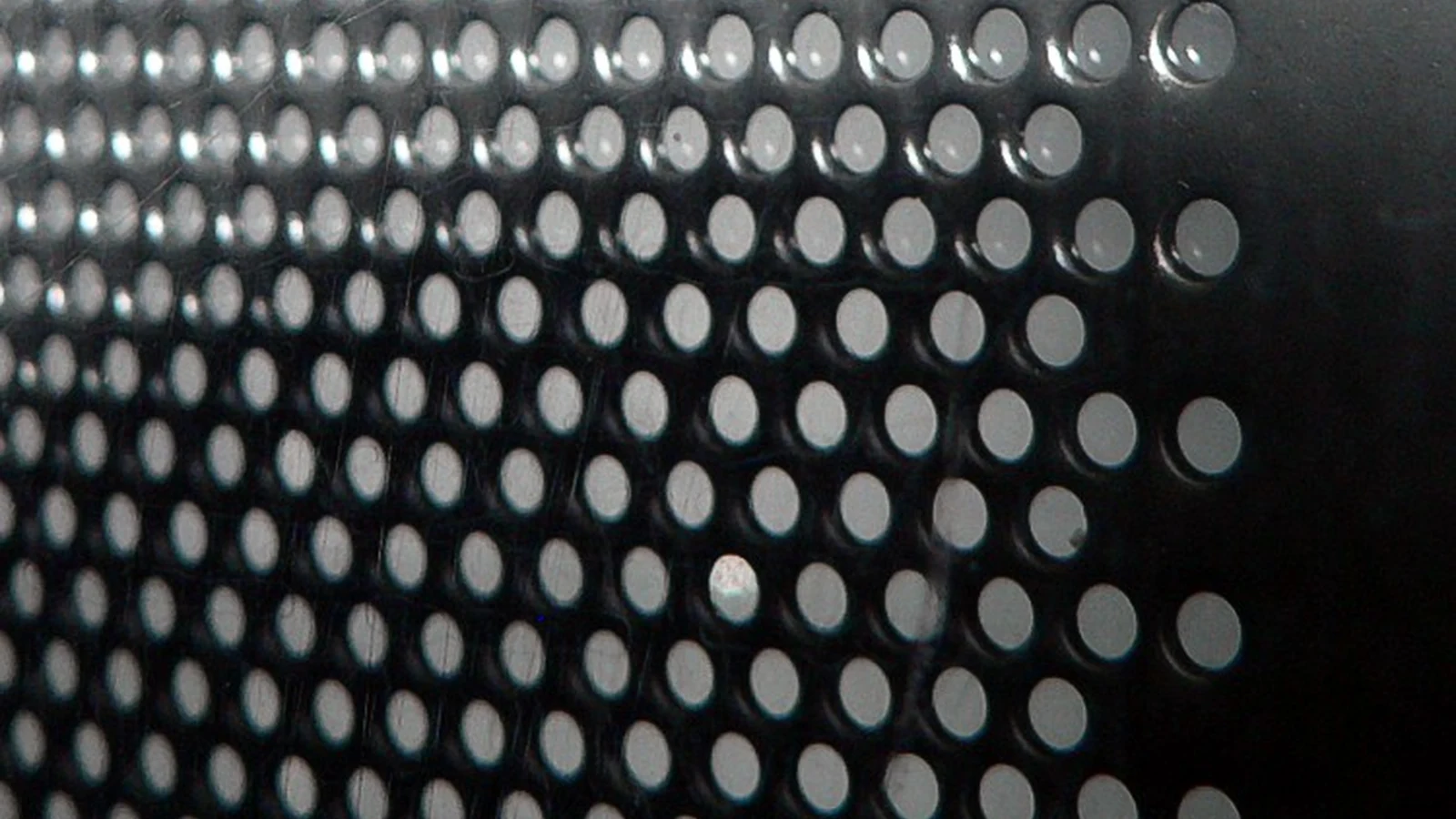
Perforations in the door screen are tiny relative to the microwave wavelength. At the oven frequency, that geometry strongly suppresses transmission through the screen. The explanation depends on the conductive material and the openings together, rather than the glass alone.
The same holes are enormous compared with visible wavelengths. Light rays from the illuminated cavity can travel through them, allowing an image to reach the eye even though part of the window area is opaque metal.
The comparison is between opening size and wavelength, not between the sizes of individual photons. Visible and microwave radiation both belong to the electromagnetic spectrum. Their wavelengths differ enormously, so the same perforated sheet can transmit enough visible light for viewing while strongly suppressing transmission at the oven's operating frequency.
The door perimeter needs its own engineering
The perimeter is a potential leakage path. Conductive surfaces, overlapping geometry, gaskets and radiofrequency choke structures create a high-attenuation boundary despite manufacturing tolerances and repeated opening.
A radiofrequency choke is a shaped feature around the door that helps suppress microwave leakage. Its dimensions and its position within the complete door assembly matter; it is not an ordinary gap filler or a part to adjust from a general explanation.
Bent hinges, contaminated sealing surfaces, damaged latches, severe corrosion or unqualified servicing can change door alignment and shielding. A damaged oven should be assessed according to manufacturer and safety guidance, not tested through improvisation.
A window with a sound mesh would not solve a large uncontrolled gap around the door. The full assembly therefore uses carefully designed conductive geometry and, in many designs, choke structures to reduce leakage at the perimeter. Hinges and latches keep that geometry aligned through repeated opening. An apparently small mechanical defect can thus have an electromagnetic consequence.
Sources: [2]
Interlocks prevent an open cavity from operating
Multiple switches monitor latch position. The control circuit removes power from the magnetron when the door is released, while monitoring arrangements are designed to respond if an interlock fails in an unsafe state.
The FDA describes requirements for independent interlocks and monitoring in U.S. microwave ovens. They are safeguards against microwave generation with an open door, not features to defeat for a demonstration. Stop using an oven with a damaged, badly closing door or one that appears to operate open, and seek manufacturer or qualified service advice.
Sources: [1]
Why an opening can transmit light but suppress microwaves
Imagine the holes in the viewing screen as part of a wave structure rather than a sieve catching tiny balls. A hole can be physically open and still transmit a long-wavelength field very poorly. Conversely, an intact-looking decorative outer layer does not establish that the hidden mesh, perimeter and latch arrangement are sound. The complete door is the useful unit of explanation.
The mesh, door perimeter and interlocks
| Term or component | What it means here |
|---|---|
| Viewing mesh | Permits viewing while strongly attenuating microwave transmission. |
| Door perimeter | Its geometry must limit another possible leakage path. |
| Interlocks | Stop generation when the door is opened as designed. |
A phone is not a microwave leakage meter
The black mesh does not absorb all microwave energy like a sponge, and the glass alone is not the primary shield. The conductive screen and the complete door-cavity geometry provide containment. A phone-reception experiment does not measure microwave leakage. A phone receiver is not a calibrated oven-leakage instrument, and whether it receives a signal cannot establish compliance with an exposure limit.
How microwave containment is tested
Engineers map electric fields, calculate waveguide cutoff and choke behaviour, and measure leakage around production doors with calibrated radiofrequency instruments. Regulators specify emission limits, interlocks, labels and endurance tests for manufactured ovens.
Microwave-door questions
How can the window transmit light while suppressing microwaves?
The conductive mesh has openings much larger than visible-light wavelengths and much smaller than the oven’s microwave wavelength. This strongly limits microwave transmission; it does not mean a real oven has mathematically zero leakage.
Can microwaves operate with the door open?
Interlocks are designed to stop microwave generation as the latch is released or the door opens. Stop using an oven that appears to operate with its door open and contact the manufacturer or a qualified service provider.
Can a scratched outer film cause leakage?
Door layers vary by model. GE identifies an inner plastic shield or film covering the screen and says it should not be removed. Follow the manufacturer’s instructions for any damaged film, mesh, latch, hinge or sealing surface.
The whole door assembly provides protection
The dark mesh explains how seeing and shielding can coexist, while the perimeter and interlocks explain why the entire door must remain intact. Microwaves are non-ionizing electromagnetic waves; they can still heat tissue at sufficient exposure. Do not infer safety from a phone experiment or attempt a home leakage test with improvised equipment.
Continue exploring
Sources and further reading
Keep exploring.
One remarkable idea at a time—nature, science, history and beyond.
Last updated November 6, 2026.

Barnakle Editorial Team
Barnakle Editorial Team is the collective byline used for Barnakle’s editorial articles. The contributor profile explains the team identity and links to the publication’s editorial policies.
More from the editorial team →