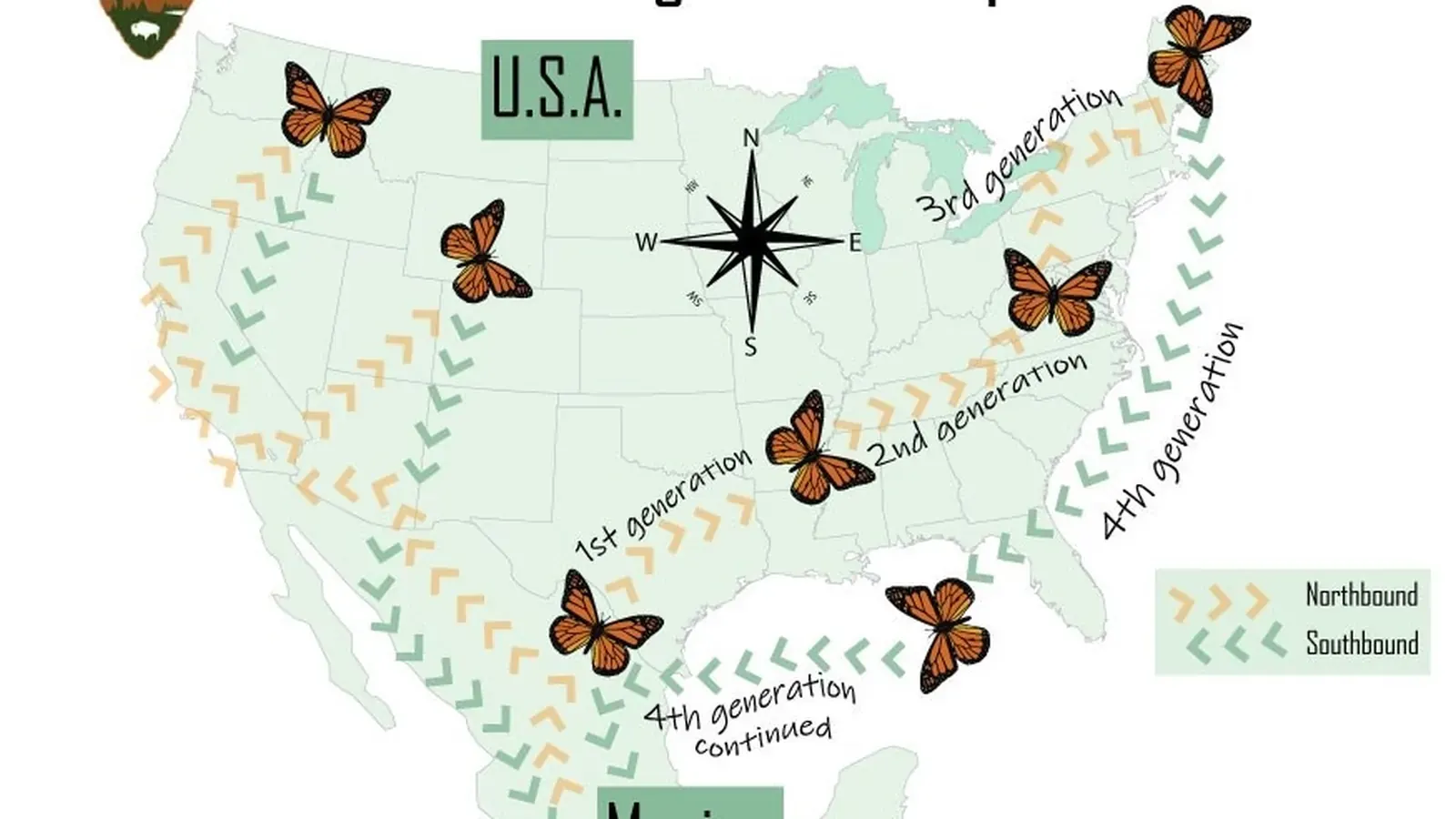
The autumn migration of eastern North American monarch butterflies includes animals travelling towards overwintering areas they have never visited. Experiments show that their orientation uses information from the sky together with internal timing. Researchers have also investigated magnetic cues that can support direction finding.
These mechanisms help explain a journey, but they should not be mistaken for evidence that a butterfly carries a complete satellite-style map of the continent.
The Sun moves while the butterfly travels
The Sun's apparent direction changes during the day. An animal following one fixed angle to it would change its compass direction as the hours passed. A time-compensated sun compass accounts for that changing relationship.
The Reppert laboratory's work links directional skylight input with processing in the brain. The relevant information can include aspects of daylight beyond simply locating a bright disc in a clear sky.
Antennae contribute biological timing
Studies of monarch orientation identify circadian clocks in the antennae as important to time compensation. Experimental changes to timing can alter the direction in which butterflies orient under controlled conditions.
The antennae are therefore doing more than sampling odours. However, a circadian clock alone is not a compass. It supplies timing information that must be combined with a directional cue.
Magnetic experiments test another source of direction
A 2014 study examined a light-dependent inclination compass. By manipulating the magnetic field around tethered monarchs, researchers tested whether its geometry influenced their orientation.
The findings supported a magnetic contribution when suitable daylight direction cues were unavailable. They also suggested a role for the antennae. This is a specific experimental result, not evidence that monarchs detect every environmental magnetic variation or use a human-style north-seeking needle.
A compass is not a position fix
Knowing a useful direction does not establish exact geographic location. A map sense would provide different information, such as how an animal's current position relates to a destination.
Subsequent research found no evidence for a particular fine-scale magnetic map sense in fall migrants. That negative result does not erase compass findings; it separates two questions that are often combined in simplified accounts of migration.
A successful migration needs more than a heading
Wind, temperature, fuel, habitat and opportunities to rest influence the actual route. Laboratory orientation experiments isolate mechanisms, while field observations reveal movement through a changing landscape. Neither alone describes every part of the journey.
The strongest explanation connects inherited migratory behaviour, learned or current environmental information and the physiological condition of the butterfly. Monarchs demonstrate how an animal can maintain useful direction over long distances without the evidence requiring it to know a precise electronic-style coordinate at every moment.
Explore a related question
How Do Migrating Birds Find Their Way?
Sources and further reading
Keep exploring.
One remarkable idea at a time—nature, science, history and beyond.
Last updated October 27, 2026.

Barnakle Editorial Team
Barnakle Editorial Team is the collective byline used for Barnakle’s editorial articles. The contributor profile explains the team identity and links to the publication’s editorial policies.
More from the editorial team →