Sunlight carries momentum. When photons strike and reflect from a suitable surface, they exert a small force. A solar sail uses a large, lightweight reflective membrane to turn that force into propulsion.
The effect is real, but it is gentle. Solar sailing is best understood as accumulating a change in motion over time, not as a sudden rocket-like burst of acceleration.
Light pressure is different from solar wind
A conventional reflective solar sail responds to photons. The solar wind is a flow of charged particles and is a different phenomenon. Some proposed propulsion systems interact with those particles, but that is not the operating principle of an ordinary light sail.
This distinction matters because the sailing-boat analogy can suggest that a stream of gas pushes the membrane. The useful comparison is momentum transfer; the physical carrier in this case is light.
A large area helps a small force
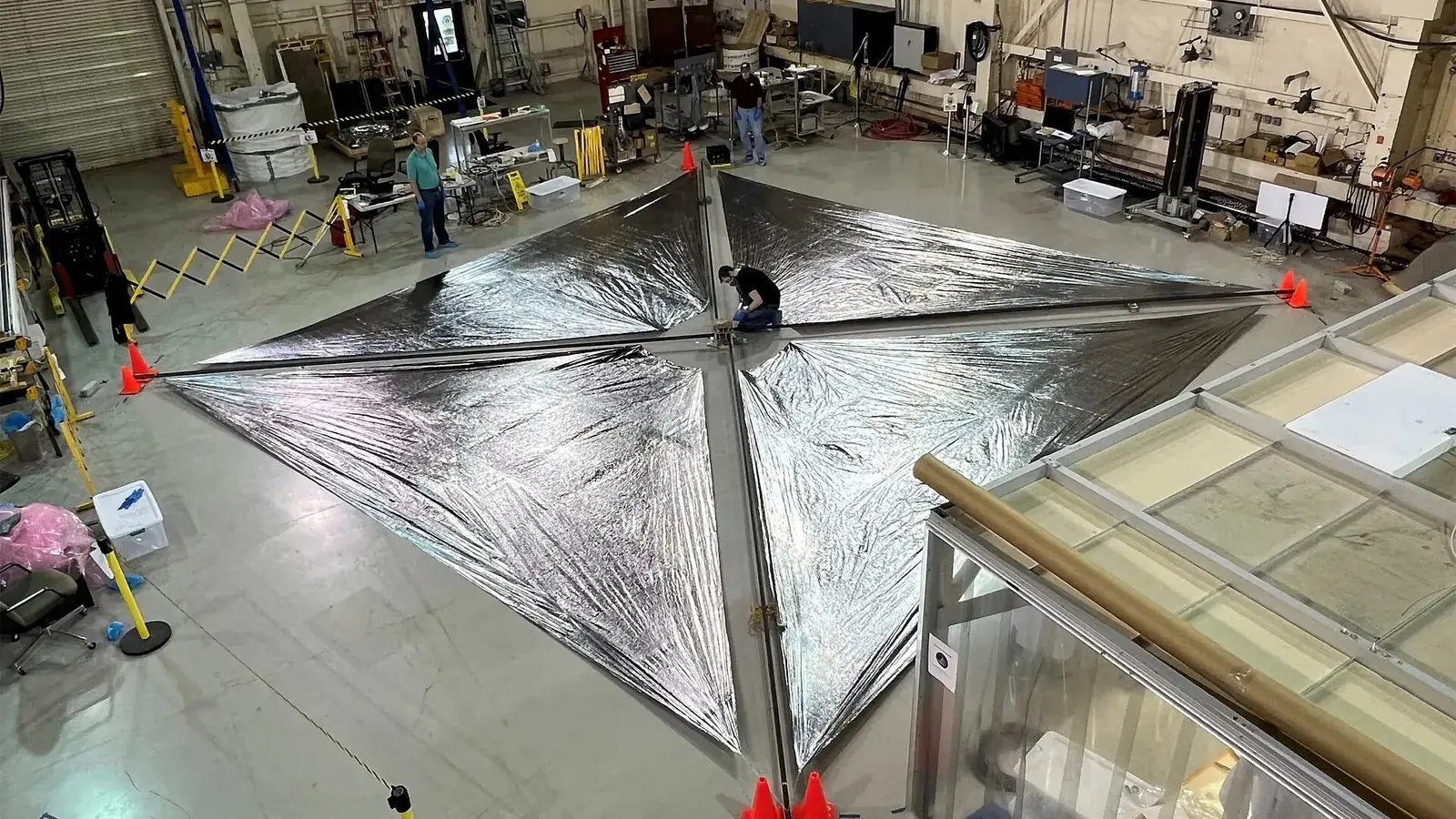
The acceleration depends on the available force relative to the spacecraft's mass. Engineers therefore seek sails with a large illuminated area and low total mass, while still providing supports, deployment hardware and control.
A thin membrane that works in a calculation must also survive folding, launch and deployment. Wrinkles, shape changes and imperfect reflectivity affect performance. The challenge is a complete spacecraft system rather than simply finding the shiniest material.
Steering changes the orbit
Changing a sail's orientation changes the force acting on the spacecraft. A component along or against orbital motion can add or remove orbital energy, allowing a trajectory to evolve over time.
A sail cannot simply point directly at the Sun and pull itself inward against gravity. Solar-sail navigation uses the dynamics of an existing orbit and the direction of the small applied force. NASA's propulsion material describes inward and outward spirals produced through trajectory control.
The push weakens with distance
For a fixed sail orientation and optical behaviour, sunlight intensity falls approximately with the inverse square of distance from the Sun. Twice the distance means roughly one quarter of the incident power per unit area, and a corresponding reduction in available radiation pressure.
Other constraints become important near the Sun, including temperature and material behaviour. More illumination is useful only if the spacecraft can operate under those conditions.
Flight tests establish what is achievable
JAXA's IKAROS mission demonstrated sail deployment and reported confirmed photon-pressure acceleration in 2010. It also tested attitude control using devices that changed the sail's optical response.
Such demonstrations test specific hardware and operations. They do not show that every proposed interstellar sail design is ready to fly. The established principle is that sunlight can supply sustained thrust without expelling onboard propellant for that thrust. Launch, control and the rest of the spacecraft still require engineering and energy.
Explore a related question
How Scientists Return Samples from Asteroids
Sources and further reading
Keep exploring.
One remarkable idea at a time—nature, science, history and beyond.
Last updated October 27, 2026.

Barnakle Editorial Team
Barnakle Editorial Team is the collective byline used for Barnakle’s editorial articles. The contributor profile explains the team identity and links to the publication’s editorial policies.
More from the editorial team →