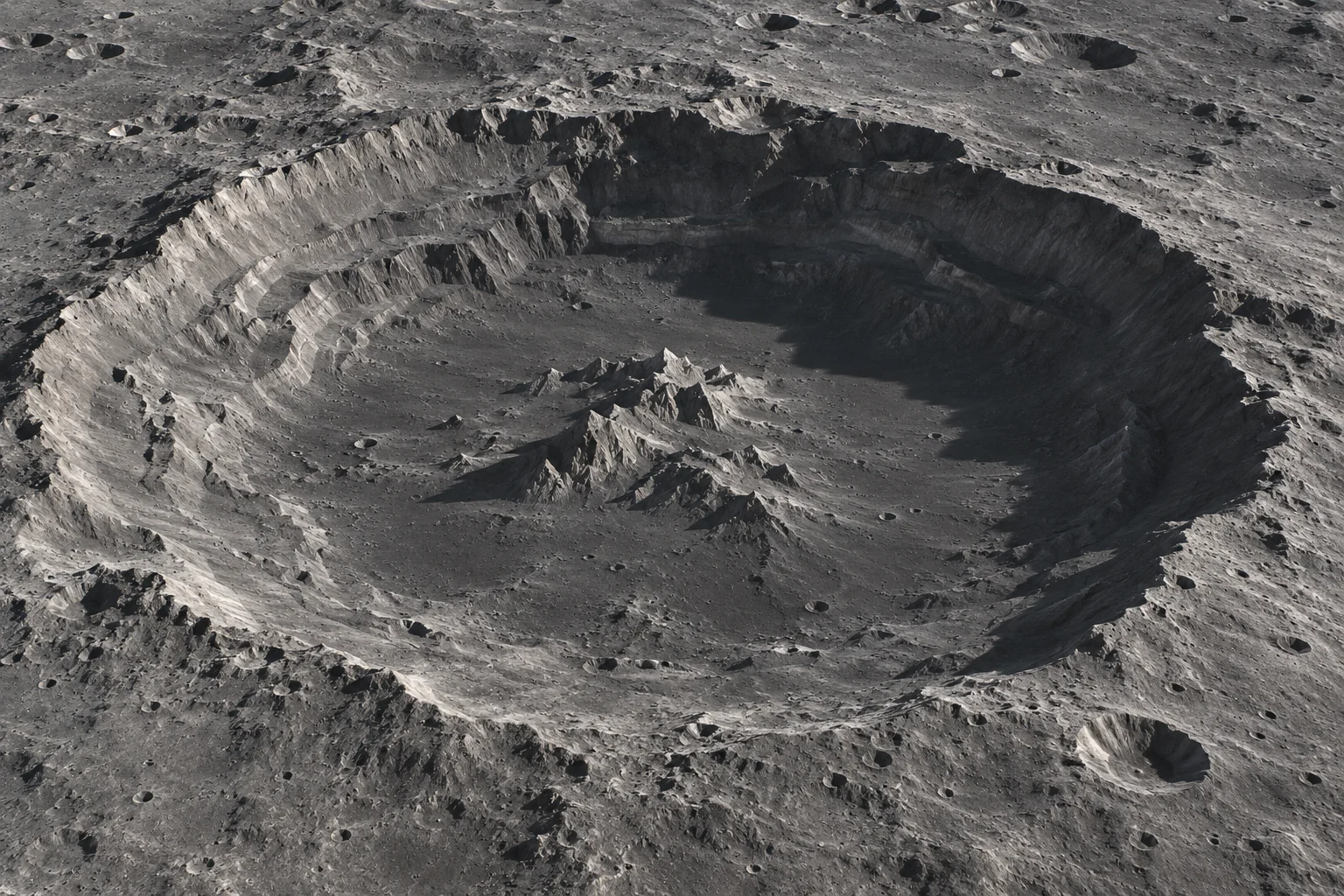
Look across a large lunar crater at sunrise and the deepest part of the scene may seem to contain a small mountain range. The mountain and the hollow can date from the same impact. First, a fast-moving object opens a cavity in the Moon. Then the walls slump and material under the centre rises as the cavity collapses. In a crater of the right size, some of that uplifted lunar rock remains standing above the surrounding floor. Astronomers call it a central peak, even when the summit breaks into several separate knobs. [1, 2, 3]
The missing stage in a picture of a hole
Imagine taking two snapshots of the same crater, one just after excavation and one after the ground has settled. The first would show a temporary cavity. Rock has been displaced, crushed and flung outwards. Some material has melted. The projectile's energy has gone into a much larger volume than the object itself once occupied. You would already recognize a hole in the ground, but measurements of its width, depth and slopes would describe a shape that could not last. [1, 2]
The second snapshot would show what gravity and the damaged rock did next. Blocks on the walls have moved down and in. Rock below the centre has risen, carrying formerly buried material closer to the surface. Impact melt and debris can occupy the floor around the uplift. Scientists call this part of the event modification. Leaving it out would be like trying to reconstruct a collapsed sandbank from the cut that first made its face too steep. The cut explains why the material moved, but its initial outline is gone. [1, 2]
Following one piece of target rock makes the distinction clearer. Some lunar material travels out of the cavity and lands beyond the rim as ejecta. Other material can stay within the crater and move upwards as the floor changes shape. A central peak belongs to that second story. Its position in the middle can tempt a viewer to imagine a surviving piece of the asteroid marking where it landed. What the peak exposes is a section of the Moon itself, intensely disturbed and brought up during the impact. [1, 2, 4]
Why small craters keep their bowls
Across the lunar surface are small craters that look remarkably like scoops. They can have raised rims and debris on their floors without developing a prominent central mountain. A larger temporary cavity has taller, less stable walls and undergoes more extensive collapse. Terraces, a relatively broad floor and a central uplift are characteristic features of a complex impact crater. Relative to its width, such a crater can be shallower than a smaller simple crater. A bigger impact can leave both a more prominent mountain and a less sharply cupped hollow. [1, 2]
Size is a guide to how much modification to expect, not a precise ruler for the height of a particular peak. Compare Tycho and Copernicus. NASA describes Tycho as roughly eighty kilometres across and its central summit as about two kilometres above the floor. Copernicus spans approximately ninety-three kilometres, yet its tallest central summit rises only about one kilometre above its floor in the Lunar Reconnaissance Orbiter Camera team's account. Looking only at which rim spans the greater distance would give the wrong prediction about which summit stands higher above the floor. [3, 4]
Three heights at Tycho
In a striking oblique view of Tycho, low sunlight throws a long shadow behind the central massif. NASA gives the height from floor to rim as about 4.7 kilometres. Set an imaginary zero on the floor and the summit reaches about two kilometres on that scale. The rim is still considerably higher. The two numbers answer an easily overlooked question: how can a mountain seem to tower over a crater in a photograph while remaining tucked deep inside it? The camera sees a substantial rise measured from a low starting point. [3]
The side-on view also reveals why the singular word peak can mislead. Tycho's central complex stretches about fifteen kilometres across in the direction shown in the NASA view. A near-vertical image compresses this group into a bright irregular patch inside a much larger circle. An oblique view separates ridges and slopes. Neither camera angle alone is a height measurement. To compare summits it helps to specify the reference surface and use measured topography as well as the shadows that first caught your eye. [1, 3]
What the mountain brings within reach
The rise of the centre gives planetary scientists a view into material once buried beneath the local surface. Spectrometers aboard spacecraft can measure sunlight reflected from exposed slopes at different wavelengths. Minerals absorb light in different patterns, which lets researchers compare the composition of a central outcrop with the material surrounding the crater. Work using data from the Clementine mission used central peaks in multiple craters to investigate the mineral makeup of the lunar crust. The method draws on two kinds of evidence together: what the light indicates and how that rock arrived at the surface. [4, 5]
At Copernicus, remote measurements identified material rich in olivine in the central peaks. That observation raises a further question about the rock's history. Olivine can be relevant to interpretations involving deep material, but finding it does not by itself settle whether the source was mantle or a body of magma that crystallized within the crust. A photograph supplies the setting. Mineral spectra narrow the possibilities. Models of the impact and the structure of the surrounding crust help researchers assess which origins fit. [4, 5]
There is one more trap in the idea that ever larger impacts simply make ever taller mountains. At basin scale the central uplift itself can become unstable and collapse. Rings of mountains can then be a more conspicuous part of the final landscape than a single central summit. Crater forms on the Moon preserve different outcomes of excavation and collapse. They are not a family of identical bowls enlarged to different scales. [1, 2]
When you next see a lunar crater photograph, try tracing the route from the rim down the wall, across the floor and back up the central slope. The terrace beneath the rim and the rise in the middle record different directions of movement in the same event. The flat stretch between them records yet more rearrangement. Read in that order, the mountain stops looking like something stranded in a hole. It becomes evidence for a brief stage when much of the hole itself was moving. [1, 2, 4]
Related reading
- What Causes Moonquakes, and Why Can the Shaking Last So Long?
- Why Does a Meteorite Have a Thin Fusion Crust?
Sources
- NASA — Moon craters
- Lunar and Planetary Institute — Impact cratering
- NASA — Tycho crater’s central peak
- Lunar Reconnaissance Orbiter Camera — Copernicus central peak
- Tompkins and Pieters — Mineralogy of the lunar crust from Clementine
Keep exploring.
We’ll email you when the first edition is ready.
Last updated November 26, 2026.

Barnakle Editorial Team
Barnakle Editorial Team is the collective byline used for Barnakle’s editorial articles. The contributor profile explains the team identity and links to the publication’s editorial policies.
More from the editorial team →