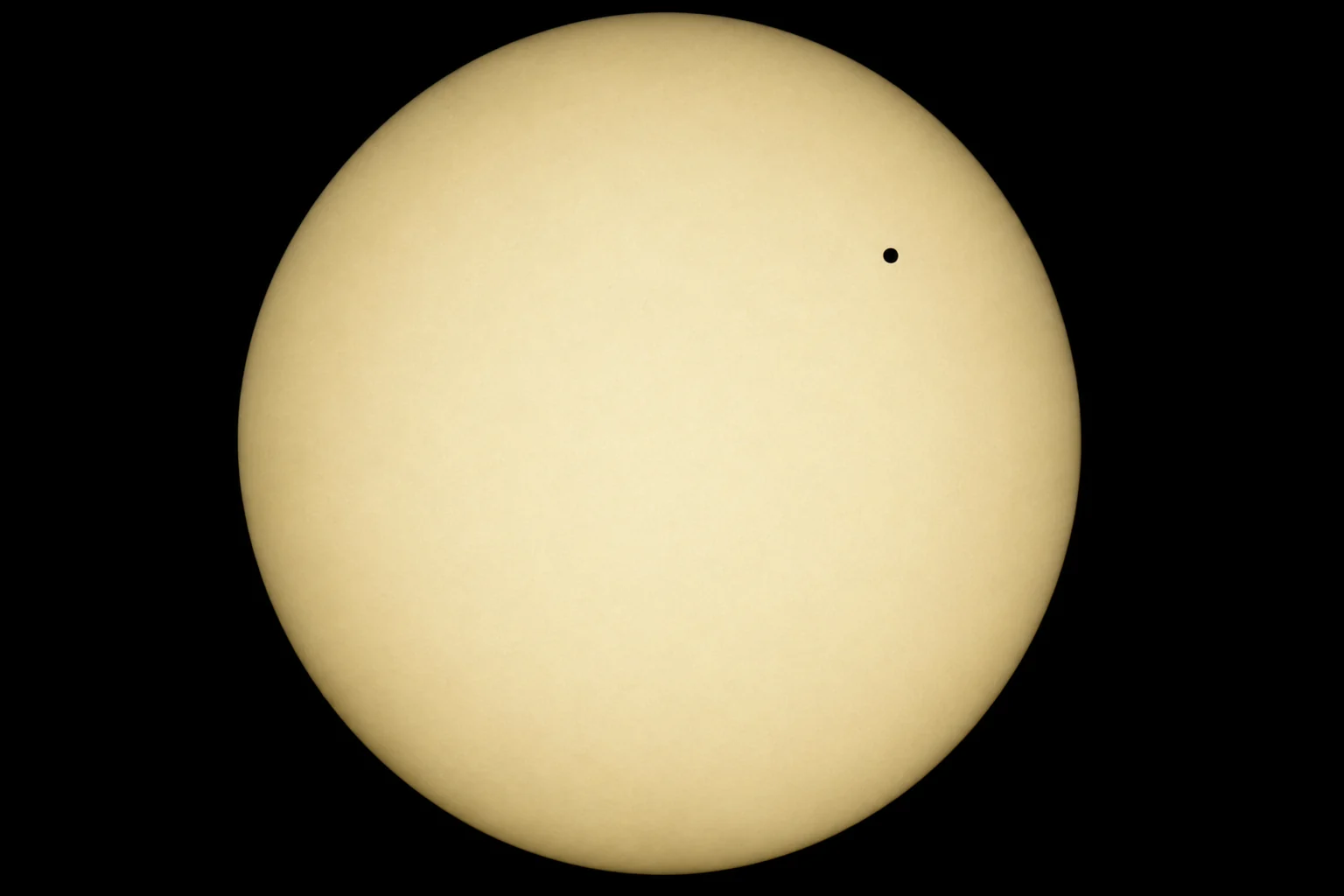
Guillaume Le Gentil set out for India to watch a black dot cross the Sun. War frustrated his plans for the transit of Venus in 1761. He stayed abroad for a second chance eight years later. This time he reached his observing site, but rain spoiled the view. The astronomers who did see the little dot were trying to answer an enormous question. How far away is the Sun?[1]
Venus offered a way to measure that distance because observers far apart on Earth saw it follow slightly different tracks across the solar disk. They could time its passage, compare their records and use the known separation of their observing sites to set the scale of the solar system. A single exquisite drawing from one place couldn’t do the same job. The difference between two views was the measurement they needed.[1, 2]
A solar system with a missing scale
Imagine a carefully drawn map with every town in the right place but no scale in the corner. You can say one road is twice as long as another. Give the mapmaker one reliable distance in kilometres, and suddenly every road can be measured. Astronomers faced a version of this problem. The time each planet took to orbit the Sun gave them a way, through Kepler’s laws, to calculate the relative sizes of their orbits. Converting those proportions into miles was another matter.[1, 2]
Venus was well placed to help. It travels around the Sun inside Earth’s orbit and occasionally comes directly between us and the Sun. From Earth it then appears as a little dark disk against a much larger bright one. On most passes the tilt between the two orbital planes carries Venus above or below the Sun as we see it. A transit calls for an alignment in two directions, which explains why astronomers could predict one yet still spend a lifetime waiting for it.[2, 3]
Two observers get different tracks
To see the principle without looking at the sky, hold up your thumb in front of a distant door frame. Close one eye and then the other. Your thumb seems to shift sideways relative to the frame. Move your thumb nearer your face and the jump grows. The distance between your eyes has stayed the same. The apparent shift, called parallax, contains information about the distance of the nearer object.[1, 2]
For a transit, imagine your two eyes placed thousands of kilometres apart on Earth. Venus is the nearer object, and the disk of the Sun supplies the backdrop. The Sun itself is at a finite distance, which the calculation must allow for. One observer sees Venus trace a line slightly closer to the Sun’s apparent centre than another observer does. Draw two parallel cuts across a round loaf and the one closer to the centre is longer. The same geometry gives the two transit tracks different lengths.[1, 2]
Edmond Halley suggested using the duration of the crossing. If Venus travels a longer apparent path across the Sun, the interval between entering and leaving will generally be longer, with the precise difference depending on the sites and viewing geometry. Measuring elapsed time is particularly convenient. Two observers using Halley’s approach can each measure a duration with a local clock. They do not have to meet beforehand to set their clocks to the same minute.[1, 2]
Why a single cloud could matter
Halley’s method required observers to catch the beginning and end of the passage at a suitable site. Joseph-Nicolas Delisle promoted another approach. Observers could compare when a particular contact occurred from accurately located stations, provided their times could be related to a common reference. A break in the clouds at just one end of the transit could still produce a usable observation. The trade was practical. One method placed a premium on seeing both ends, the other on knowing positions and times precisely.[1]
The geography was unusually demanding for an experiment whose subject was visible across much of a hemisphere. Astronomers wanted stations sufficiently far apart to produce a measurable difference, with the Sun above the horizon at the right moments. Additional stations offered insurance against bad weather. A reliable notebook from a distant observatory might therefore be worth more to the calculation than a dozen excellent observations made side by side. Le Gentil’s experience shows how quickly a promising point on a map could yield nothing at all.[1, 2]
The black drop that spoiled the timing
Even under clear skies, deciding when to stop the clock was surprisingly difficult. Near the moment when Venus had just moved fully onto the Sun, some observers saw a dark neck connecting the little round planet to the Sun’s edge. The neck appeared to stretch and then break. Which instant should count as separation? Near the end of the transit the effect could play out in reverse. Two conscientious people at adjacent instruments could report different times.[2]
This “black drop” has an optical explanation. Brightness falls off toward the edge of the visible Sun, and a telescope blurs fine detail by a small amount. Together those effects can make the gap between the dark silhouettes look pinched. The uncertainty could turn a hoped-for precision of seconds into something closer to a minute. Combining observations made the transit valuable, but recording an extra digit on a clock could do nothing to sharpen the boundary seen through the eyepiece.[2]
The distance the clocks were chasing
Astronomers today use an astronomical unit equal to exactly 149,597,870,700 metres, roughly 150 million kilometres. It is a defined unit of length. Earth’s actual distance from the Sun varies as the planet follows its slightly elliptical orbit. The number gives a sense of the scale eighteenth-century observers were trying to recover from the passage of a dot across a circle.[4, 5]
The last two transits of Venus occurred in 2004 and 2012. The next pair will be in December 2117 and December 2125. What Le Gentil missed was more than an unusual view of a familiar planet. It was a brief opportunity for people standing on different parts of a moving Earth to use that separation as the measured side of a triangle stretching out into space.[1, 3]
Related reading
- Why Does Venus Look Bigger When It Is a Crescent?
- How Did a Blinking Star Reveal the Rings of Uranus?
Sources
- Smithsonian Libraries — The worldwide transit expeditions of 1761 and 1769
- Royal Astronomical Society — Transit geometry, observing campaigns and the black drop
- NASA — Solar paths of the 2004 and 2012 transits of Venus
- NASA Jet Propulsion Laboratory — The astronomical unit in metres
- NASA Science — Earth’s orbit and distance from the Sun
Keep exploring.
One remarkable idea at a time—nature, science, history and beyond.
Last updated November 25, 2026.

Barnakle Editorial Team
Barnakle Editorial Team is the collective byline used for Barnakle’s editorial articles. The contributor profile explains the team identity and links to the publication’s editorial policies.
More from the editorial team →