A slow-loading spring produces an extraordinarily fast underwater strike
A peacock mantis shrimp can break open a hard shell with a movement that is difficult to follow at ordinary video speed. The apparent contradiction is the interesting part: the animal does not need a muscle that contracts at the full speed of the final strike.
Instead, it separates energy storage from energy release. The muscle prepares the system; a spring and latch make the brief movement possible. Understanding that sequence is more informative than comparing the animal to a bullet or calling it the strongest creature on Earth.
First, which mantis shrimp are we talking about?
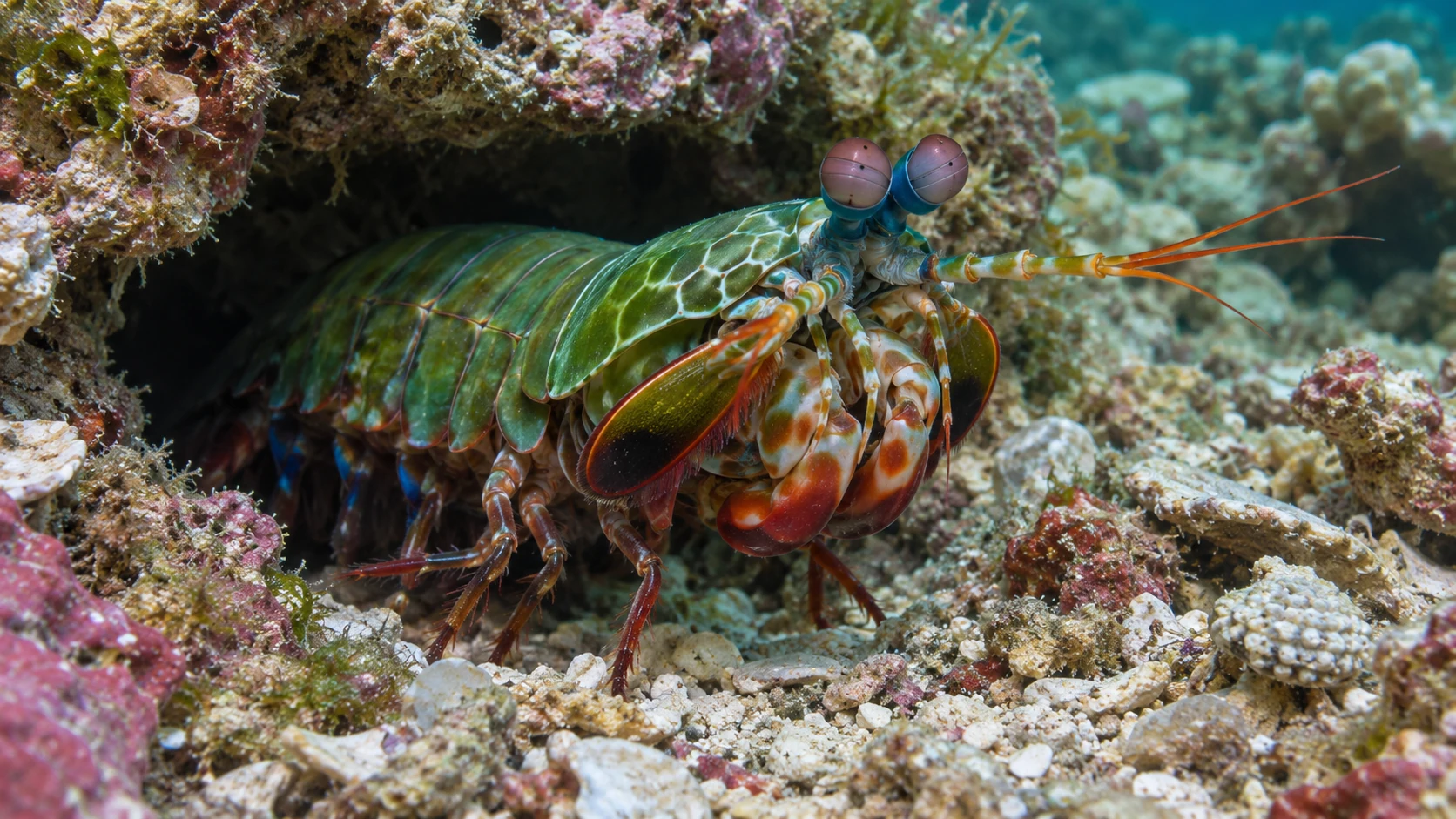
Mantis shrimp are stomatopod crustaceans with specialized prey-catching appendages. Their diversity includes forms with hammer-like striking parts and forms with spear-like structures. The familiar shell-smashing example is the peacock mantis shrimp, Odontodactylus scyllarus.
The Natural History Museum distinguishes these different approaches to capturing prey. “Mantis shrimp punch” is a convenient phrase, but it should not turn every species into an identical miniature boxer. [1]
The distinction matters to the mechanics. A structure suited to striking a hard shell and one suited to reaching or spearing prey face different demands. Similar ancestry does not mean identical performance, targets or behaviour.
Why muscle alone is not the whole explanation
A muscle can do work over a loading period, putting energy into an elastic structure. That stored energy can then be released in much less time. The movement’s instantaneous power can consequently exceed what the loading muscle could supply directly at that instant.
The Patek Lab describes this class of mechanism as latch-mediated spring actuation. The muscle, spring and latch have different jobs. In some fast systems, relatively slow, forceful muscle contraction is exactly what allows a powerful spring to be loaded. [2]
Think of drawing a bow. Your arm can load it over a noticeable interval; the release is much quicker. The spring has not created energy from nothing. It has changed the time over which stored energy is delivered.
For the shrimp, that distinction separates three measurements people often mix up: energy, the amount transferred; power, the rate of transfer; and force, the interaction at a particular moment. A spectacular value for one is not automatically the same kind of record for the others.
The spring is part of the exoskeleton
The classic 2004 study of the peacock mantis shrimp linked its rapid strike to elastic energy storage, including a saddle-shaped exoskeletal structure. High-speed imaging also revealed bubbles forming and collapsing near the prey during strikes. [3]
This is a biological spring, not a hidden metal coil. Its material and geometry allow it to deform during loading and release energy as the mechanism moves.
A later study of the saddle investigated its layered, biomineralized construction. Combining different material properties with the saddle’s shape helps it function as an elastic component while managing stresses during deformation. [4]
That is an engineering lesson worth separating from the animal’s reputation. A spring does not have to look like the coil in a pen. Shape and material arrangement can create useful elastic behaviour in structures that look very different.
The latch gives loading and release different schedules
If the appendage simply moved while the muscle was trying to load the spring, energy storage would be harder to control. A latch allows the mechanism to remain held during preparation and then release.
The Patek Lab’s account describes a system combining exoskeletal springs, latches and a four-bar linkage. The linkage helps convert movement within the mechanism into the rapid motion of the striking appendage. [5]
In a simplified sequence, the animal loads, holds and releases. Those verbs describe functions rather than an exact diagram of every tissue. A useful introductory model should make the sequence clearer without pretending the appendage is an ordinary door latch attached to a household spring.
| Stage | What happens? | Why it matters |
|---|---|---|
| Loading | Muscle does work on elastic structures | Energy can accumulate before visible motion |
| Holding | A latch restrains the prepared mechanism | Preparation and release can occur on different timescales |
| Release | The spring-driven mechanism accelerates the appendage | Stored energy is delivered rapidly |
| Impact and fluid response | The club strikes and cavitation can follow | The target experiences more than a simple slow push |
What is cavitation?
Cavitation involves the formation of vapour cavities when local pressure falls sufficiently, followed by collapse as conditions change. In the mantis shrimp’s strike, extremely rapid motion through water can create this fluid response near the appendage and target.
Measurements combining high-speed imaging with force and acoustic sensors helped distinguish the force of direct contact from the force associated with bubble collapse. The Patek Lab reports these as separate components of the striking event. [5]
The bubble is not a balloon of air that the shrimp breathes out before punching. Nor does the explanation require the entire surrounding water to reach ordinary boiling temperature. Local pressure changes are central to the mechanism.
A review by the researcher describes the strike as a cascade of energy release across very different timescales, ending in rapid cavitation-bubble collapse. The emphasis is on a sequence of physical events, rather than one magical instant. [6]
How fast is the punch, really?
Reported speed depends on the species, individual, strike conditions and measurement. The peacock mantis shrimp studies established extremely fast movement in water; they did not establish one number that every mantis shrimp must reproduce.
Comparative research measured spring mechanics across 12 species with different appendage forms. It found meaningful variation in spring contributions and performance, illustrating why one famous smasher cannot stand in for the whole group. [7]
A useful way to read a dramatic statistic is to ask four questions: what was measured, on which species, under what conditions, and was it a peak or an average? A maximum tip speed, a peak force and a comparison to body weight answer different questions.
This also avoids misleading bullet comparisons. A bullet has its own mass, speed and collision conditions. Saying that two objects are “like” one another in one respect does not make their energy or damage equivalent.
Why does the club not simply shatter?
Delivering repeated impacts creates a materials problem for the striker as well as the target. The club’s internal organization matters alongside its outer shape.
A 2025 study used laser-ultrasonic measurements and numerical simulations to investigate the club’s response to stress waves. It identified phononic properties associated with filtering damaging high-frequency components. [8]
Northwestern University’s account of that work distinguishes this wave-filtering behaviour from simply making a harder impact surface. The layered structure affects how mechanical disturbances travel through the material. [9]
“Shield” in this context is a description of a material function. It does not mean the animal is indestructible or protected by an invisible force field. It means that the structure can influence the propagation of particular stress waves.
For another biological impact problem, see how woodpeckers withstand repeated impacts. The animals face different motions and materials, so one mechanism should not be copied wholesale into the explanation of the other.
What researchers actually have to measure
A normal camera can miss most of the event. Researchers therefore combine methods: imaging to reconstruct movement, sensors to record force or sound, and models to test whether proposed mechanical arrangements explain the observations.
The 2004 imaging study and subsequent measurements illustrate why a visible shell break alone cannot identify the full mechanism. The shell tells you an outcome occurred; the synchronized measurements help distinguish contact, motion and fluid effects. [3]
Imagine seeing two peaks on a force recording. Without timing information, you might guess they came from two contacts. A synchronized image sequence can test that interpretation by showing what the appendage and bubble were doing at the same moments.
This is a broader scientific habit: do not let the most obvious visible action substitute for measuring the sequence that produced it. An extremely short event can contain several physically distinct stages.
Why the mechanism interests engineers
The system links questions about fast motion, elastic mechanisms and damage-resistant materials. The researcher review describes contributions to biomechanics, fluid dynamics and bioinspired materials science. [6]
The useful inspiration is a set of principles: load energy over time, control its release, manage the movement and protect the structure from repeated stress. Copying those principles into a machine requires independent testing. The existence of a successful biological system does not guarantee that a scaled-up imitation will behave the same way.
Scale is part of the challenge. A small appendage moving through water and a large industrial tool do not face identical combinations of inertia, material loading and fluid response. “Inspired by” should describe a starting idea, not a finished engineering validation.
Frequently asked questions
Do all mantis shrimp smash shells?
No. The group includes different appendage types and prey-capture strategies. The famous peacock mantis shrimp is a smasher; spear-bearing forms should not be described as identical boxers. [1]
Does the spring replace muscle?
No. Muscle supplies the work that loads the elastic mechanism. The spring allows that energy to be released rapidly, so the jobs are complementary. [2]
Is the bubble just trapped air?
The relevant phenomenon is cavitation: vapour cavities form under local pressure conditions and then collapse. It is different from an ordinary air bubble deliberately released by the animal. [6]
Does the club survive because it is simply very hard?
Hardness is not a complete explanation. Structure, toughness and the way stress waves propagate all matter to repeated-impact performance. The 2025 study adds wave-filtering behaviour to that picture. [8]
Keep exploring
- How Woodpeckers Withstand Repeated Impacts
- How Electric Eels Generate Powerful Shocks
- How Do Geckos Walk on Walls?
Sources and further reading
Reference review: November 7, 2026. Abstract-only sources are labelled in the references.
- Natural History Museum — Mantis shrimp: The crustacean that packs a punch
- Duke University Patek Lab — Latch-mediated spring actuation (LaMSA)
- Patek et al., Nature (2004) — Biomechanics: Deadly strike mechanism of a mantis shrimp (PubMed abstract)
- iScience (2018) — Biomechanical Design of the Mantis Shrimp Saddle: A Biomineralized Spring Used for Rapid Raptorial Strikes
- Duke University Patek Lab — Mechanics of Movement: Mantis Shrimp
- Patek, Integrative and Comparative Biology (2019) — The Power of Mantis Shrimp Strikes: Interdisciplinary Impacts of an Extreme Cascade of Energy Release (PubMed abstract)
- Journal of Experimental Biology (2013) — Comparative spring mechanics in mantis shrimp (PubMed abstract)
- Science (2025) — Does the mantis shrimp pack a phononic shield? (PubMed abstract)
- Northwestern University — Mantis shrimp clubs filter sound to mitigate damage (2025 research account)
Keep exploring.
One remarkable idea at a time—nature, science, history and beyond.
Last updated November 8, 2026.

Barnakle Editorial Team
Barnakle Editorial Team is the collective byline used for Barnakle’s editorial articles. The contributor profile explains the team identity and links to the publication’s editorial policies.
More from the editorial team →