A moving shadow explains totality, partial eclipses and the ring of fire
A solar eclipse is a change in the view from a particular place. The Sun has not switched off. The Moon has moved into a position where it blocks some or all of the Sun’s bright face for observers within the right part of its shadow.
That local viewpoint explains much of the apparent complexity. Two people watching the same event from different places can see dramatically different things. A narrow region may experience totality while a much larger surrounding area sees a partial eclipse.
The three-body alignment
For a solar eclipse, the order is Sun, Moon, Earth. Sunlight reaches the Moon, and the Moon blocks some of the light that would otherwise reach part of Earth’s surface.
NASA’s basic eclipse geometry describes solar eclipses in terms of the Moon’s shadow intersecting Earth. It is not Earth’s shadow falling on the Moon; that is the arrangement associated with a lunar eclipse. [1]
A useful mental model is a lamp, a small opaque ball and a wall. The ball changes which parts of the lamp are visible from different points on the wall. The model explains a viewing geometry, but the real Sun, Moon and Earth are separated by enormous distances. A tabletop arrangement should not be mistaken for a scale model.
Why can the much smaller Moon cover the Sun?
What matters to the view is angular size: how large an object appears in the sky. The Sun is much larger than the Moon, but it is also much farther away. Their apparent diameters can therefore be similar.
The Canadian Space Agency’s eclipse guide explains this apparent-size relationship as part of the alignment that makes solar eclipses possible. Physical size and apparent size are different quantities. [2]
Imagine holding a small coin in front of a distant building. The coin is not larger than the building; it simply occupies enough of your field of view to cover it. The analogy explains apparent size without claiming that eclipses depend on the objects being physically alike.
The apparent sizes are not perfectly fixed. Distances change as the Moon orbits Earth and Earth orbits the Sun. That variation helps determine which kind of central eclipse is possible.
Total eclipses and annular eclipses are different outcomes
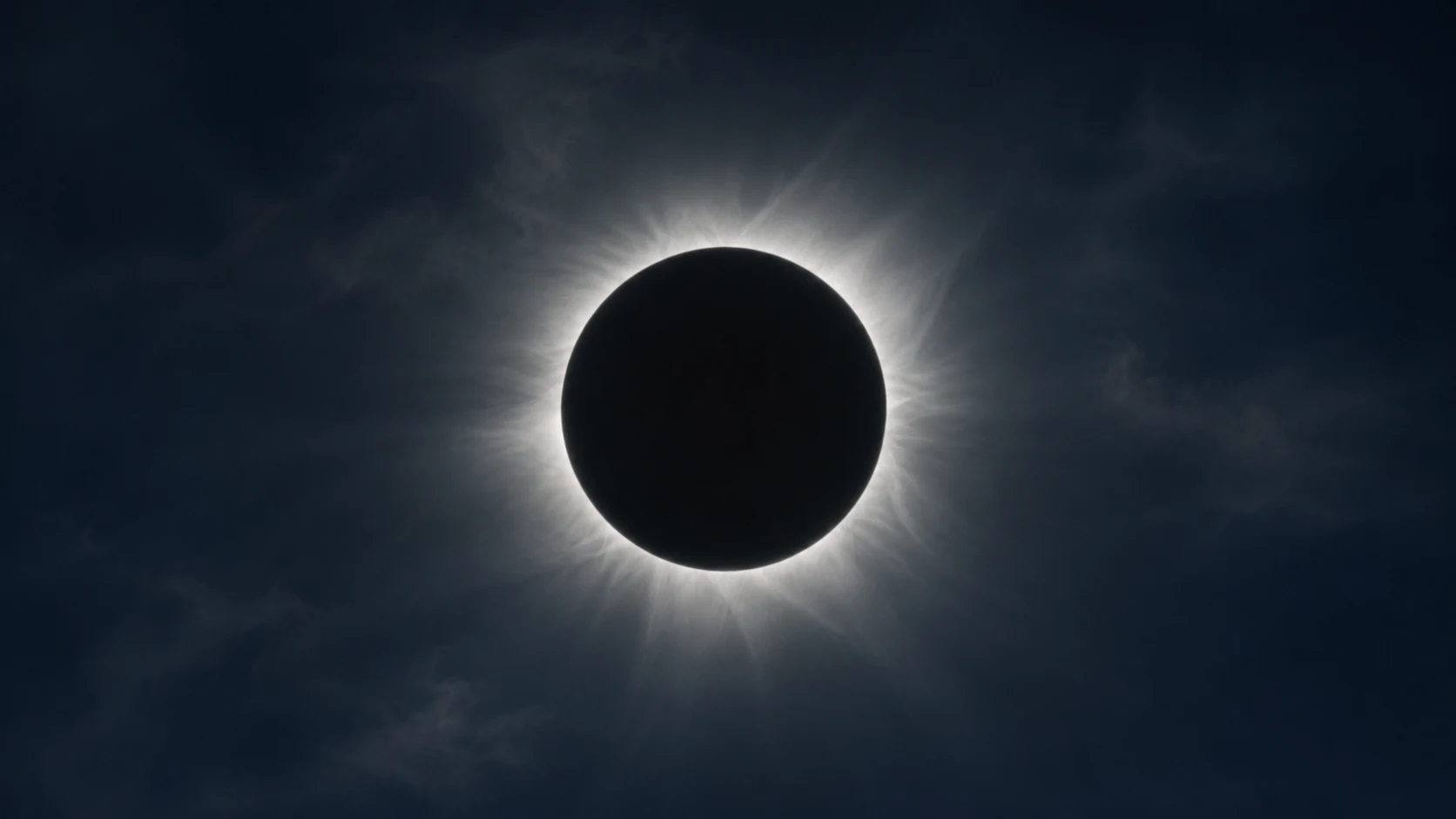
During a total solar eclipse, the Moon completely covers the Sun’s bright face for an observer in the appropriate region. During an annular eclipse, the Moon appears too small to cover it completely, leaving a ring of sunlight around the dark lunar disk.
NASA distinguishes these from a partial eclipse, where only part of the Sun appears covered. A hybrid eclipse changes between total and annular along different portions of its path because of the geometry of the shadow and Earth’s curved surface. [3]
The popular phrase “ring of fire” describes annularity. It should not be used interchangeably with the faint outer atmosphere visible around the covered Sun during totality. A bright remaining ring of the Sun’s face and the solar corona are different things.
| Type | View from the relevant location | Key distinction |
|---|---|---|
| Partial | Only part of the Sun’s bright face is covered | Some direct sunlight remains visible |
| Total | The bright face is completely covered briefly | Totality occurs within a limited moving region |
| Annular | A bright ring surrounds the Moon | The Moon’s apparent disk is too small for complete coverage |
| Hybrid | The central eclipse is total in some places and annular in others | The event’s type varies along its path |
Umbra, penumbra and antumbra
The shadow has different regions. Within the umbra, the Sun’s bright face is fully blocked. In the penumbra, only part is blocked. Beyond the tip of the umbral cone lies the antumbra, where the Moon can appear inside the larger apparent solar disk, producing annularity.
NASA’s geometry explanation connects these regions to what observers see. They are names for different shadow conditions, rather than three separate objects moving across Earth. [4]
Consider two observers standing on opposite sides of a shadow boundary. Their view can change even though they are watching the same alignment at almost the same time. The observer is part of the geometry; a description that leaves out location is incomplete.
Why is there not a solar eclipse every month?
New moon is the phase in which the Moon lies generally between Earth and the Sun. The alignment is usually not exact enough for its shadow to reach Earth because the Moon’s orbital plane is tilted by about five degrees relative to Earth’s orbital plane around the Sun.
NASA’s Moon eclipse explanation identifies that tilt as the reason eclipses are occasional rather than monthly. At most new moons, the Moon passes above or below the required alignment as seen from Earth. [5]
A top-down diagram can conceal the issue. If all three objects are flattened onto one sheet, it may look as though the Moon must block the Sun every orbit. A side view reveals the missing dimension: the Moon can pass north or south of the line needed for an eclipse.
For the phase cycle itself, see why the Moon changes shape. An ordinary lunar phase is not produced by Earth’s shadow sliding over the Moon.
What are nodes and eclipse seasons?
The Moon’s tilted orbital plane intersects Earth’s orbital plane along a line. The crossing points are called nodes. Eclipses become possible when the necessary lunar phase occurs sufficiently close to the appropriate alignment with those crossings.
NASA’s explanation of eclipse periodicity describes eclipse seasons: windows during which the alignment can produce eclipses. The season is an opportunity for the geometry, not a promise that every location on Earth will see the event. [6]
This distinction separates two questions: can an eclipse happen, and can I see it from here? Orbital alignment answers the first. The shadow’s intersection with Earth’s surface, the local horizon and viewing conditions help answer the second.
Why does totality move across a narrow path?
The shadow changes position as the Moon moves and Earth rotates. Its inner region intersects only part of the globe, creating a path rather than covering the entire daylight side at once.
NASA’s guide to eclipse maps distinguishes the central shadow path from the much broader region of partial-eclipse visibility. A map showing a large shaded area should therefore be read carefully: “visible eclipse” does not necessarily mean “total eclipse.” [7]
Imagine a weather map with a narrow band inside a broader region. The two areas can describe different conditions within one event. Eclipse maps likewise use boundaries to answer specific questions; ignoring the legend can produce the wrong expectation.
Path widths and durations vary between eclipses and along a path. A number from one famous event should not be presented as the fixed width or length of all total eclipses.
Why is a very deep partial eclipse still different from totality?
Covering almost all of the Sun is not the same as covering its bright face completely. NASA’s total-eclipse FAQ distinguishes the experience inside the path of totality from the partial phases and partial views outside it. [8]
A percentage can obscure that boundary. “Nearly complete” describes how much is covered, but the remaining bright portion changes the view and the viewing requirements. A partial eclipse does not become total simply because a rounded percentage looks impressive.
It is also worth checking what a percentage measures. A diameter-based measure and an area-based measure are not interchangeable. Two overlapping disks can have similar-looking labels while describing different geometric quantities.
How can scientists predict eclipses?
Eclipse prediction combines models of the Sun, Moon and Earth’s motions with the geometry of shadows and an observer’s position. Repeating orbital patterns help organize eclipses into related series, but repetition alone is not a complete local forecast.
NASA’s eclipse FAQ explains the Saros cycle and why related eclipses do not simply repeat over the same place. Similar orbital conditions can recur while Earth’s orientation places the shadow over a different region. [9]
The distinction is similar to knowing when a repeating event occurs versus knowing where a moving spotlight will land. A cycle provides useful structure; a location-specific prediction needs more information.
Viewing safety follows the bright Sun, not the event’s name
NASA advises specialized solar-viewing protection whenever any part of the Sun’s bright face is visible. Ordinary sunglasses are not suitable. Safe solar viewers should comply with ISO 12312-2 and should be inspected for damage.
Partial and annular eclipses never provide a total phase for unprotected direct viewing. The exception during a total eclipse is only the brief interval when the bright face is completely covered; protection must be used again before it reappears. Eclipse glasses must not be used as filters for looking through binoculars, telescopes or camera optics, which require appropriate front-mounted solar filters and expert guidance. [10]
The important distinction is the light reaching your eyes. The title on an event poster does not establish that your location is inside totality or that the total phase has begun.
Frequently asked questions
Is a solar eclipse caused by Earth’s shadow?
No. A solar eclipse is the Moon blocking the Sun from the observer’s viewpoint. Earth’s shadow on the Moon produces a lunar eclipse. [1]
Can a solar eclipse happen at full moon?
The required solar-eclipse alignment is associated with new moon. Full moon places the Moon on the other side of Earth, where the alignment can instead produce a lunar eclipse. [5]
Does everybody on Earth see the same eclipse?
No. The shadow covers only certain regions, and the view differs within them. A total event can be seen as partial from outside its central path. [7]
Does an annular eclipse show the corona in the same way as totality?
An annular eclipse leaves a bright ring of the Sun’s face visible. That is different from the complete coverage that allows the faint corona to stand out during totality. [8]
Keep exploring
- Why Does the Moon Change Shape?
- Why Do Stars Twinkle?
- How Starlight Reveals the Elements in Distant Suns
Sources and further reading
Reference review: November 7, 2026. Abstract-only sources are labelled in the references.
- NASA Goddard — Basic Solar Eclipse Geometry
- Canadian Space Agency — Your guide to solar eclipses
- NASA Science — Types of Solar Eclipses
- NASA Science — Why Do Eclipses Happen?
- NASA Science — Eclipses and the Moon
- NASA Goddard — Periodicity of Solar Eclipses: Eclipse Seasons
- NASA Goddard — Key to Solar Eclipse Maps
- NASA Science — Total Solar Eclipse FAQ
- NASA Science — Eclipses Frequently Asked Questions
- NASA Science — Eclipse Viewing Safety
Keep exploring.
One remarkable idea at a time—nature, science, history and beyond.
Last updated November 8, 2026.

Barnakle Editorial Team
Barnakle Editorial Team is the collective byline used for Barnakle’s editorial articles. The contributor profile explains the team identity and links to the publication’s editorial policies.
More from the editorial team →