Egg mimicry, early development and persuasive begging make a nest takeover possible
A small bird feeding a chick much larger than itself can look like an inexplicable mistake. The scene makes more sense when it is treated as the outcome of several stages: entering a nest, getting an egg accepted, hatching, securing food and avoiding the host’s defences.
This article concerns the common cuckoo, Cuculus canorus, with reed warblers as a well-studied example of its hosts. Other cuckoos and other brood-parasitic birds do not necessarily use every part of the same strategy.
What is brood parasitism?
In brood parasitism, a bird exploits another bird’s parental care. An obligate brood parasite depends on hosts to raise its offspring rather than building and tending an ordinary nest of its own.
The Oxford University Museum of Natural History describes the common cuckoo as an obligate brood parasite. A female can place her egg in a suitable host nest, leaving incubation and care to the other birds. [1]
“Parasite” here describes an ecological relationship: one organism benefits by exploiting another’s investment. It is not a claim that the cuckoo understands the arrangement as a human deception or has made a moral choice.
The distinction helps keep the explanation biological. A successful cuckoo lineage must leave surviving offspring. Its behaviour and traits can be shaped by selection without the bird planning each evolutionary step.
Getting an egg into the nest is only the first challenge
A cuckoo egg must remain in the nest long enough to develop. Hosts can attack a cuckoo, reject a suspicious egg or otherwise defend their breeding attempt. An egg that is laid successfully is not automatically an egg that will hatch.
Oxford’s account describes rapid laying and the resemblance between cuckoo eggs and those of particular hosts. These features address different problems: the opportunity to lay and the chance of subsequent acceptance. [1]
Imagine a sequence of gates. Passing the first does not remove the others. A nest visit can succeed while egg acceptance fails; an accepted egg can still fail to produce a surviving chick. That is why a complete explanation cannot stop at “the cuckoo lays its egg in another nest.”
Egg mimicry is more than looking vaguely similar to us
Common cuckoo eggs vary in appearance among host-associated groups. Researchers have studied how closely their patterns resemble the eggs of the hosts they exploit.
Mary Caswell Stoddard and Martin Stevens quantified pattern mimicry using methods intended to reflect avian vision. They found better mimicry in associations with hosts that showed stronger egg rejection. The work connects the appearance of the egg to the defensive pressure it faces. [2]
A separate study examined egg background colour and luminance through models of bird vision. Many cuckoo host-associated groups closely matched those aspects of host eggs, again with stronger mimicry associated with stronger rejection. [3]
This matters because a human observer is not the final judge of the match. Birds’ visual systems differ from ours. Two eggs that look reasonably similar in a photograph can differ in signals available to the host.
For that sensory background, explore why birds see colours humans cannot. The point is not that every host uses every possible visual cue, but that the relevant observer is the bird.
A female does not repaint each egg to match the nest
Egg mimicry is an evolved and inherited trait, not a last-minute painting task. A female’s characteristic egg appearance is associated with the host strategy of her lineage.
A 2016 genetic study investigated the ancient origin and maternal inheritance of blue cuckoo eggs. It supplied evidence linking that egg phenotype to a maternal lineage, helping explain how host-associated variation can persist within the common cuckoo. [4]
More recent work adds an important distinction. A 2025 genomic study, described by the Max Planck Institute for Biological Intelligence, found that European cuckoo egg base colour was inherited almost exclusively through the maternal line, while patterning depended more on genes inherited from both parents. [5]
It would therefore be too simple to say that every detail of every cuckoo egg is controlled in exactly the same way. Base colour and pattern are related features, but they need not have identical genetic architecture.
The wider lesson is that an adaptation can be inherited without the animal understanding how it works. The female does not have to inspect an egg, calculate a colour recipe and redesign her next one.
Why an early start helps the chick
Hatching before the host’s young can give a brood parasite a competitive advantage. Research on internal incubation found relatively advanced embryos at laying in common cuckoos and some other parasitic species with extended laying intervals.
The study linked this head start to the interval between fertilization and laying. Its authors cautioned that internal incubation could be a consequence of that interval, rather than necessarily a trait that originally evolved specifically for brood parasitism. [6]
That is a useful distinction between present usefulness and evolutionary origin. A feature can help an animal now without having first appeared for precisely that purpose.
Early development also does not mean the chick can dispense with incubation. It means that the starting point and schedule differ. The host’s later investment remains part of the system.
Why does a cuckoo chick push other eggs out?
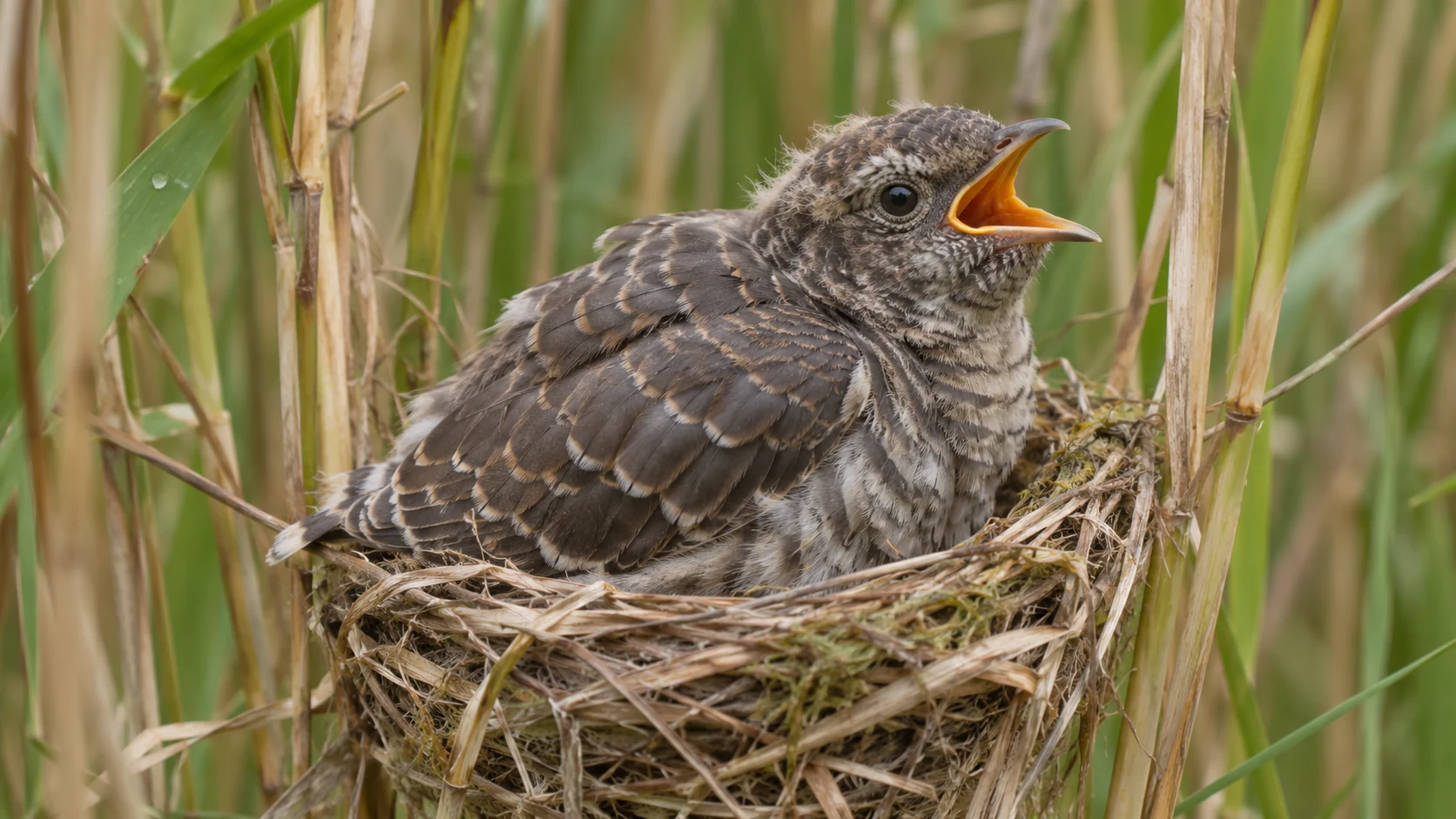
Young common cuckoos can evict host eggs or nestlings, leaving themselves as the sole occupant. In the familiar reed-warbler system, this removes competing mouths from the nest.
The Cambridge account of cuckoo and reed-warbler interactions describes this behaviour as part of the parasite’s strategy. It also documents hosts’ responses to the threat, rather than presenting them as universally passive. [7]
Removing competition helps explain what the behaviour achieves. It does not imply that a newly hatched chick makes a conscious calculation about food budgets. A functional explanation and a claim about the animal’s understanding are different things.
| Stage | Challenge for the cuckoo | Relevant trait or behaviour |
|---|---|---|
| Laying | Access a host nest | Rapid use of an opportunity |
| Egg stage | Avoid host rejection | Host-associated egg resemblance |
| Hatching | Gain a developmental advantage | Earlier development and hatching |
| Nestling stage | Secure sufficient parental feeding | Eviction and effective begging signals |
How can one chick receive food intended for a whole brood?
A single large chick is not necessarily enough to stimulate the feeding rate it needs. Experiments with reed warblers found that a cuckoo’s rapid begging calls were especially important.
Researchers compared single chicks and used playback to test the effect of calls. Hosts increased provisioning when single blackbird or song-thrush chicks were accompanied by cuckoo calls or the calls of a brood of reed warblers. The acoustic signal helped produce a response that size alone did not explain. [8]
The experiment is powerful because it changes one part of the situation. A photograph of a large chick being fed can suggest that size is responsible. Playback lets researchers ask whether the sound changes the host’s behaviour.
A further study examined why the cuckoo’s call is unusually rapid. Its interpretation was that exaggerated vocal signalling compensates for the visual stimulus of only one open mouth, rather than the several mouths of a host brood. [9]
This is not the chick imitating the adult cuckoo’s familiar call. The relevant signal is a nestling begging display acting on the host’s feeding behaviour.
Why do hosts sometimes accept an obvious-looking intruder?
To a human, a very large chick may look unmistakably foreign. The host’s decision is made within its own sensory and evolutionary context. Recognizing an odd egg, recognizing a foreign chick and deciding whether to abandon a nest are different problems.
Cambridge’s Kilner Group describes work on other cuckoo-host systems in which chick number and the sound of begging influence rejection. That variation shows why one host’s response cannot be assigned to every species. [10]
There are also costs to getting a defensive decision wrong. A host that rejects its own offspring loses part of its reproductive investment. A rule that rejects every unusual-looking egg or chick is not automatically the best outcome.
Calling hosts “stupid” hides the question researchers are actually testing: which cues are available, what responses do they trigger, and what are the costs of acting or failing to act?
Host defences can depend on the evidence available
In a Cambridge study, reed warblers combined information from nearby alarm activity and more direct evidence of cuckoo risk. Their egg-rejection response depended on the combination, rather than simply escalating after any distant alarm.
The researchers interpreted this as a response calibrated to risk, including the cost of mistakenly rejecting an egg. It demonstrates that the host’s behaviour can depend on context and information, not just the appearance of the clutch alone. [7]
Imagine having two imperfect clues about a threat. Either may be insufficient on its own, while both together justify a stronger response. That comparison helps explain the experiment without claiming the bird performs a human-style calculation.
What does the evolutionary arms race really mean?
Better host recognition can favour better parasite resemblance. Better parasite resemblance can, in turn, favour more effective host defences. Researchers use the term coevolution for this kind of reciprocal evolutionary influence.
The pattern-mimicry and colour studies connect measurable egg traits with host rejection, rather than relying solely on a story about an endless contest. [2] [3]
An arms race does not mean every host always loses or that evolution is guaranteed to produce a perfect disguise. Different species and populations face different circumstances, and a trait can have benefits and costs at the same time.
The result is a sequence of adaptations and countermeasures. The striking scene of a small bird feeding a large cuckoo is one visible outcome of that longer interaction.
Frequently asked questions
Do all cuckoos use other birds’ nests?
No. This article concerns the common cuckoo and selected comparisons. The behaviour of one brood-parasitic species should not be assigned to the entire cuckoo family.
Does the adult cuckoo return to feed its chick?
In the common cuckoo’s obligate brood-parasitic strategy, the host supplies incubation and parental care. The adult cuckoo does not share the ordinary feeding duties described here. [1]
Does the chick simply look like a host chick?
Egg resemblance and chick begging are different parts of the strategy. In reed warblers, experiments show that the chick’s vocal display helps stimulate feeding even though it is a single large nestling. [8]
Can hosts fight back?
Yes. Egg rejection and other defences vary among hosts and can depend on perceived risk. The parasite’s success is a biological possibility, not a guaranteed outcome in every nest. [7]
Keep exploring
- Why Birds See Colors Humans Cannot
- How Crows Recognize Faces and Share Threat Information
- How Do Migrating Birds Find Their Way?
Sources and further reading
Reference review: November 7, 2026. Abstract-only sources are labelled in the references.
- Oxford University Museum of Natural History — Obligate Brood Parasites: The Common Cuckoo
- Stoddard and Stevens (2010) — Pattern mimicry of host eggs by the common cuckoo, as seen through a bird's eye
- Stoddard and Stevens, Evolution (2011) — Avian vision and the evolution of egg color mimicry in the common cuckoo (PubMed abstract)
- Fossøy et al., Nature Communications (2016) — Ancient origin and maternal inheritance of blue cuckoo eggs
- Max Planck Institute for Biological Intelligence — Cuckoos: maternal genes responsible for differently colored eggs (2025 genomic research account)
- Birkhead et al., Proceedings of the Royal Society B (2011) — Internal incubation and early hatching in brood parasitic birds
- University of Cambridge — Neighbourhood watch and more: how reed warblers watch out when there's a cuckoo about (2016 research account)
- Davies et al. (1998) — Nestling cuckoos, Cuculus canorus, exploit hosts with begging calls that mimic a brood (abstract and full-text link)
- Kilner et al., Animal Behaviour (1999) — How selfish is a cuckoo chick? (PubMed abstract)
- University of Cambridge, Kilner Group — Study Species and host defences
Keep exploring.
One remarkable idea at a time—nature, science, history and beyond.
Last updated November 8, 2026.

Barnakle Editorial Team
Barnakle Editorial Team is the collective byline used for Barnakle’s editorial articles. The contributor profile explains the team identity and links to the publication’s editorial policies.
More from the editorial team →