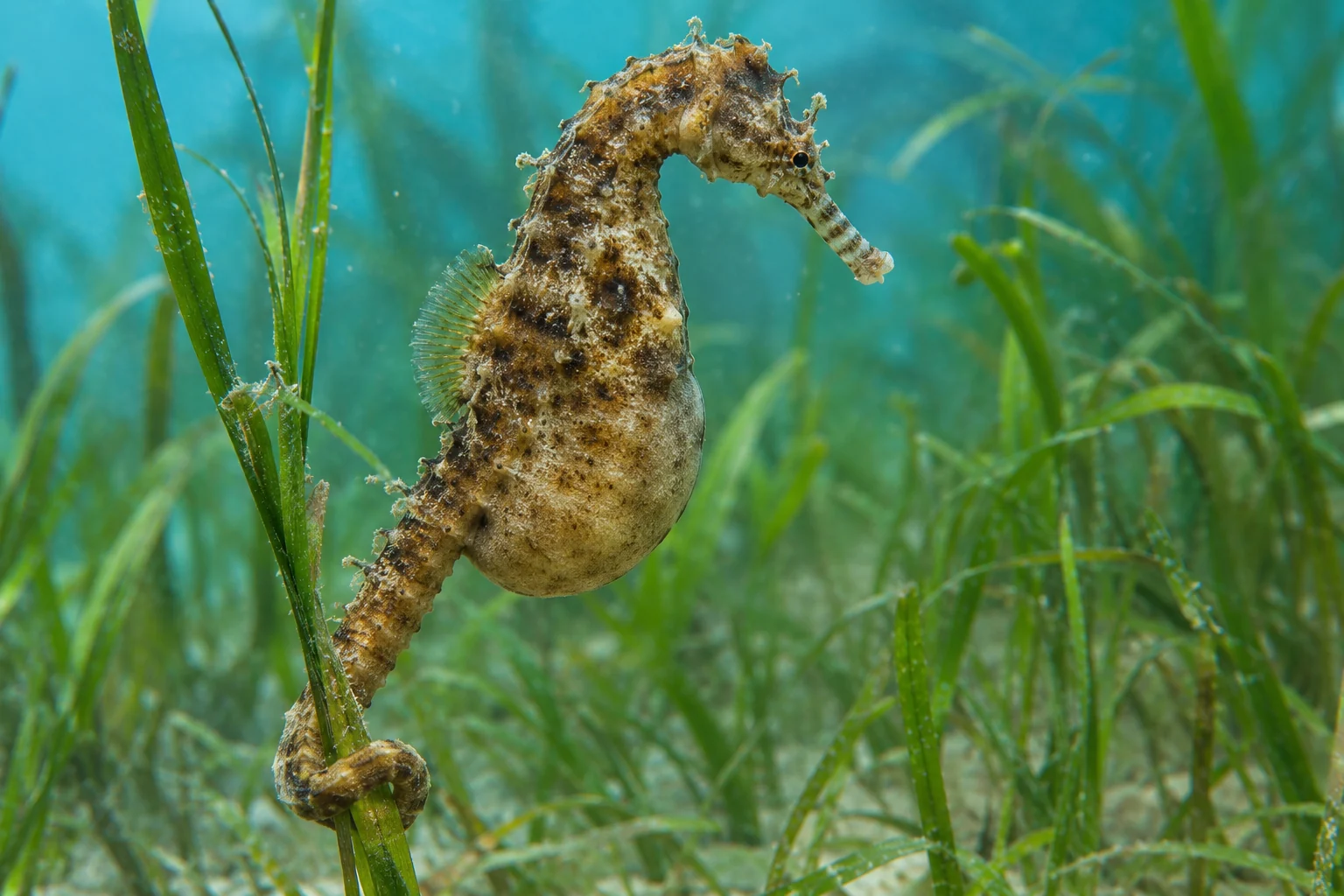
In seahorses, the father carries developing offspring inside a specialised pouch. That pouch does much more than keep the eggs from drifting away: it changes during pregnancy and participates in supporting the embryos.
How do seahorse fathers carry their young? A female transfers eggs into the male’s brood pouch, where they are fertilised and develop. The pouch provides a protected gestational environment. The father carries the developing offspring until they are ready to be released into the surrounding water. [1]
The female produces eggs; the male carries the pregnancy
Male pregnancy does not mean the male produces the eggs. The female supplies eggs and the male supplies sperm. What differs from more familiar reproductive arrangements is where the embryos are incubated and which parent provides the gestational environment.
NOAA describes courtship followed by the transfer of mature eggs into the male’s pouch. Development then proceeds there before the young are expelled into the surrounding water. Egg production, fertilisation and incubation are connected stages, but they are distinct jobs in the reproductive process. [1]
This distinction helps prevent an easy misconception: a seahorse father is not simply a female fish given a different name. The remarkable feature is the evolution of a specialised male structure that supports developing offspring.
The pouch is living tissue, not a passive bag
A pocket of living tissue can regulate and exchange substances in ways that a container cannot. Studies of the brood pouch investigate its lining, blood vessels and changes in gene activity across stages of pregnancy. Those changes help reveal which physiological tasks it performs.
Whittington and colleagues profiled pouch gene expression in the pot-bellied seahorse, Hippocampus abdominalis. Their 2015 study identified changes associated with tissue remodelling, transport, gas exchange, salt-and-water regulation and immune protection. The work linked pregnancy stages with shifts in the pouch’s molecular activity. [2]
Gene expression is evidence about biological activity, not a direct measurement of every molecule crossing into every embryo. It guides and supports mechanistic explanations, while anatomical and physiological measurements test other parts of the picture.
How do the embryos get enough oxygen?
Growing embryos need respiratory gas exchange. A sealed fleshy pouch creates a challenge because parental tissue separates the developing young from the external environment. The father’s tissues must support exchange across that additional barrier.
Dudley and colleagues examined the pouch during pot-bellied seahorse pregnancy. In their 2021 study, the lining became more folded, capillary density increased, and the distance between capillaries and the pouch interior decreased. These changes increase exchange area and shorten the route across which gases must diffuse. [3]
The researchers interpreted the remodelling as likely facilitating respiratory gas exchange. That is a functional explanation supported by measured anatomy. It should not be inflated into a claim that every aspect of oxygen supply has been quantified in every seahorse species.
Does the father contribute food as well as shelter?
The eggs begin with resources supplied by the female, including yolk. To investigate a paternal contribution, researchers can compare the composition of newly fertilised eggs with that of developed young. Development uses energy, so the changing balance can reveal whether initial reserves alone explain the outcome.
Skalkos and colleagues compared dry mass and lipid content in pot-bellied seahorses in 2020. They interpreted the findings as evidence for nutrient supplementation from the brooding father, including replacement of lipid resources consumed during development. The study supports paternal provisioning rather than the idea that the pouch is only a storage compartment. [4]
This is a measured comparison interpreted through a biological model. It does not establish that the father supplies all embryonic nutrition or that the original yolk has become irrelevant. Both parents contribute, through different routes and at different stages.
A later study examined protein
In 2024, Skalkos and colleagues investigated protein provisioning in the same species. They used dry mass and total nitrogen to estimate protein content in newly fertilised eggs and neonates. The developed young contained significantly more estimated protein mass, which the authors interpreted as evidence of paternal protein transport during pregnancy. [5]
The distinction between evidence and method matters. This result was not based on watching a visible stream of food move through a transparent pouch. It came from comparing chemical and mass measurements at defined developmental stages.
Together, the nutrient studies extend the explanation beyond a striking behavioural fact. Carrying the young entails a physiological investment, and investigators can test parts of that investment quantitatively.
What opens the pouch at birth?
A 2022 study investigated the anatomy and control of birth in pot-bellied seahorses. Micro-CT imaging and microscopy revealed substantial skeletal muscle associated with bones near the pouch opening. The findings suggested a role for these structures in opening the pouch and expelling young. [6]
The researchers’ University of Sydney explanation also reports an unexpected experimental result: applying isotocin, a fish hormone related to oxytocin, did not make their pouch tissue preparations contract as predicted. They proposed that skeletal muscles and coordinated body movements are important in the process. [7]
Their account clearly leaves further biomechanical tests to be done. It is therefore more accurate to describe the proposed muscle mechanism as a supported hypothesis than to declare that scientists have proved precisely how much conscious control a seahorse has over birth.
A coordinated form of parental investment
Egg transfer, gestational remodelling, exchange, provisioning and release form a sequence. Each stage poses a different problem, and no single feature explains the whole pregnancy. A pouch gives the embryos a place to develop; its changing biology helps make that place workable.
The most useful scientific picture combines multiple kinds of evidence. Gene-expression data identify changing activity, tissue measurements reveal anatomy, composition measurements investigate nutrients, and observations of birth test how structures move. Those methods make the story richer than a single surprising sentence about which parent gives birth.
Frequently asked questions
Do male seahorses lay the eggs?
No. Females produce and transfer the eggs. The male fertilises them and supports development in his brood pouch.
Is the pouch just a place to hide eggs?
No. Research shows changes in living tissue and evidence of physiological support for the developing young.
Does the father provide every nutrient?
No such conclusion follows. Egg yolk is an initial maternal contribution, while studies support additional paternal provisioning during gestation.
Are all the detailed findings universal across seahorses?
No. Many studies discussed here used pot-bellied seahorses. Their findings need appropriate testing before being generalised to every species.
Keep exploring
Sources and further reading
- NOAA Ocean Service — Seahorse egg transfer and male pregnancy
- Whittington and colleagues (2015) — Seahorse brood-pouch transcriptome; research abstract
- Dudley and colleagues (2021) — Structural changes to the male brood pouch; research abstract
- Skalkos and colleagues (2020) — Paternal nutrient provisioning; research abstract
- Skalkos and colleagues (2024) — Paternal protein provisioning; research abstract
- Dudley and colleagues (2022) — Brood-pouch morphology and male parturition; research abstract
- University of Sydney — Researchers explain the proposed mechanics of seahorse birth
Reference review: November 11, 2026.
Keep exploring.
One remarkable idea at a time—nature, science, history and beyond.
Last updated November 12, 2026.

Barnakle Editorial Team
Barnakle Editorial Team is the collective byline used for Barnakle’s editorial articles. The contributor profile explains the team identity and links to the publication’s editorial policies.
More from the editorial team →