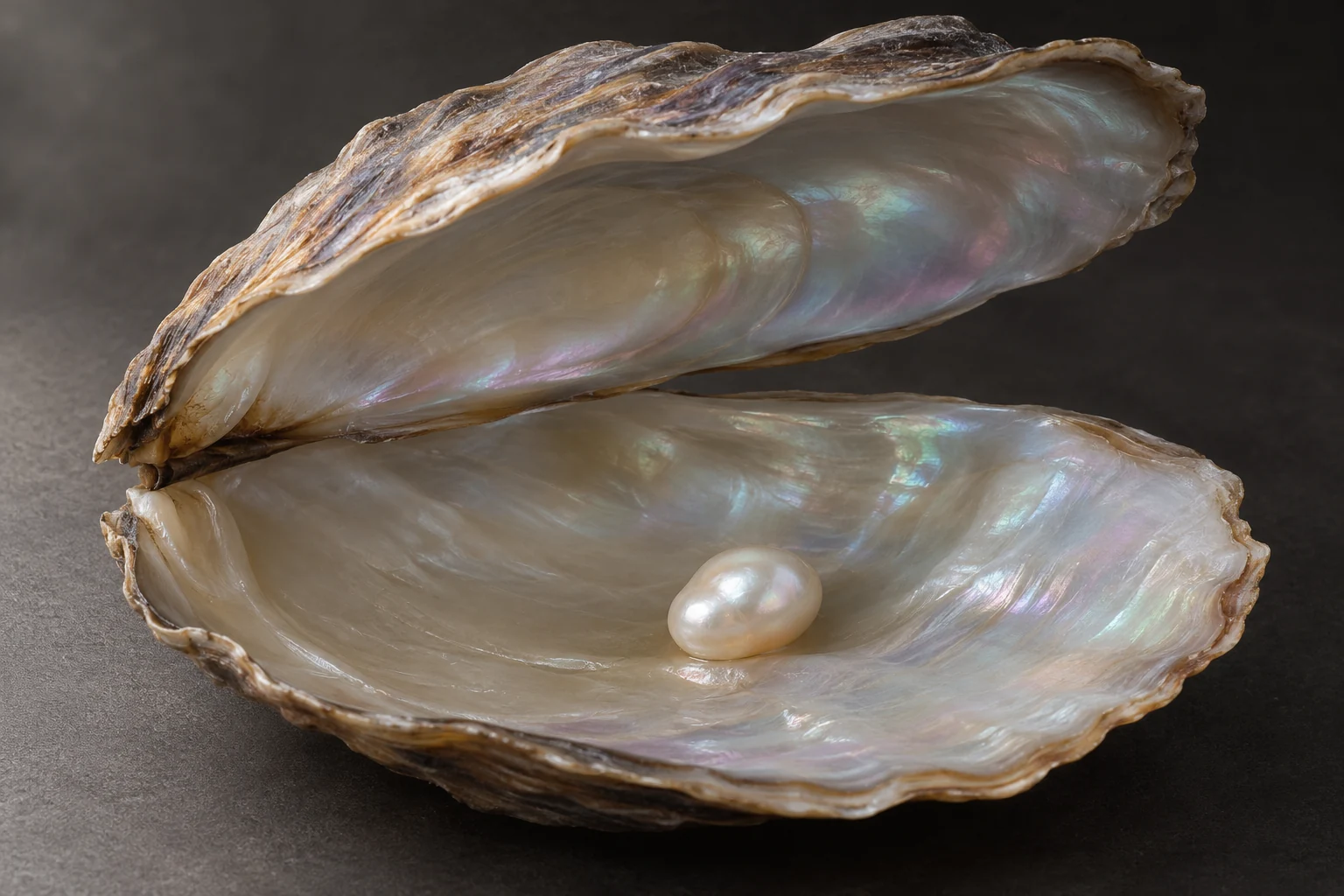
A pearl is often explained as a grain of sand coated by an oyster. That familiar story leaves out the most important part: living tissue creates a pearl sac whose cells secrete the material of the growing pearl.
How do oysters make pearls? In pearl-producing mollusks, specialised epithelial cells can form a closed pearl sac after tissue injury or deliberate tissue transplantation. The sac deposits mineral and organic material. In a nacreous pearl, this becomes a layered composite called nacre, rather than a simple lump of one pure mineral. [1]
The pearl sac does the building
The mantle is tissue involved in shell formation. A pearl forms when appropriate cells establish a separate secretory enclosure: the pearl sac. Its biological activity is more important than imagining an object passively rolling around inside a shell.
The 2021 research paper on nacreous pearl structure describes pearl formation following mantle injury or the transplantation of mantle tissue in culturing. The enclosed cells reproduce aspects of the shell-building programme within a confined space. That is how a mollusk can construct a mineralised body inside itself. [1]
This explanation separates trigger from mechanism. Something may initiate the process, but it is the tissue’s response and continued secretion that produce growth. An irritant alone is not a pearl-making machine.
Why the grain-of-sand story is incomplete
A pearl does not require one universal kind of central object. GIA describes natural pearl formation in the bodies or mantle tissue of certain mollusks, commonly around a microscopic irritant. Culturing can instead introduce mantle tissue with or without a manufactured shell bead. [2]
The resulting centre can therefore differ. In particular, the bead used in one cultivation method should not be treated as proof that every natural pearl began around a similarly shaped nucleus.
A better short explanation focuses on where the secretory cells are and what they produce. That retains the useful idea of a biological response without making a grain of sand a mandatory ingredient.
What is nacre?
Nacre is the material commonly called mother-of-pearl. It is a composite of calcium carbonate and organic components, organised in fine layers. A nacreous pearl’s appearance comes from this structured material rather than from a coating of paint.
GIA’s account of laboratory analysis distinguishes nacreous pearls from non-nacreous examples, including pearls with more porcelain-like surfaces. That distinction matters: “pearl” is broader than “a perfectly round object covered in classic iridescent nacre.” [6]
In a layered composite, composition and arrangement both matter. Knowing that calcium carbonate is present does not fully describe the shape, organisation or optical response of the finished structure.
Pearl oysters are not simply any oyster on a menu
Smithsonian Ocean explains that the familiar pearl oysters belong to a different bivalve family from many food oysters. Food oysters can also produce pearls, but the result need not resemble the lustrous jewellery pearl that people usually picture. [3]
The broader category is mollusks. Some freshwater mussels also produce pearls, and different hosts and growth conditions yield varied structures. A shell opening is therefore not a guarantee that a particular pearl type will be inside.
This is a useful example of an everyday name concealing biological diversity. “Oyster” can group animals that are familiar for different reasons, while the tissues and structures of interest belong to particular pearl-producing hosts.
How cultured pearls differ from natural pearls
GIA defines natural pearls as forming without human intervention and cultured pearls as resulting from human intervention in a living mollusk. Cultured pearls may be bead-nucleated, tissue-nucleated or otherwise non-bead cultured, and production occurs in both saltwater and freshwater environments. [4]
The distinction is about origin, not a claim that the cultured object was moulded from plastic. The mollusk still supplies the biological growth process. Conversely, the fact that a pearl grew in an animal does not make “natural” the correct technical label for a cultured pearl.
Those terms should therefore be kept separate from everyday uses of “real.” A cultured pearl and an imitation are not the same category, and neither should be confused with a natural pearl formed without intervention.
What the bead-and-tissue method changes
In one common cultivation approach, a bead and a piece of mantle tissue are introduced into a host. GIA’s description explains how the tissue forms a sac and secretes nacre onto the bead. Other approaches use implanted tissue without a bead. [2]
The tissue is not merely packaging around a ready-made pearl. It supplies the cells that establish the secretory structure. The host then has to remain in suitable condition for growth to continue.
This account describes the biological principle rather than instructions for operating on a mollusk. The details vary by host and production system, and a simple external drawing cannot represent every internal arrangement.
Internal structure records a complicated history
GIA researchers examining known Pinctada maxima pearls describe how bead position, grafted tissue and development of the pearl sac can lead to different internal structures. In some cases, a bead may be rejected while a non-bead cultured pearl develops. The absence of an obvious bead is therefore not, by itself, proof of natural origin. [5]
That is one reason laboratory identification looks inside a pearl rather than relying only on its surface shape. Its history can be more complex than a single tidy diagram suggests.
A round outline and a growth origin are different kinds of information. Shape can be observed externally; establishing origin may require evidence from structures hidden beneath the surface.
How researchers investigate a pearl
GIA’s laboratory overview describes combining surface observations with radiography and, where appropriate, more detailed methods such as micro-CT. These tools reveal internal growth patterns and features that are not accessible to an ordinary photograph. [6]
Research into pearl growth also examines the organisation of layers at much smaller scales. What looks like a smooth object to the eye can contain a detailed record of successive deposition and changing growth conditions.
The valuable scientific question is how living cells organise material through time. The result connects animal physiology with mineral formation, giving a pearl more to explain than its familiar shine.
Frequently asked questions
Does every pearl begin with a grain of sand?
No. The trigger and central material vary. The pearl sac and its secreting cells are central to the growth mechanism.
Are all pearls covered in nacre?
No. Non-nacreous pearls exist, and their structure and appearance differ from classic mother-of-pearl surfaces.
Are cultured pearls made by living animals?
Yes. Human intervention initiates or manages the process, but a mollusk supplies the growth.
Does a pearl without a bead have to be natural?
No. Non-bead cultured pearls exist, which is one reason internal structure needs careful interpretation.
Keep exploring
Sources and further reading
- Gim and colleagues (2021) — The mesoscale order of nacreous pearls; research paper
- GIA — Pearl description and cultured pearl formation
- Smithsonian Ocean — Pearl oysters versus food oysters
- GIA — The difference between natural and cultured pearls
- GIA research (2021) — Internal structures of known Pinctada maxima pearls
- GIA research — How pearls are analysed from start to finish
Reference review: November 11, 2026.
Keep exploring.
One remarkable idea at a time—nature, science, history and beyond.
Last updated November 12, 2026.

Barnakle Editorial Team
Barnakle Editorial Team is the collective byline used for Barnakle’s editorial articles. The contributor profile explains the team identity and links to the publication’s editorial policies.
More from the editorial team →