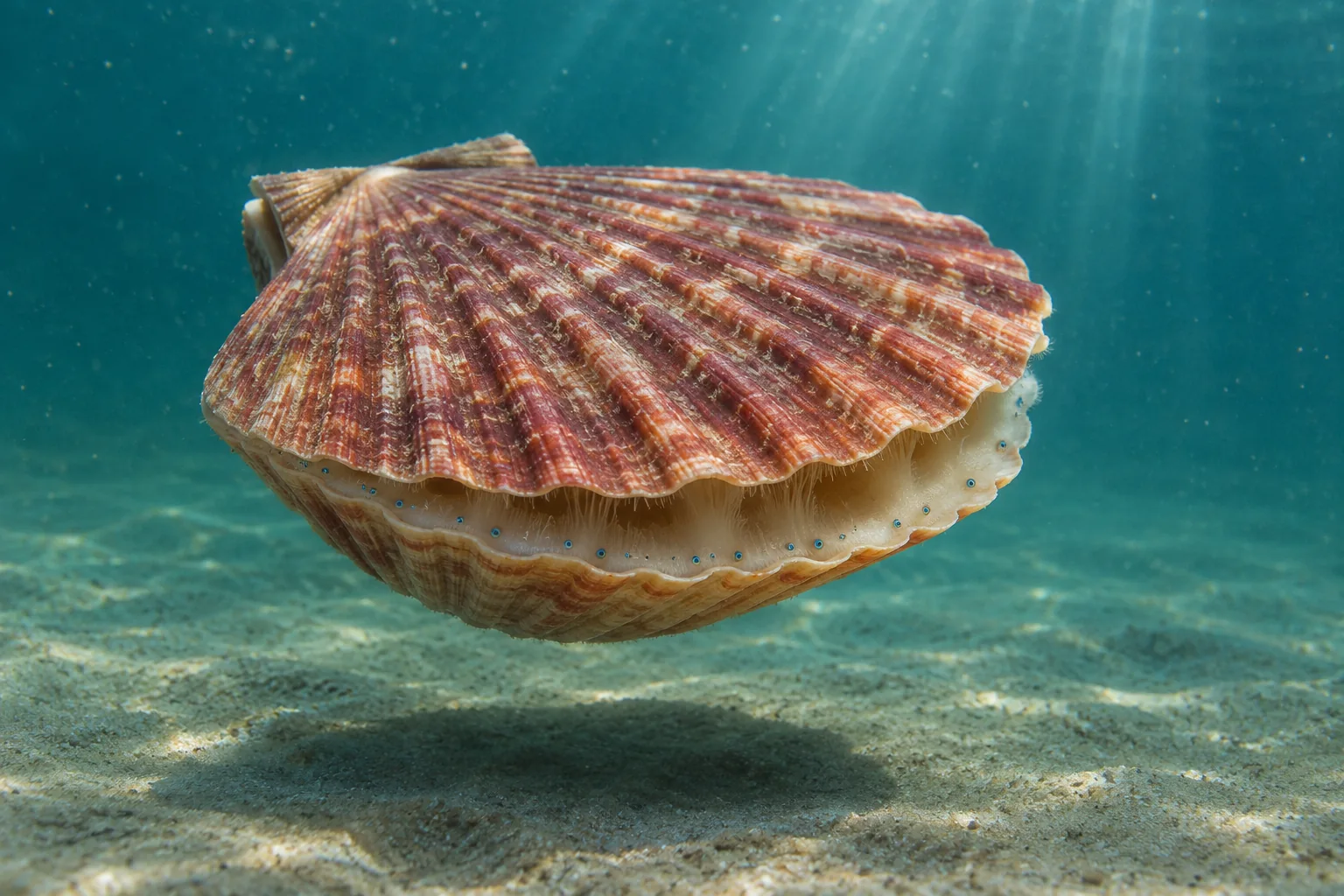
A scallop lying on the seabed can suddenly lift off and move through the water. It does so by rapidly closing its shell and forcing water out in jets. A large muscle supplies the closing power, while an elastic hinge helps open the shell for the next stroke. [1, 2]
The action can look like underwater flapping, but the shell halves are not fins. They form part of a pumping mechanism. Following the water through that pump explains how an animal without swimming legs or a fish-like tail can make a quick escape.
What kind of animal is a scallop?
Scallops are bivalve molluscs, the group that also includes clams and oysters. A bivalve’s shell consists of two parts, often called valves. The familiar fan-shaped outline belongs to a living animal with soft tissues between those valves, not simply an empty pair of plates. [6]
Many scallops can swim, a striking contrast with the more stationary adult lifestyles associated with several other bivalves. Their abilities vary with species, age, body form and conditions. “Scallops can swim” is useful; “all scallops swim equally well” is not. [2, 4]
The difference also matters when looking at illustrations. A generic scallop can show the arrangement of two valves and a mantle margin without representing the exact shell proportions of every named species.
How does closing a shell produce movement?
Water is taken into the space enclosed by the shell and mantle. A rapid contraction of the adductor muscle draws the valves together, raising pressure and expelling water through openings. Fisheries and Oceans Canada describes sea scallops forcing water out near the corners of the hinge to propel themselves forward. [1]
Sending water one way produces a reaction in the opposite direction. The moving water carries momentum; the scallop receives a push. This is jet propulsion using surrounding seawater rather than a propeller or a continuous stream of burned fuel.
An ordinary shell closure does not necessarily produce the same movement as a swimming stroke. Where water exits matters. The mantle, the soft tissue lining the shell, helps define the openings through which water leaves during propulsion. [2, 5]
That arrangement is why “it flaps its shell” is an incomplete explanation. A movement can resemble a wingbeat while relying on a different interaction with the surrounding fluid.
Which muscle powers a scallop’s swimming stroke?
The adductor muscle links the shell valves and pulls them toward one another. A rapid, striated portion provides the powerful contractions used for swimming. A slower, tonic portion serves a different role in maintaining valve position. [2, 3]
In a 1992 study, researchers measured the adductor’s mechanical performance during jet-propelled swimming using pressure and flow measurements. The abstract emphasises the value of studying a muscle during its actual movement rather than assuming that simplified laboratory loading exactly reproduces natural performance. [3]
That is an instructive distinction for any account of animal strength. A muscle is not merely a fixed force rating. Its contribution depends on how it shortens, when it acts and the load encountered during a real movement.
The large adductor is also the part commonly sold as a scallop in some seafood markets. A living scallop has considerably more anatomy than that familiar portion suggests. [6]
What opens the shell again?
The hinge ligament acts as an elastic spring. Closing the valves stores mechanical energy in that structure. When the rapid contraction relaxes, the ligament helps push the valves apart, resetting the shell to take in water again. [2]
This does not make the animal’s motion free of energy cost. The muscle supplied energy during closure. Elastic recoil can return some stored energy, but it does not create a new energy supply from nothing.
The opening phase is therefore part of the swimming mechanism, not merely a pause between useful strokes. A pump that cannot refill cannot keep expelling water. Thinking about the full cycle—intake, compression, expulsion and reopening—makes the anatomy easier to connect with the visible motion.
Which way does a swimming scallop travel?
In the familiar swimming mode described for the great scallop, Pecten maximus, water leaves on either side of the dorsal hinge and the curved edge of the shell leads. That is one reason a scallop may appear to be taking repeated bites out of the water ahead of it. [5]
Scallops can also make other movements, including jumps and righting actions, with different patterns of water ejection. It would be misleading to treat every shell clap in a video as the same stroke or assign one travel direction to every movement. [5]
A useful viewing question is therefore: which edge is leading, and where would the expelled water be going? The answer links the animal’s direction of movement to its propulsion more directly than judging how vigorously the shell seems to flap.
Why do scallops swim in bursts?
For many scallops, swimming is especially associated with escaping predators rather than travelling continuously through open water. DFO’s sea-scallop account describes short bouts and notes that undisturbed scallops rarely swim. These observations concern that account’s animals, not a universal maximum duration for every species. [1]
Swimming requires repeated muscular work while carrying a shell and soft tissues through water. The animal’s form, muscle capacity and hinge mechanics therefore constrain the performance it can sustain. The shell remains useful protection even while imposing a mechanical burden. [2, 4]
Resting on the seabed should not be confused with being incapable of movement. Nor should a short escape sequence be interpreted as evidence that the animal normally spends its day swimming like a fish.
How does a scallop notice danger?
Scallops have eyes distributed around the mantle edge. NOAA’s description of the Atlantic sea scallop notes more than 100 blue eyes sensitive to light intensity. Numbers and details differ among species, so that count should not be applied to every scallop. [7]
The great-scallop account also describes responses to shadows, movement and experimental exposure to different sea-star cues. Those responses show that the escape sequence has a sensory context: swimming is not simply a muscle contracting at random. [5]
This article does not assume scallops experience a human-like detailed view of their surroundings. Detecting useful changes in light or recognising a threat-related cue is a different claim from seeing the world as a person does.
Can scallops swim in very cold water?
Yes, but the mechanics depend on the animal. Denny and Miller studied the Antarctic scallop Adamussium colbecki. Their abstract discusses cold-water challenges, including more viscous seawater and reduced muscle power, and the unusually resilient hinge material found in this species at low temperature. [4]
The authors did not present that resilience as a complete explanation for exceptional swimming. They described limited performance and uncertainty about the adaptive benefit. It is a good example of why an appealing natural material should not be turned into a simple superpower claim.
Across these different cases, the central mechanism remains recognisable: a living shell becomes a refillable pump, a muscle delivers a rapid squeeze, and expelled seawater provides the reaction that moves the scallop.
Keep exploring
Meet two other marine animals whose bodies handle water in very different ways:
Sources and further reading
Scallop-swimming research checked November 16, 2026. The muscle-performance and Antarctic studies are used from their abstracts, with species-specific findings kept distinct from general mechanics.
- Fisheries and Oceans Canada — Offshore Scallop, biological synopsis
- Tremblay, Samson-Dô and Guderley (2015) — When Behavior and Mechanics Meet: Scallop Swimming Capacities and Their Hinge Ligament; abstract and indexed introductory text
- Marsh, Olson and Guzik (1992) — Mechanical performance of scallop adductor muscle during swimming; PubMed abstract
- Denny and Miller (2006) — Jet propulsion in the cold: Mechanics of swimming in the Antarctic scallop Adamussium colbecki; PubMed abstract
- Marine Biological Association, MarLIN — Great scallop, Pecten maximus
- NOAA Fisheries — Atlantic Sea Scallop, appearance and biology
- NOAA National Marine Sanctuaries — Sea Scallop, mantle eyes
Keep exploring.
One remarkable idea at a time—nature, science, history and beyond.
Last updated November 16, 2026.

Barnakle Editorial Team
Barnakle Editorial Team is the collective byline used for Barnakle’s editorial articles. The contributor profile explains the team identity and links to the publication’s editorial policies.
More from the editorial team →