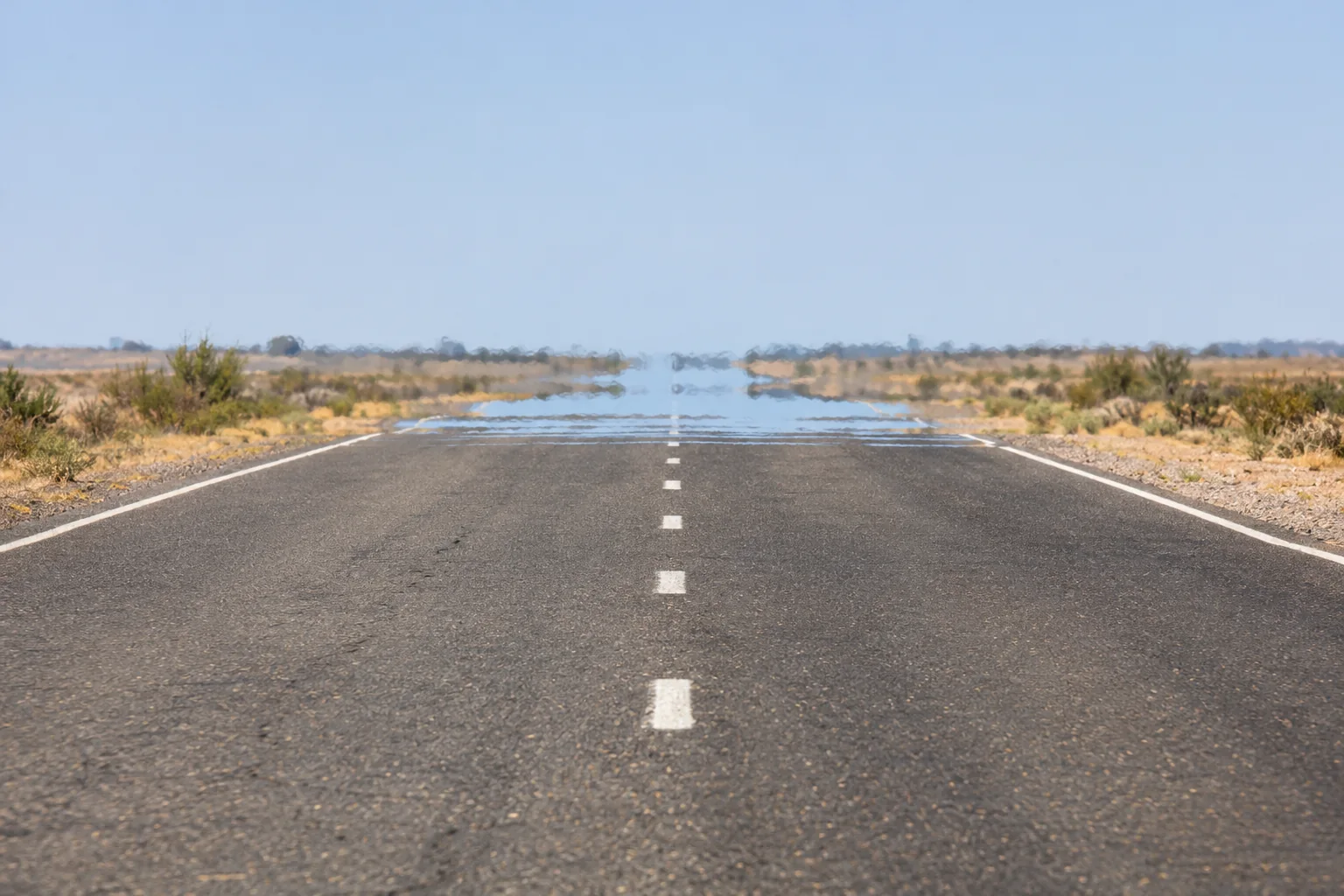
The road ahead looks wet, but the shining patch never becomes a puddle. A distant ship seems suspended above the sea. Both scenes can result from atmospheric refraction: light follows curved paths through air whose optical properties change with height, producing displaced, inverted or distorted images. [1]
A mirage is a physical optical effect. The light really reaches the observer along an unusual route. Interpreting that light as water or a floating vessel is the perceptual part of the experience; the atmosphere supplies the altered image in the first place. [2, 5]
Why can air bend light?
Light travels at different speeds in different optical media. Refractive index expresses that difference relative to light in a vacuum. When a ray crosses a boundary at an angle, a change in refractive index can change its direction. This is refraction, the same broad principle used by lenses. [4]
Air is not optically uniform. Temperature affects density, and density affects its refractive index. Layers with different temperatures can therefore steer light, even though every part of the path still looks like ordinary transparent air. [1]
A textbook drawing may show a ray taking a sharp turn at a boundary. In a real atmosphere with continuously changing properties, the path can bend gradually. Stacking many small changes is a useful way to imagine that smooth curve; it does not require an invisible sheet of glass over the road.
Why does a hot road look covered in water?
Sun-warmed asphalt heats the air immediately above it. A strong temperature change can develop between that very warm near-surface air and the cooler air higher up. Under suitable conditions, light from the sky curves upward toward an observer instead of continuing down to the ground. [2, 3]
The arriving light appears to come from a low position ahead. Because the sky is bright, its image resembles the bright reflection that a wet surface might produce. Nothing has condensed onto the asphalt to create that apparent patch. [2]
This is the familiar inferior mirage. “Inferior” concerns image position, not the strength or quality of the display. The miraged image appears below the object giving rise to it, and an inverted image is part of the classical hot-road effect. [6]
Why does the apparent puddle move as you approach?
The visible patch depends on the geometry between the observer, the atmosphere and the incoming light. Changing position changes which light paths can reach the eyes. It is not a pool occupying a fixed piece of road, waiting for someone to arrive. [2, 3]
For an explanatory comparison, imagine two observers looking across the same heated surface from different heights. Their eyes need not intercept the same set of curved rays. Seeing different appearances would not imply that one observer imagined the effect; their viewing conditions differ.
This is why a photograph without information about viewpoint and conditions can be difficult to interpret. It records a real appearance from one location, not the complete temperature profile that produced it.
Can mirages happen in cold places?
Yes. A superior mirage is associated with a temperature inversion: relatively cold air lies below warmer air. Refraction can then bend light downward toward the observer, making distant objects appear elevated or producing additional images above their usual positions. Cold water and snow-covered surfaces can support such conditions. [1, 3]
This makes “mirage” a much broader idea than a thirsty traveller seeing water in a hot desert. The essential ingredient is an appropriate variation in refractive index along the sightline. Heat at a desert surface is one way to create it, not the definition of the phenomenon.
In maritime views, altered refraction can also make distant features visible when normal viewing conditions would conceal them. Descriptions sometimes group these effects together, but specialist optical terminology distinguishes simple looming from mirages that contain inverted or multiple images. [5, 6]
What is a Fata Morgana?
A Fata Morgana is a complex mirage display in which images may be stretched, compressed or stacked in alternating orientations. A distant coastline or vessel can acquire shapes that look surprisingly architectural. More complicated atmospheric layering produces a more complicated relationship between object and image. [6, 7]
It is tempting to interpret each apparent tower as a separate solid feature. Several features in the display may instead be repeated or distorted parts of the same distant scene. The optical pattern is not a reliable outline of an undiscovered building.
The name covers varied displays, and a single simple ray diagram does not explain every case. That is a reason to treat an identification cautiously when a photograph lacks a clear horizon, known objects or information about weather conditions. [6]
Is a mirage the same as heat shimmer?
Not exactly. Uneven, changing air can make a scene waver, while a mirage involves a more organised alteration of image paths. They can appear together above a heated surface, which helps explain why the watery-looking patch on a road may also seem restless. WMO lists shimmer separately from mirage in its classification of atmospheric optical phenomena. [1]
The distinction is useful when describing an observation. A trembling outline alone does not establish a particular mirage type. An inverted image, a displaced feature or multiple images provides more specific evidence about what the light is doing.
Likewise, the everyday word “reflection” describes the appearance but does not require an ordinary reflecting surface. The hot-road explanation rests on refraction through air, rather than a water mirror hidden at ground level. [2, 4]
Can a camera photograph a mirage?
Yes. A camera at the appropriate position receives the altered light too. The effect does not require thirst, expectation or a uniquely human visual system. A recorded image can preserve the atmospheric distortion even when the observer understands its cause. [3, 5]
Photographic evidence still has limits. Without identifying the object and knowing the viewing geometry, a picture may not distinguish confidently among several atmospheric effects. It proves what reached that camera, not automatically every detail of the explanation attached to it.
The useful question is therefore not simply whether an image looks strange. Ask what object supplied the light, where the image appears relative to it and what atmospheric structure could connect that object to the observer. A mirage becomes much less mysterious when the apparent puddle is understood as a light path rather than a destination.
Keep exploring
Compare this atmospheric effect with a rainbow and a familiar illusion involving the Moon:
Sources and further reading
Mirage explanations checked November 16, 2026, using meteorological and optical sources. The image illustrates a hot-road effect rather than a recorded weather event.
- World Meteorological Organization — International Cloud Atlas: Mirage
- Hong Kong Observatory — Mirage, 25 May 2020
- University of British Columbia — Atmospheric Science 113: Optical Phenomena
- OpenStax, College Physics 2e — The Law of Refraction
- Andrew T. Young, San Diego State University — An Introduction to Mirages
- Andrew T. Young, San Diego State University — Types of Mirages
- Institute of Physics — Mirages: atmospheric temperature gradients and complex displays
Keep exploring.
One remarkable idea at a time—nature, science, history and beyond.
Last updated November 17, 2026.

Barnakle Editorial Team
Barnakle Editorial Team is the collective byline used for Barnakle’s editorial articles. The contributor profile explains the team identity and links to the publication’s editorial policies.
More from the editorial team →