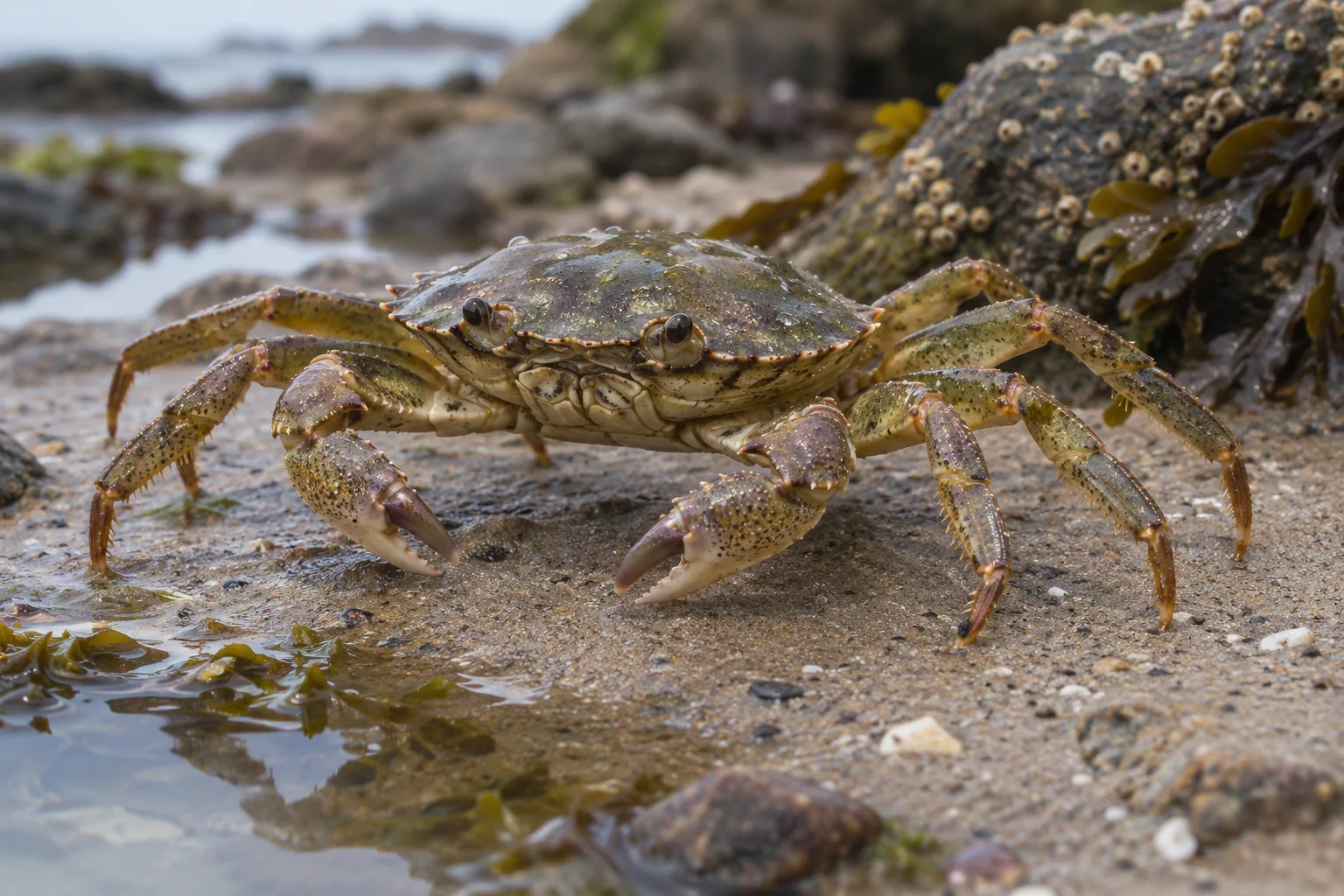
Many crabs walk sideways because their leg joints, limb proportions and muscle arrangement make lateral steps an effective way to move. The legs extend from the sides of a broad body, and important joints have ranges of movement that suit pulling and pushing the animal sideways. [1, 2]
That does not mean every crab is physically incapable of moving forward. Some can change direction, and certain true crabs prefer forward walking. The interesting question is why a particular body works especially well in one direction, rather than why all crabs supposedly obey the same rule. [1, 3]
What counts as sideways for a crab?
Sideways movement carries the animal mainly across its body, rather than toward the front where its eyes and mouth face. During a lateral walk, the limbs on one side lead while those on the opposite side trail. Both sets contribute to moving the body across the surface. [1]
A leg can lead or trail on different occasions. Reversing lateral direction does not require the whole body to turn first, placing different demands on the limbs from those of a consistently head-first walker. [2]
Researchers therefore separate body orientation from the direction of travel. A sideways-moving crab can keep its front facing one way while progressing another way. Looking only at the apparent direction of its face can make a purposeful movement seem more awkward than it really is. [1, 2]
Why do the joints make a difference?
A crab leg is a series of segments, with joints that do not all move in the same plane. Their combined action positions the foot and produces a step. The important issue is how those allowed movements add up, not whether the leg has a single human-like knee. [2, 3]
The 2008 comparative study examined a sideways-walking shore crab, a forward-walking spider crab and a crayfish. It found greater ranges of motion in joints acting along the preferred walking direction. Limb proportions and the way the legs rested around the thorax also differed with walking preference. [1]
These comparisons give a more informative answer than saying the shell is simply too wide for forward walking. Body shape is part of the arrangement, but the range, orientation and coordination of the joints determine how the limbs can actually move that body. [1, 3]
What are the muscles doing?
Muscles act across the joints to move the hard segments of a crab's external skeleton. A limb can flex or extend at one joint while other joints position it relative to the body. The finished step is the combined result of several actions rather than one hinge opening and closing. [2]
The muscular-anatomy study of Libinia emarginata compared a forward-walking crab with better-known sideways walkers. Its significance is that similar-looking appendages can have different functional emphases. A shared crab-like outline does not guarantee identical joint use, muscle organization or preferred direction of progression. [2]
This also explains why a short forward shuffle need not contradict a sideways preference. The available joints can permit movements outside the usual gait, while the configuration still makes one direction more effective for sustained travel. Preference describes what an animal commonly does, not every movement it can make. [3]
How do several legs make one coordinated walk?
The feet must alternate between making useful contact and being repositioned. A leg in contact can contribute support and propulsion; a lifted leg can be advanced for another step. Coordinating these phases lets the animal progress without all its feet moving identically at once. [6]
In a Louisiana State University thesis comparing several crabs on land and underwater, lateral walking predominantly used an alternating tetrapod gait. In contrast, the spider crabs' forward walking used a different sequence of steps. Those observations describe the animals and conditions studied, rather than a fixed gait for every crab. [6]
The direction of a walk and its footfall pattern are therefore separate descriptions. Two animals can both travel sideways while differing in how long feet stay down, how widely the legs spread, or how the sequence changes as their surroundings change. [6, 7]
Does moving underwater change the problem?
Water supplies buoyancy but also resists movement. A crab crossing from air into water encounters a different balance of body support and fluid forces. Its feet and stance must function within those conditions, so underwater locomotion cannot always be treated as ordinary land walking with a blue background. [7]
A 1998 intertidal-crab study compared locomotion in air and water and described an underwater punting gait. The result highlights how the same general walking apparatus can produce different movement patterns in different environments. The sideways direction alone does not capture everything about a step. [7]
Are ghost crabs a good example?
Ghost crabs make the lateral arrangement easy to notice on open sand. Waikīkī Aquarium describes four pairs of slender walking legs, with the claw-bearing pair used for other tasks such as feeding and digging. Their closely placed legs and restricted joint directions suit their familiar sideways travel. [4]
Their external skeleton supports the muscles and organs, but also limits how growth can occur. The aquarium describes molting as the process that allows a larger skeleton to replace the old one. The walking machinery is thus part of a rigid, jointed covering that periodically has to be renewed. [4]
Did sideways walking evolve independently in every crab?
A 2026 eLife reviewed preprint investigated locomotion across fifty living crab species and mapped the observations onto an evolutionary framework. Its authors inferred a single origin of the widespread sideways mode within the true-crab lineage, with forward-moving groups providing important exceptions. [5]
That reconstruction is a research result, not direct footage of an ancient ancestor. Its conclusions depend on sampled species, behavioral classification and the evolutionary framework. It also distinguishes the repeated evolution of a crab-like body from the history of a particular way of moving. [5]
The everyday answer remains mechanical: many crabs have limbs that work well for lateral progression. The exceptions make that answer stronger. Comparing forward walkers, sideways walkers and different environments reveals how anatomy and coordination shape the direction an animal usually takes. [3, 6]
Keep exploring
Discover two other ways animals move: a snail’s muscular crawl and a scallop’s jet-powered swim.
Sources and further reading
Crab locomotion checked November 17, 2026. Comparative anatomy and gait studies are distinguished from evolutionary reconstruction; the eLife study is identified as a reviewed preprint. Findings from individual species are not universalized.
- Vidal-Gadea and colleagues — Skeletal adaptations for forwards and sideways walking in three decapod species (2008)
- Vidal-Gadea and Belanger — Muscular anatomy of the legs of the forward-walking crab Libinia emarginata (2009)
- Journal of Experimental Biology — Invertebrate paraxial locomotory appendages: design, deformation and control (1999)
- Waikīkī Aquarium — Ghost Crab
- eLife — Evolution of sideways locomotion in crabs (2026 reviewed preprint)
- Schreiner, Louisiana State University — Locomotor adaptations of crabs on land and underwater (2004 thesis abstract)
- Martinez and colleagues — Underwater punting by an intertidal crab (1998)
Keep exploring.
One remarkable idea at a time—nature, science, history and beyond.
Last updated November 17, 2026.

Barnakle Editorial Team
Barnakle Editorial Team is the collective byline used for Barnakle’s editorial articles. The contributor profile explains the team identity and links to the publication’s editorial policies.
More from the editorial team →