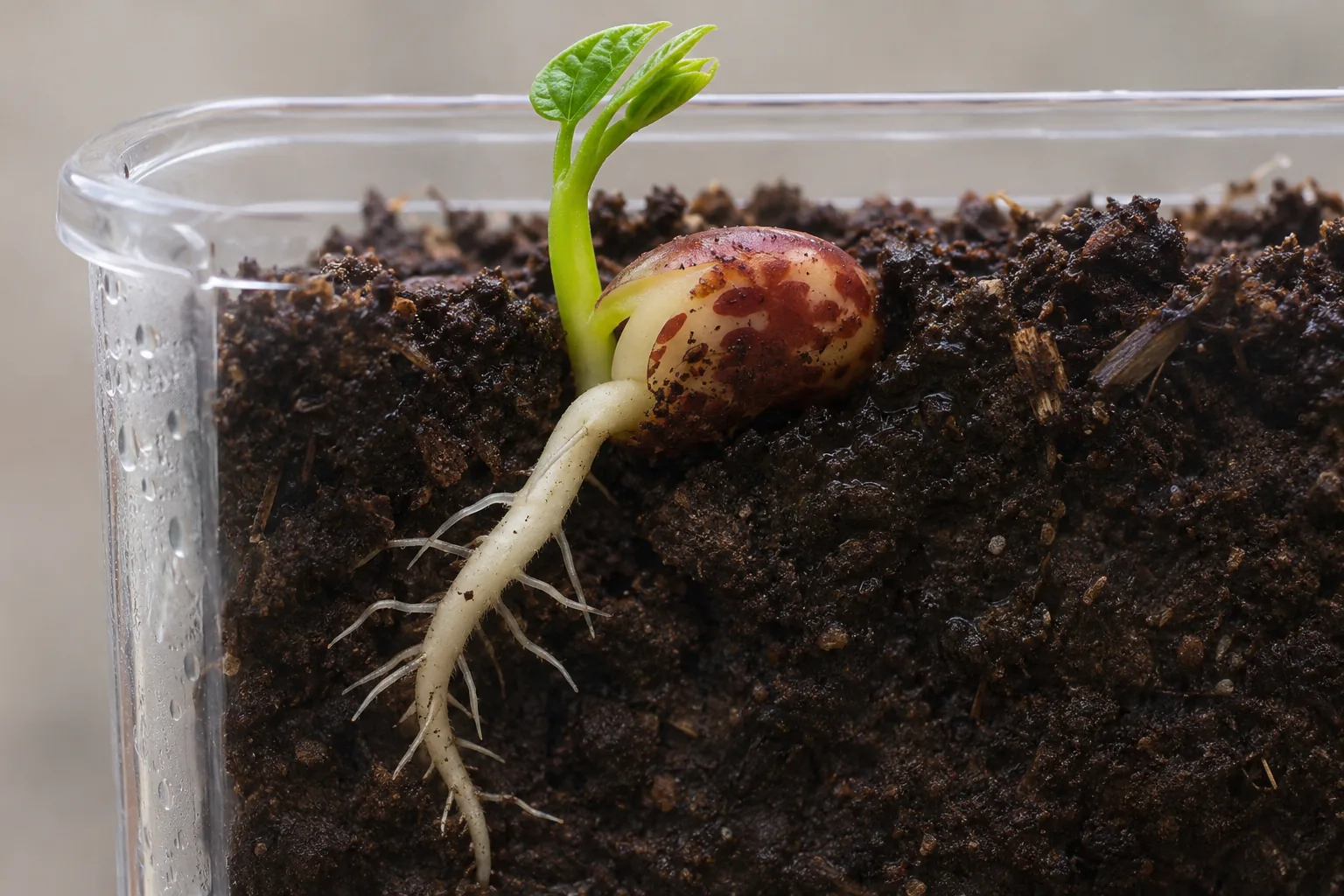
Plant roots respond to gravity through a process called gravitropism. Specialized cells detect changes in orientation, chemical signals redistribute, and cells on opposite sides of a growing region elongate differently. The unequal growth bends the root, helping many primary roots turn downward into the soil. [1, 2]
Roots convert a physical cue into a growth response. Detection and bending occur in different regions; no conscious knowledge is involved. [1]
What does positive gravitropism mean?
A growth response toward gravity is called positive gravitropism. Growth in the opposite direction is negative gravitropism. Many primary roots show the positive response, while shoots commonly grow upward. These terms describe the direction of growth relative to gravity rather than whether a response is beneficial. [2]
Turning a seedling changes its orientation, but does not remove the directional cue. A root positioned sideways can subsequently curve toward a new downward path. The response does not require the root to see sunlight, so darkness does not by itself prevent a plant from responding to gravity. [2]
This is different from a loose object simply falling. The root remains attached to the plant, and its tissues change shape through growth. Gravity supplies information used by living cells, rather than dragging the entire root tip downward like a weight on a string. [1, 2]
Where is gravity detected?
In the root cap, specialized cells contain starch-filled plastids called statoliths. Their changing position after reorientation provides a physical starting point for the response. [1]
These structures should not be imagined as little eyes or spirit levels assembled from separate parts. They are organelles inside living cells. Their movement interacts with cellular signaling machinery, which must connect the change of position to a change in the root's growth pattern. [5]
Researchers can model how statolith position and hormone transport relate to one another. A 2021 integrative study explored this connection mathematically. Such models test whether proposed relationships can account for observed behavior, while remaining distinct from directly observing every molecular step inside a root. [5]
Why is auxin part of the explanation?
Auxin is a plant growth regulator whose distribution helps influence how tissues develop. In root gravitropism, its unequal distribution across the root is associated with unequal cell elongation. The important feature is not simply that auxin exists, but where it is and how the relevant cells respond. [3]
Su and colleagues describe PIN transport proteins changing location to help produce a lateral auxin gradient. The signal moves from the sensing region toward the region that bends. [1]
In a root's elongating tissues, a relatively stronger auxin signal on the lower side can reduce elongation compared with the upper side. When the upper side lengthens more, the growing root curves downward. The opposite effects often described in shoots show why a hormone's action must be understood in its tissue context. [2, 3]
Where does the bend actually happen?
Much of the curvature occurs in the elongation zone behind the tip. Signals connect the cells detecting orientation with those whose unequal lengthening produces the turn. [1]
Imagine two joined strips that lengthen by different amounts. The longer strip has to lie around the outside of a curve. That geometric picture helps explain differential growth, although living root tissue is much more complex than two uniform strips. [3]
The developing shape also changes the signal being sensed. As the root turns, its gravity-sensing cells acquire a new orientation. Successful reorientation therefore involves a changing system, rather than a command that stays identical from the first instant until the root is vertical again. [3, 5]
How have scientists tested the hormone gradient?
A 2012 study combined a fluorescent reporter and mathematical model to investigate Arabidopsis roots. Auxin shifted rapidly toward the lower side after reorientation; the asymmetry then disappeared while the root was still completing its bend. [3]
This illustrates why the visible curve and a chemical signal need not rise and fall at the same time. The timing of detection, signaling and growth all matter. A photograph of the final root shape cannot by itself reveal the sequence of events that produced it. [3, 5]
Are starch and auxin separate systems?
They interact. A 2019 study examined how auxin signaling affects the production of starch granules within the root apex. The researchers investigated genes involved in starch synthesis and found that altering this system affected statolith development and the gravitropic response. [4]
That finding adds a feedback relationship to the simple story. Auxin is involved in a response downstream of gravity sensing, but it also helps shape the structures important to perception. Describing statoliths as the sensor and auxin as the output is a useful introduction, not the whole biological network. [4]
Why do some roots grow at an angle?
A root system is not a bundle of identical vertical lines. The review of flowering-plant roots describes lateral roots maintaining characteristic angles relative to gravity. Development and environmental conditions can modify those responses, helping produce a branching system that explores soil rather than following one narrow track. [1]
Genes also influence the direction of the response. The 2016 Nature Plants study identified proteins associated with normal root gravitropism and reported reversed behavior when that system was altered. Such experiments help separate the presence of gravity from the cellular machinery needed to respond in the usual direction. [6]
What happens when plants grow in space?
Space research changes the context in which the sensing system operates. NASA teaching material uses root orientation to introduce how low-gravity conditions affect plants. The question is not whether a root possesses an idea of up and down, but what directional signals remain available to its cells. [7]
Studying these conditions helps make the Earth-based mechanism clearer. A physical cue, intracellular structures, hormone transport and differential growth must work together. The downward root we see is the visible outcome of that coordination, with important differences among tissues, species and developmental stages. [4, 7]
Keep exploring
Follow what happens after a root finds its way into the soil, then compare this growth response with the rapid closure of a Venus flytrap.
Sources and further reading
Root gravitropism checked November 17, 2026, against plant research and institutional teaching sources. Arabidopsis experiments, mathematical models and general explanations are identified separately; the 2016 NGR study is cited at abstract level.
- Su, Keith and Masson — Gravity Signaling in Flowering Plant Roots (2020 review)
- OpenStax, Biology — Plant Sensory Systems and Responses
- Band and colleagues — A transient lateral auxin gradient controls root gravitropism (2012)
- Zhang and colleagues — Auxin-mediated statolith production for root gravitropism (2019)
- Frontiers in Plant Science — An Integrative Model of Plant Gravitropism Linking Statoliths Position and Auxin Transport (2021)
- Nature Plants — Negative gravitropism in plant roots (2016 abstract)
- Blancaflor, NASA Technical Reports Server — How do plants know up from down? (2024 teaching presentation)
Keep exploring.
One remarkable idea at a time—nature, science, history and beyond.
Last updated November 17, 2026.

Barnakle Editorial Team
Barnakle Editorial Team is the collective byline used for Barnakle’s editorial articles. The contributor profile explains the team identity and links to the publication’s editorial policies.
More from the editorial team →