A North American porcupine has to touch another animal for its quills to transfer. It can raise them, turn its back and swing its tail, bringing the sharp tips into contact with whatever is close behind it. A quill that catches can release from the porcupine’s skin and stay behind when the animals separate. That last moment is the one that matters. The porcupine can walk away with a few fewer quills while the animal that came too close is left with an unpleasant reason to remember the encounter. [1, 2]
Spot the quills among the fur
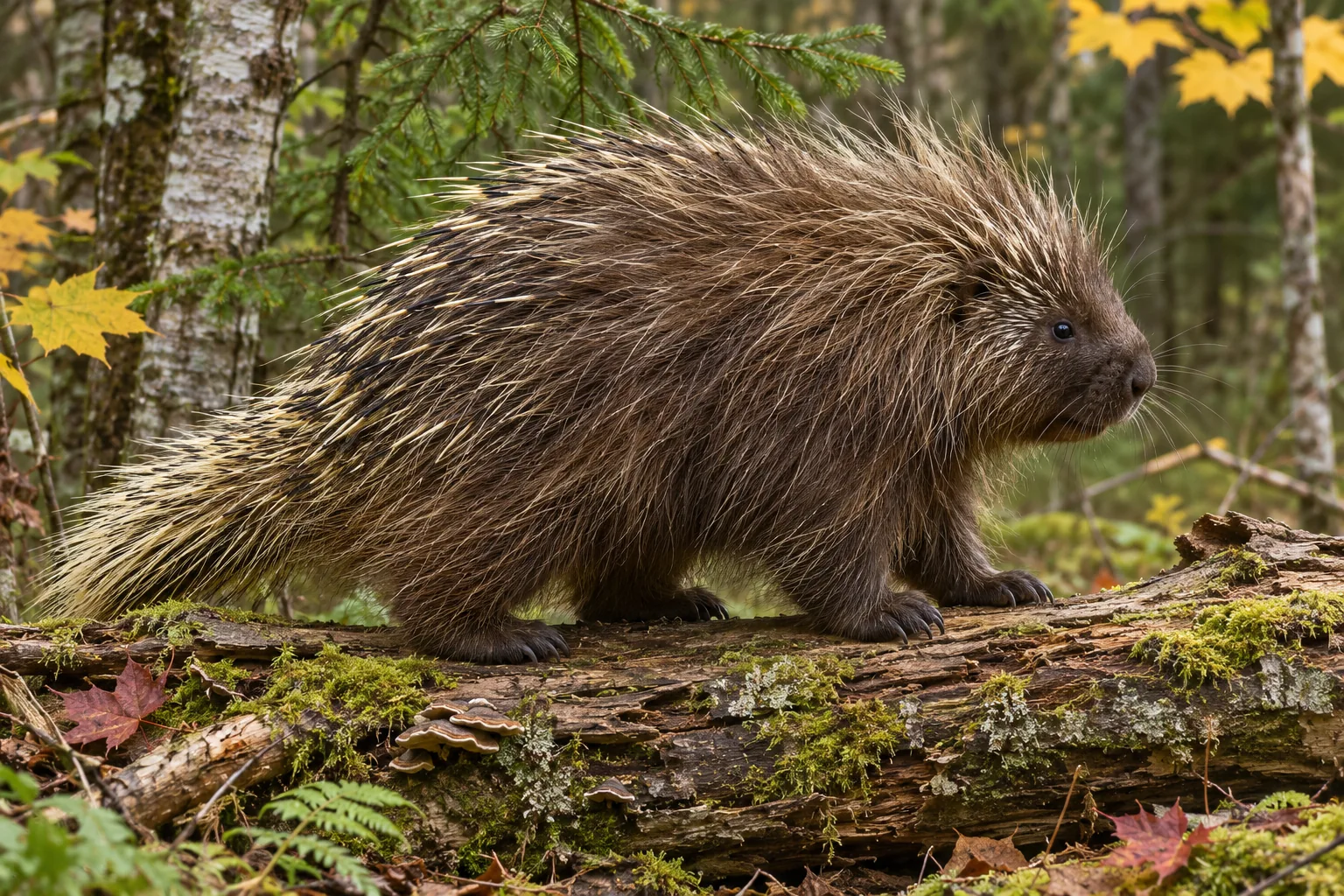
A resting porcupine can look almost shaggy. Longer guard hairs partly conceal the quills along its back, and a coat photographed from the side may have a softer outline than you would expect. The quills themselves are specialized hairs. They have stiff shafts and taper to narrow points, with tiny backward-facing barbs near the tips. Its face, feet and underside have quite different coverings. A porcupine has good reason to pay attention to which part of its body faces a disturbance. [1, 2]
The figure often given for an adult is about 30,000 quills. Think of that as an estimate of the scale of the coat. It does not mean that every animal carries an identical set or that every quill points outward all day. The coat works in patches, and the quills are individually attached. When part of the back bristles, it changes the orientation of many individual tips at once. When a few come away, the rest of the patch can continue to stand. [1, 2]
Compare two photographs of the same sort of animal, one taken from the side as it feeds and the other from behind with the quills raised. The difference in apparent size can be remarkable without a single quill having grown. You are seeing more of the shafts from the side and more separation between their tips. The dark and light bands can also stand out more clearly when the animal changes its posture. At close range the visible warning and the physical barrier occupy the same part of the coat. [2]
What happens before anything touches the coat
Retreat is an option. A porcupine may move away or find shelter, and an animal that recognizes its outline may leave it alone. When pressed, the porcupine can turn the quilled back and tail toward the approaching animal. Raising the quills changes a surface that mostly lies along the body into one that presents a field of points. The tail can swing to bring those points into contact at close range. The point of contact might be hidden behind the porcupine’s body from a person watching at a distance. [1, 2]
That sequence helps explain the familiar impression that a porcupine threw something. Imagine seeing a dog close the gap, recoil abruptly and return with quills on its muzzle. The first and last parts are conspicuous. The touch between them can be very brief, particularly if the tail is moving at the same time. Quills on the second animal are evidence that a transfer occurred. They say little about how long the two animals stayed together or which one closed the final few centimetres. [1]
A tip that catches and a root that lets go
There are two attachments to keep track of during a transfer. One is where the quill grows in the porcupine. The other forms when the tip catches in the contacting animal. As the animals move apart, those attachments work against one another. If the quill detaches at its root while the tip stays in place, the whole shaft goes with the other animal. A quill with a firm hold at both ends would leave the porcupine momentarily fastened to the animal it was trying to escape.
Biologist Uldis Roze studied the root end of this problem. His experiments on North American porcupines found that an erected quill subjected to contact resembling an encounter came free more readily afterward. In his study the average tension needed for withdrawal fell by about 38 percent under those conditions. The effect depended on the quill having been raised. Raising the coat therefore changes more about the encounter than the direction the tips face. [3]
At the other end, researchers examining North American porcupine quills under magnification documented small barbs facing back along the shaft. In mechanical comparisons, barbed tips resisted withdrawal more strongly than tips with the barbs removed. The result is especially interesting alongside Roze’s observation. Easier release at the root and a firmer hold at the tip can operate during a single contact. The animal does not have to control each quill separately as it disengages. [3, 4]
How a young porcupine starts life with quills
A porcupette is born with a coat that includes quills. They are soft at birth and stiffen as they dry, a change that takes place within hours. The animal does not have to wait to grow an entirely new set before it has the beginnings of a defensive coat. This short early stage answers a question raised by an adult’s appearance. A newborn and an adult possess the same recognizable feature in different physical conditions. [5]
The rest of the animal also deserves a look. North American porcupines spend considerable time in trees, feeding on plant material. Claws and the textured undersides of the feet help with climbing. A side view of a porcupine on a branch can show the feet gripping below, the nose directed toward food and the defended back exposed above. Those parts of its anatomy are doing different jobs at the same moment. The coat lets the animal keep a substantial protective covering on its exposed side while it uses the front of its body to feed. [1, 2, 5]
If you encounter footage of a porcupine raising its quills, watch the outline before watching the tail. First the hair-like coat changes shape. Then the animal presents its defended side. A successful warning can end the encounter right there. It is only when another animal closes the gap that the remarkable differences between a quill’s tip and its root come into play.
Keep exploring
Compare the growth of deer antlers with the origin of cactus spines. A pointed shape can arise from very different tissues in nature.
Sources and further reading
The wildlife profiles describe the living North American species. Separate studies investigate how an erected quill releases and how its tip interacts with tissue.
- Smithsonian’s National Zoo and Conservation Biology Institute — North American porcupine
- US National Park Service — Acadia porcupines
- Roze — A facilitated release mechanism for quills of the North American porcupine
- Cho and colleagues — Microstructured barbs on the North American porcupine quill
- Alaska Department of Fish and Game — Porcupine wildlife notebook
Keep exploring.
One remarkable idea at a time—nature, science, history and beyond.
Last updated November 18, 2026.

Barnakle Editorial Team
Barnakle Editorial Team is the collective byline used for Barnakle’s editorial articles. The contributor profile explains the team identity and links to the publication’s editorial policies.
More from the editorial team →