The short answer
Deer shed antlers because antlers belong to a repeating seasonal growth cycle. They develop from structures on the skull called pedicles, grow under a blood-supplied covering known as velvet, harden and become exposed bone, then separate from the pedicles as the cycle changes. A new set can grow in a later phase. In many deer species, this cycle is coordinated with seasonal reproductive biology. [1][2]
The impressive branches on a buck’s head are therefore temporary structures, not lifelong extensions that simply add a new point every year. Understanding the cycle requires following living tissue through several different states.
Antlers are bone, not a keratin sheath
Horns and antlers can look similar from a distance, but they are constructed differently. A typical bovid horn has a bony core covered by a keratin sheath. Antlers are branching bony structures that are normally shed and replaced.
The distinction includes exceptions that make careful wording useful. Pronghorns, for example, shed their horn sheaths, while the underlying structure is not the same as a deer’s annually cast antler. A general statement that every kind of horn remains entirely unchanged would miss that case. [1]
Elk and moose belong to the deer family and grow antlers too. The broad shape of a moose’s antler and the branching form of a white-tailed deer’s antler differ, but both participate in an antler cycle. Shape alone does not determine whether an appendage is a horn or an antler.
The pedicle is the starting point
At the base of each antler is a pedicle, a permanent bony structure associated with the skull. Antlers develop from this region. The distinction between pedicle and antler explains how a deer can repeatedly replace the conspicuous structure without discarding part of its whole skull each time. [2]
After an antler is cast, the exposed region must heal and prepare for further growth. Research and management descriptions distinguish those healing events from the later visible extension of a new antler. The timing is not identical in every deer species. [3]
A shed antler found on the ground is therefore the product of a separation process at a specific biological interface. It is not normally a branch that broke off because the deer knocked it against a tree.
Why growing antlers wear velvet
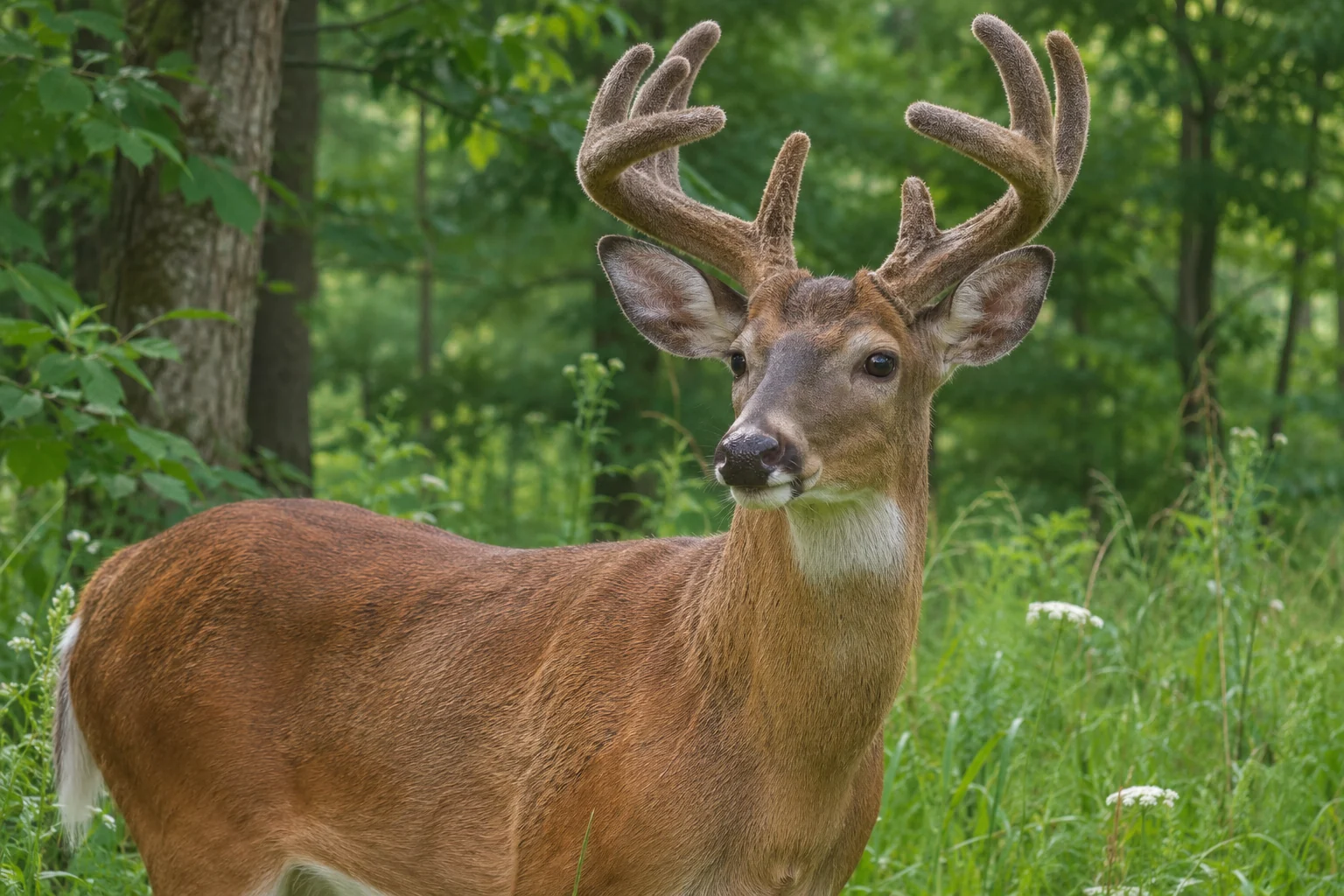
During growth, the antlers are covered by soft, vascular skin called velvet. This living covering supplies the growing structure and gives it a fuzzy appearance. The developing antler is not simply a piece of finished hard bone wearing decorative fur.
Growing tissue needs nutrients and a blood supply. As an antler extends and branches, the animal is investing material and energy in building a new structure. Conditions that affect the animal’s growth and nutrition can therefore affect its antlers as well. [4]
The velvet stage is important for interpreting photographs. A buck with soft-looking antlers is not necessarily carrying an abnormal set. It may be in a normal growing phase that looks very different from the exposed hard antlers familiar from autumn images.
How the antlers harden
As the growth phase ends, the antlers become more fully mineralized and their biological support changes. Velvet is no longer maintained over the finished hard structure and is removed or shed, leaving exposed bone.
Seasonal hormonal changes help coordinate these transitions. In white-tailed deer, the annual pattern links antler development, hardening and casting to changes in reproductive physiology and day length. It should not be reduced to one hormone acting as a simple on-off button for every species and condition. [4]
Rubbing against vegetation can help remove remaining velvet, but rubbing is not what creates the antler’s entire branching shape. Much of that structure has already developed beneath the covering. Removing the velvet reveals the product of growth rather than sculpting it from a featureless rod.
Why the attachment eventually weakens
Later in the cycle, bone is resorbed at the antler–pedicle junction. As the attachment weakens, the antler can separate. The remaining pedicle region supports the next sequence of healing and development. [4]
The two antlers need not detach at exactly the same moment. A deer carrying one antler for a period is not automatically evidence of a fight or an injury. It may be between two ordinary casting events.
The point is not that every missing antler has the same explanation. Trauma and unusual development can occur. The seasonal cycle simply provides the normal mechanism that must be considered before treating a missing structure as damage.
Why grow an expensive structure only to lose it?
Antlers have important roles in social and reproductive behaviour, including displays and contests. Those roles can make their seasonal development useful even though the investment is substantial.
Calling an antler a weapon captures only part of that biology. Its presence and size can contribute to interactions before physical contact occurs. The value of the structure depends on the animal’s life history and the timing of those interactions.
Shedding also avoids carrying the same large structure indefinitely. That consequence does not mean weight reduction is a complete explanation for the origin of the annual cycle. Evolutionary explanations need evidence about benefits, costs and reproductive success, rather than a convenient story attached to one visible feature.
Do female deer grow antlers?
In many familiar deer species, males normally grow antlers and females normally do not. Caribou are an important exception: both sexes can grow them, although males generally carry larger sets. [5]
The timing of antler retention can also differ between sexes and reproductive states. That is why antlers alone are not a universally reliable indicator of sex at every point in a caribou’s year.
This exception matters whenever a general article says “only male deer have antlers.” A clearer statement identifies the typical pattern and then acknowledges the deer-family member that does not follow it. A white-tailed buck is a useful example of one cycle, not a template for every cervid.
Why points do not function as birthday candles
Antler size and form are influenced by age, nutrition and genetics, as well as the animal’s condition. They can change as the animal matures and later ages. Counting points therefore does not reveal an exact number of birthdays. [6]
Two deer of the same age can grow different antlers, while deer of different ages can share a similar point count. A broken tip can further change what an observer sees without changing the age of the animal.
The same caution applies to comparing one deer across different years. Antlers are rebuilt under that year’s biological conditions. They can be informative about development without operating as a simple annual record like evenly spaced marks on a ruler.
Regeneration is different from ordinary bone turnover
Living bone throughout a mammal’s body is continually remodelled. Antlers add a striking larger-scale process: a complex external structure is repeatedly grown and shed from a specialized region.
That makes the system interesting to researchers studying growth and regeneration. It does not establish that humans can reproduce an antler’s growth programme in an injured limb, or that a product derived from antlers will cause human tissue to regrow. Those would require different evidence.
The scientific value is already considerable without those extra claims. Antlers show how seasonal signals, supporting tissue, blood supply, mineralization and localized separation can be coordinated within one mammal’s life.
Common questions
### Does the deer shed its pedicles too? Normally no. The pedicles remain associated with the skull, while the antlers separate at their attachment region. That continuing base is central to the repeated cycle.
Are antlers living while they are covered in velvet?
They are actively developing structures supported by living, blood-supplied tissue. Their condition during growth differs from the exposed hard antler later in the cycle.
Does a larger set always mean an older deer?
No. Age is one influence, but nutrition, genetics and condition also matter. Size and point count are not exact age measurements.
Is shedding a sign that the animal is sick?
Seasonal antler casting is normal. A specific animal can still have a separate health issue, but the routine loss and replacement of antlers is part of its biology.
Keep exploring
Sources and further reading
- U.S. National Park Service — Horns vs. antlers
- American Museum of Natural History — Horns and antlers: what’s the difference?
- Mississippi State University Deer Ecology and Management Lab — Antler growth cycle
- University of Missouri Extension — Antler development in white-tailed deer
- Alaska Department of Fish and Game — Caribou wildlife viewing
- U.S. Fish and Wildlife Service — Eight points about antlers
Reference review: November 12, 2026.
Keep exploring.
One remarkable idea at a time—nature, science, history and beyond.
Last updated November 14, 2026.

Barnakle Editorial Team
Barnakle Editorial Team is the collective byline used for Barnakle’s editorial articles. The contributor profile explains the team identity and links to the publication’s editorial policies.
More from the editorial team →