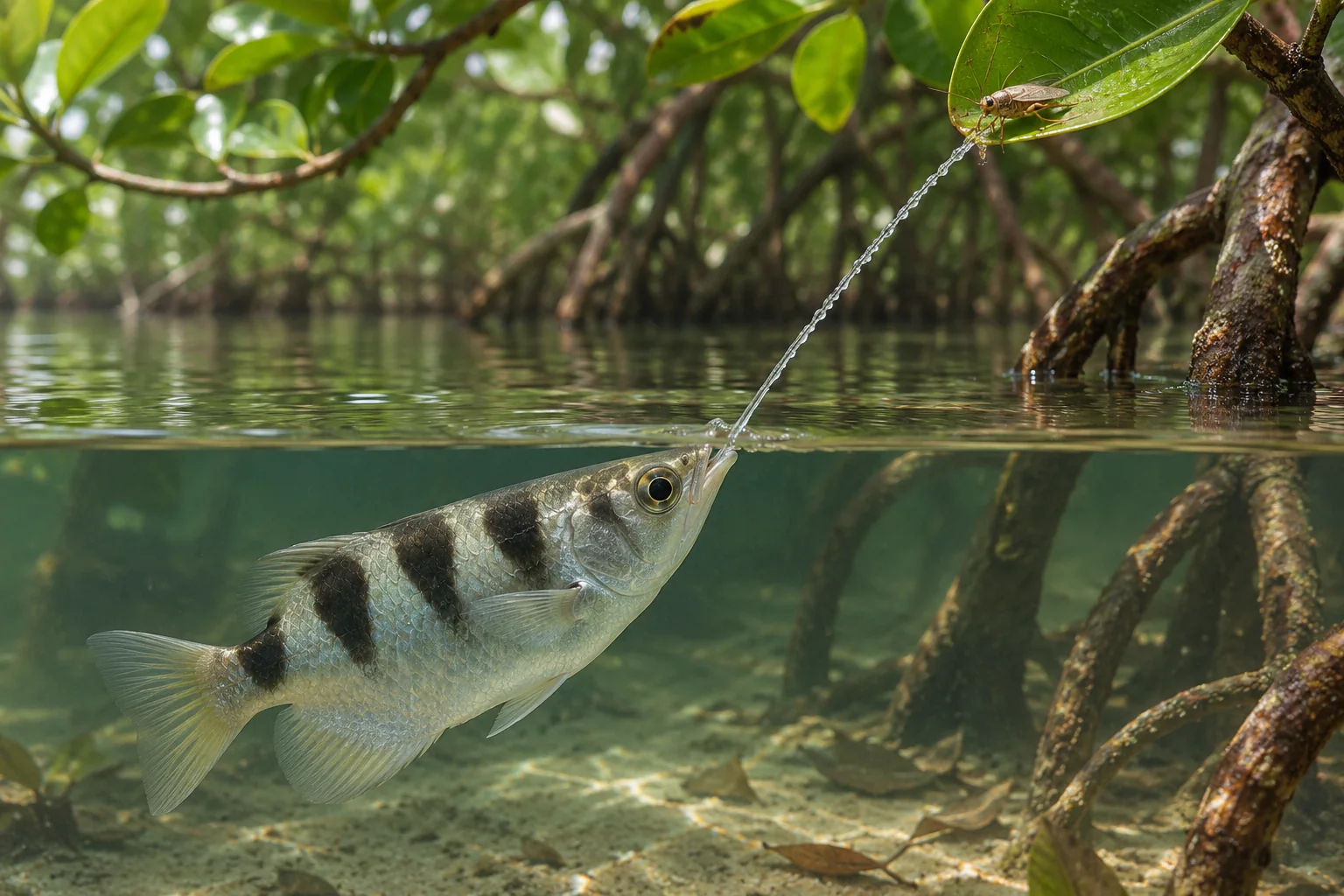
An insect resting on a leaf above a tropical stream seems safely beyond a fish’s reach. An archerfish turns that gap into a hunting opportunity: it brings its mouth to the surface, fires a narrow jet of water and knocks the insect down. The shot has to solve several problems at once. Light bends between air and water, the target may cling to its perch, and the fish must reach the falling meal before another fish does.
Archerfish shoot down insects by shaping a pulse of water so that it becomes concentrated near its target. Their vision, mouth movements and stabilizing fin movements work together. Experiments also show that they can adjust their aim when the conditions affecting a shot change. There is more here than a strong squirt: the fish controls where, when and how its water arrives. [1, 2, 3, 4, 5]
How an archerfish shot works
- The fish identifies an above-water target and positions itself near the surface.
- It aims across the air–water boundary, where refraction changes the target’s apparent location.
- It expels a controlled water pulse through its mouth.
- Later, faster water catches the front of the jet, concentrating the impact.
- The fish moves to intercept prey knocked into the water.
Each step has a different job. Finding a target is a visual problem. Dislodging it is a fluid-mechanics problem. Collecting it is a timing problem. A successful hunt requires the whole sequence, rather than an exceptional performance in only one part.
Why aiming through the surface is difficult
Light changes direction when it crosses between water and air at an angle. For an observer underwater, an object above the surface therefore appears in a displaced direction. The distortion depends on viewing angle, so simply pointing at an apparent position is not generally equivalent to aiming at the real target.
Archerfish are valuable research animals partly because their shots reveal a decision that would otherwise remain hidden. Researchers can present targets, change viewing conditions and measure where the water lands. A review of their visual challenges describes not only refraction but also the difficulty of distinguishing prey against foliage and making decisions while competitors are nearby. [1]
It is tempting to say that the fish calculates the same equations a physicist would write down. That goes beyond the evidence. A behavior can produce an effective correction without the animal representing that correction as a symbolic formula. The useful question is what information the fish uses, how it learns and how its performance changes when that information is disturbed.
The jet becomes more concentrated in flight
A long, uniform stream would distribute its water over time. An insect gripping a leaf is more readily dislodged if a useful amount of momentum arrives in a short interval. High-speed observations have shown how the archerfish’s pulse changes during its journey.
In a 2012 experiment on Toxotes jaculatrix, researchers found that water leaving later in the shot could travel faster than water at the front. The later water catches up, building a larger head that strikes the target abruptly. The study identified an amplification of power outside the fish, through the dynamics of the jet itself. It did not identify a source of extra energy appearing from nowhere. [2]
The distinction between energy and power is useful here. Energy is the amount transferred; power is the rate of transfer. Delivering a given amount in a shorter interval raises the average power during that interval. The fish’s muscles still supply the work, but the moving water redistributes when that work reaches the target.
Imagine two deliveries containing the same total amount of water. One arrives as a gentle trickle over several seconds; the other arrives as a compact pulse. They need not exert the same short-lived force. This is a conceptual comparison, not a numerical reconstruction of a measured archerfish shot.
Different target distances require different timing
Focusing is only useful if it happens at the right place. If the jet concentrates too early, it must continue travelling after that event. If it concentrates too late, the target receives a less concentrated impact. Distance therefore matters to the timing of the shot as well as to its direction.
Research published in 2014 found that archerfish actively adjusted their mouth-opening dynamics for targets at different distances. The result was that the strongest focusing developed shortly before impact. The water pulse was not just a fixed projectile fired harder or softer on every occasion; its formation was being tuned to the task. [3]
This helps explain why the mouth is central to the behavior. A nozzle controls the speed and shape of an outgoing fluid stream. Changing that opening through time changes the sequence of water entering the air. Small adjustments at the source can therefore produce a different event farther along the trajectory.
How the fish keeps its aim steady
Expelling water also affects the animal doing the expelling. A shooter that changes position or orientation at the wrong moment risks moving the launch point of its own jet. The fish’s fins are part of the solution.
A 2021 study recorded rapid fin movements coordinated with shooting. The pectoral fins switched to a synchronized forward movement shortly before the jet began, followed by a backward movement. Pelvic-fin movements were also linked to the sequence, and aspects of the timing depended on target height. These observations show a coordinated whole-body action rather than an isolated mouth movement. [4]
Coordination does not mean that every fin movement is visually dramatic. Some of the most useful actions occur just before the water becomes obvious. That is one reason slow-motion recordings and carefully aligned measurements reveal more than a casual view of a fish apparently sitting still and spitting.
Can an archerfish learn from a miss?
A miss contains information: the water arrived on one side of the target rather than at its centre. In laboratory work, researchers can use such errors to ask whether an animal merely repeats a movement or adapts its output.
A study published in 2024 introduced airflow that displaced shots. The fish adjusted their shooting as trials continued, providing evidence of motor adaptation under the tested conditions. The experiment supports a capacity to update performance when the physical situation changes; it does not prove that all aiming skill is acquired through the same learning process. [5]
The broader lesson is that precision need not be rigid. An effective hunting system can combine an established repertoire with feedback from recent outcomes. Keeping those possibilities separate avoids two misleading extremes: treating the behavior as a perfectly preprogrammed reflex or treating every successful shot as a fresh piece of conscious calculation.
The hunt continues after impact
Knocking prey loose is not the same as possessing it. The food can land away from the shooter’s initial position, and nearby fish may try to take it. Research on archerfish hunting describes this as a combination of skills, including shot adjustment and securing the catch. [6]
This changes how success should be evaluated. A beautiful shot followed by a lost meal is an incomplete hunt. A useful experiment might measure accuracy, the force delivered, the time taken to collect food or the share of prey actually eaten. Those measurements answer related but different questions.
It also explains why archerfish are interesting beyond the unusual spectacle. Their behavior links seeing, acting and responding to a moving outcome. The water jet makes part of that chain visible, but the ecological problem includes the target’s attachment, the environment and the presence of other animals.
What an archerfish does—and does not—demonstrate
| Observation | Careful interpretation |
|---|---|
| The jet concentrates before hitting prey. | Fluid motion concentrates the delivery of momentum; energy conservation still applies. |
| Mouth movements change with target distance. | The fish adjusts shot formation, rather than using one unchanging pulse. |
| Fish adapt to experimental disturbances. | Aiming can be updated under tested conditions; that does not establish a human-like understanding of optics. |
Questions about archerfish shooting
Are archerfish shooting saliva?
The projectile is a jet of water expelled from the mouth. Calling it “spit” describes the action informally, but it can obscure the importance of water flow and nozzle-like mouth movements.
Do they always shoot directly upward?
No. Research examines shots across different angles and target positions. Near-vertical geometry can simplify the refraction problem, but the full behavior cannot be reduced to one fixed angle.
Is accuracy only a matter of powerful muscles?
No. Force matters, but timing, jet formation, visual guidance and body stabilization matter too. Increasing the amount of water without controlling its arrival would not solve every part of the hunt.
Why study a fish squirting water?
Because the visible shot gives researchers a measurable output from a complex sensory and motor task. It connects questions about animal learning with questions about how moving fluids carry force.
Explore related questions
Sources and further reading
Sources checked November 13, 2026. Research abstracts and institutional overviews are identified below; a full-text review of restricted papers is not claimed.
- Archerfish vision: Visual challenges faced by a predator with a unique hunting technique — research review abstract
- Vailati, Zinnato and Cerbino (2012) — How Archer Fish Achieve a Powerful Impact
- Gerullis and Schuster (2014) — Archerfish Actively Control the Hydrodynamics of Their Jets — research abstract
- Archerfish coordinate fin maneuvers with their shots (2021) — research abstract
- The archerfish uses motor adaptation in shooting to correct for changing physical conditions (2024) — research article
- Hunting in archerfish: an ecological perspective on a remarkable combination of skills — research review abstract
Keep exploring.
One remarkable idea at a time—nature, science, history and beyond.
Last updated November 14, 2026.

Barnakle Editorial Team
Barnakle Editorial Team is the collective byline used for Barnakle’s editorial articles. The contributor profile explains the team identity and links to the publication’s editorial policies.
More from the editorial team →