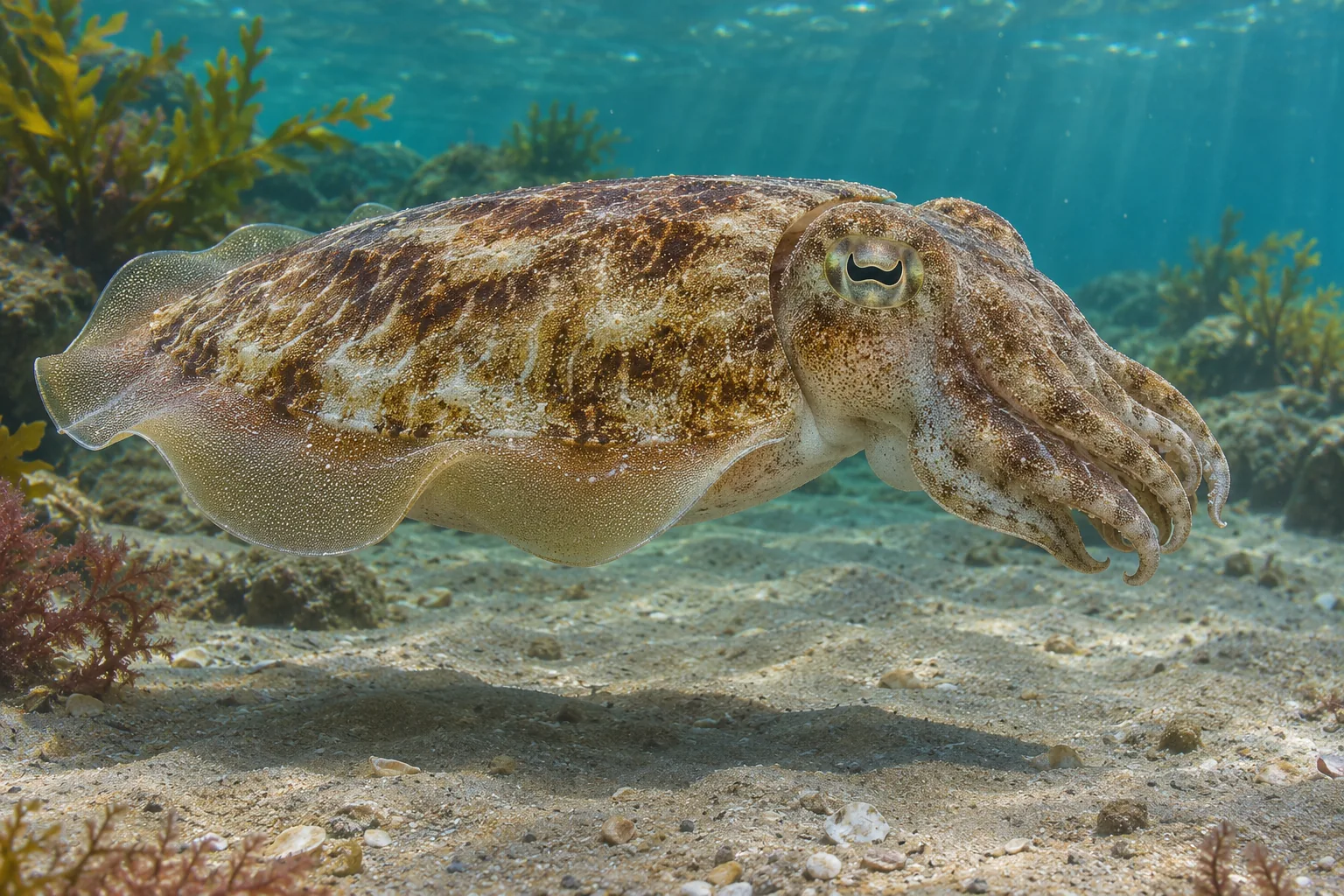
A cuttlefish can hang above the seabed with its fins rippling gently, neither sinking like a stone nor rising like a cork. Its ability to hover depends partly on a structure that is easy to overlook inside its soft body: a pale, chambered internal shell called the cuttlebone.
Cuttlefish control their buoyancy by adjusting liquid within the gas-containing spaces of the cuttlebone. The shell keeps those spaces open against surrounding water pressure. Changing how much liquid the structure contains changes its density, helping balance the weight of the animal. Fins and jet propulsion then handle movement and fine positioning. Buoyancy control and swimming complement each other; they are different jobs. [1, 2, 3, 4]
What is a cuttlebone?
The name suggests a vertebrate bone, but a cuttlebone is an internal shell. Cuttlefish are cephalopod molluscs, related to squid, octopuses and nautiluses. Their shell has become a lightweight structure enclosed within the mantle rather than an external covering surrounding the animal. [7]
Inside, thin partitions divide a highly porous architecture into many chambers. The solid material is only part of the structure; much of its volume is space. Those spaces can contain gas and liquid. A dry cuttlebone lying outside an animal therefore gives only a partial picture of what the living buoyancy system does.
Work on the mechanical design of the common cuttlefish’s shell describes a highly porous calcium-carbonate structure built from chamber walls and supporting partitions. Its geometry combines low weight with resistance to compression. The interest for engineers is not simply that the shell is light, but that it remains mechanically useful despite containing so much empty space. [2]
Why a soft-bodied animal needs a buoyancy system
Any submerged object experiences an upward force equal to the weight of the water it displaces. Whether it rises or sinks depends on the balance between that buoyant force and its own weight. An animal whose average density closely matches seawater can remain at a depth without generating a large continuous supporting force.
Classic measurements on Sepia officinalis found that its living tissues would, without the contribution of the cuttlebone, be somewhat denser than seawater. The comparatively low-density shell offsets that tendency. Those measurements refer to the studied species and specimens; they should not be treated as one exact density applying to every cuttlefish. [3]
A useful imagined comparison is a rigid underwater container. If its outside volume remains unchanged while some internal water is removed, it displaces the same amount of seawater but weighs less. That moves it toward greater positive buoyancy. Adding water reverses the change. This simplified comparison captures the mass balance, although a living cuttlebone has far more intricate compartments and biological controls.
Moving liquid is central to the adjustment
A cuttlefish does not need to carry an airway to the sea surface. The important control is the relative amount of liquid and gas space within its internal shell. Researchers investigating the cuttlebone’s osmotic mechanism examined how differences in dissolved salts could move water across the system’s exchange surfaces. [4]
Osmosis is the movement of water associated with differences in solute concentration across a selectively permeable barrier. By changing ionic conditions, an animal can influence where water tends to move. In the cuttlebone, the relevant exchange region is known as the siphuncular zone.
Removing liquid leaves more internal space available for gas and reduces the structure’s mass for its volume. Allowing more liquid in increases that mass. This is why describing the cuttlebone merely as an air-filled float misses the control mechanism. The distribution of liquid is adjustable, not incidental.
There are also important time scales. A density adjustment through the shell is not equivalent to an immediate flick of a fin. Thinking of the cuttlebone as the animal’s underlying buoyancy setting, with muscular movements handling faster corrections, is more useful than imagining it as a rapid mechanical elevator.
Why the gas does not behave like an ordinary balloon
A soft gas-filled balloon becomes smaller as the surrounding pressure rises. If its displaced volume shrinks, it provides less buoyancy. The rigid cuttlebone provides a different arrangement: the shell bears mechanical load and supports internal spaces instead of allowing them to collapse freely with each increase in pressure.
That does not mean pressure becomes irrelevant. Supporting a gas-containing space at depth requires a structure capable of resisting the pressure difference. The deeper the animal goes, the more demanding that job becomes. Research comparing cuttlebones across species has linked shell morphology with habitat depth. There is no single universal safe depth for every member of the group. [5]
The contrast is between two design problems. A flexible chamber changes shape easily, while a rigid chamber must resist loading. Both strategies have consequences. The cuttlebone solves one problem—keeping useful low-density space—by accepting another: maintaining enough strength in a very lightweight structure.
The chambers are not all identical reservoirs
The internal arrangement also changes as a cuttlebone grows. Research mapping gas and liquid within the common cuttlefish’s shell found differences between newer and older chambers. Newly formed chambers initially contain liquid; the pattern of later liquid removal and gas filling develops across the structure. [6]
The same work found that changes in shell density could occur while the total mass of gas remained approximately constant over the relevant interval. Gas diffusion was relatively slow. That finding is a useful correction to the picture of a cuttlefish rapidly inflating and deflating a miniature air tank.
Where the liquid lies also matters to balance. Moving mass toward one end of an animal can change its tendency to tilt, even if total mass changes only slightly. The shell therefore contributes to posture as well as overall buoyancy. The detailed distribution is a biological arrangement, not a set of identical compartments that all empty together.
Fins and jet propulsion still matter
Neutral buoyancy does not make an animal motionless. Water moves, prey moves and the animal must change direction. A cuttlefish uses the fin running around its mantle for controlled movement, and it can expel water for jet propulsion. The cuttlebone reduces the underlying tendency to rise or sink; it does not replace those movements. [1]
Imagine trying to hold a heavy object at a fixed height with your arms. Making its effective weight smaller would help, but it would not steer the object or stop it drifting sideways. Buoyancy has a comparable division of labour with propulsion. Reducing the vertical imbalance leaves the muscular system to handle position and motion.
This also explains why a hovering cuttlefish may still show continuous fin movements. A visible movement does not mean the buoyancy system has failed. Fine control can continue around a nearly balanced average state, just as small adjustments keep many moving systems near a desired position.
A cuttlebone is not the same as a fish’s swim bladder
| Feature | Cuttlebone | Typical flexible gas bladder |
|---|---|---|
| Main structure | Rigid, chambered internal shell | Compliant gas-containing organ |
| Important control | Liquid distribution within a porous shell | Gas amount and pressure–volume relationships |
| Mechanical challenge | Resisting external pressure while remaining light | Managing gas and volume as pressure changes |
This comparison describes broad principles, not every variation among fishes or cephalopods. It is especially important not to assume that a squid, octopus and cuttlefish all use the same internal support. Their shared ancestry includes substantial differences in the shells and tissues retained by living species. [5, 7]
Why engineers study the structure
Low-density materials often face a compromise: adding pores reduces weight but can also reduce strength. Cuttlebone research explores how the arrangement of walls and partitions affects that trade-off. Experiments and structural analysis have investigated how its architecture deforms under compression. [2]
That does not mean a building or vehicle can simply be made from enlarged cuttlebone. Scale, material properties, loading direction and manufacturing all matter. The transferable idea is a structural principle: where material is placed can be as important as how much material is used. A biological shell provides a system to study, rather than a ready-made engineering blueprint.
Questions about cuttlefish buoyancy
Is the cuttlebone an actual bone?
No. It is a modified internal shell in a mollusc. Its name reflects its appearance and firmness, not a close match to the bones in a fish or mammal.
Does the cuttlefish fill it with air from above the sea?
No surface air supply is needed. The system involves internal gas-containing spaces, exchange processes and regulation of liquid within the shell.
Can the animal change depth instantly by changing its cuttlebone?
Fast position changes involve swimming and jet propulsion. Buoyancy regulation through the shell works alongside those faster muscular actions.
Why can a cuttlefish hover with so little obvious effort?
A near balance between weight and buoyancy reduces the force needed simply to avoid sinking. The fins can then make the smaller corrections needed for posture and movement.
Explore related questions
Sources and further reading
Sources checked November 13, 2026. Research abstracts and institutional overviews are identified below; a full-text review of restricted papers is not claimed.
- Waikīkī Aquarium, University of Hawaiʻi — Cuttlefish
- Mechanical design of the highly porous cuttlebone: A bioceramic hard buoyancy tank for cuttlefish (2020) — research article
- Denton and Gilpin-Brown (1961) — The Buoyancy of the Cuttlefish, Sepia officinalis — published extract
- The Osmotic Mechanism of the Cuttlebone (1961) — published research extract
- Cuttlebone morphology limits habitat depth in eleven species of Sepia (2000) — research abstract
- Denton and Gilpin-Brown (1961) — The Distribution of Gas and Liquid within the Cuttlebone — research paper PDF
- Smithsonian Ocean — Cephalopods: Octopus, Squid, Cuttlefish, and Nautilus
Keep exploring.
One remarkable idea at a time—nature, science, history and beyond.
Last updated November 14, 2026.

Barnakle Editorial Team
Barnakle Editorial Team is the collective byline used for Barnakle’s editorial articles. The contributor profile explains the team identity and links to the publication’s editorial policies.
More from the editorial team →