In 2010, someone who knew Jupiter by sight could have drawn it wrong. One of the planet’s most conspicuous brown stripes, the South Equatorial Belt, had faded until it looked pale. By 2011 the dark belt was back. Jupiter’s familiar markings are weather, and the clouds that let us see a stripe can change even while the planet keeps spinning underneath them.[3]
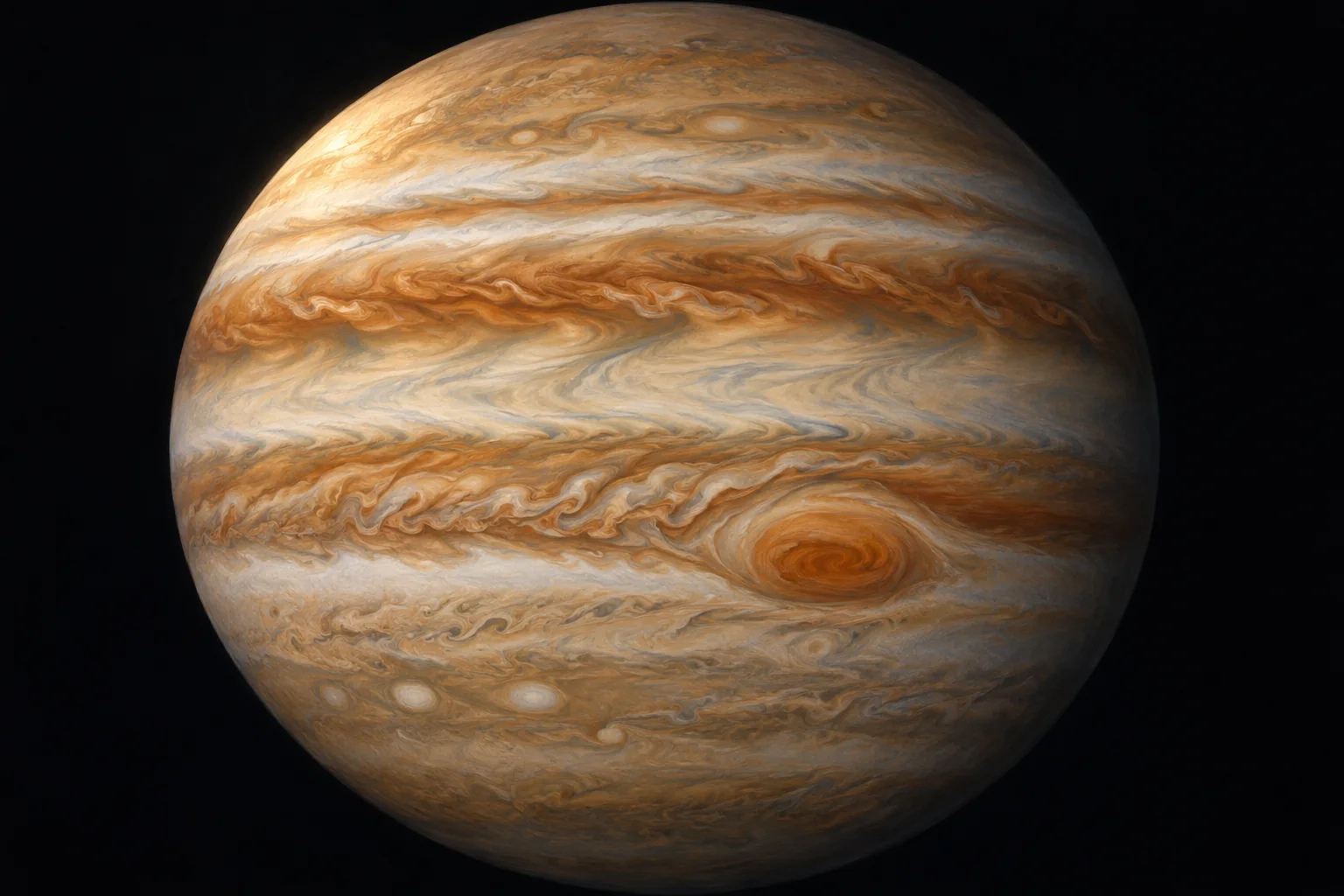
The stripes have two ingredients. Fast winds organize Jupiter’s atmosphere into broad lanes that follow lines of latitude. Within those lanes, differences in the height, thickness and composition of the clouds determine how much sunlight comes back to us. Astronomers call the brighter bands zones and the darker ones belts. A telescope shows the contrast directly. Finding out what moves beneath it took a spacecraft that could measure gravity.[2, 4, 5]
Why the stripes circle the equator
Imagine following a small, recognizable cloud tuft in a series of Jupiter pictures. At first it races across the face of the planet along with almost everything else you can see. Jupiter takes about ten hours to turn once. Compare pictures taken a whole turn apart, however, and another movement emerges. Cloud tufts at different latitudes change position relative to each other. They are riding winds with different speeds and sometimes opposite directions relative to the rotating planet.[1]
Jupiter’s rapid rotation helps organize moving gas into powerful eastward and westward jets. A cloud caught in one of these currents travels much more readily along its latitude band than across the entire pattern. Where adjacent streams slide past each other, small features can stretch into ribbons or curl into eddies. Seen from far away, the bands look almost like ruled lines. Seen close up, their edges look like weather on a very lively day.[1, 5]
There are two quite different motions in that picture. One carries a marking from the middle of the visible disk around the limb and out of sight. The other changes its position relative to a nearby marking. An observer who measured only how long a spot stayed visible would mix the two together. Tracking several features over successive rotations lets an observer see which changes belong to the local winds.
What makes one lane lighter than the next?
A visible-light image records sunlight that has travelled into the atmosphere and scattered back toward the camera. A thick, high cloud can intercept much of that light before it reaches darker material farther down. Bright zones contain reflective clouds associated with ammonia ice. Darker material mixed among the clouds also affects the belts’ appearance. Identifying a particular chemical from a shade of brown alone is much harder than naming the band.[2]
Think of a pale veil stretched over a patterned surface. The underlying pattern loses contrast as the veil becomes thicker. From a photograph alone, a lighter patch could mean that the underlying material changed or that more light scattered above it. Jupiter adds a third complication. A camera can observe light outside the range of human sight, where the gases above the clouds absorb and scatter it differently.[2]
Cassini demonstrated this by photographing the same planet through different filters. Its blue-light view showed the familiar stripes. In ultraviolet light the deeper cloud pattern was much harder to see because the gas above it scattered so much of the incoming light. Features high in the atmosphere stood out differently once again in the near infrared. The planet had no need to change its weather between exposures for the pictures to look strikingly different.[2]
The year a dark belt turned pale
The South Equatorial Belt gave researchers a natural test of the veil idea. Observations in the mid-infrared carried information about the clouds and ammonia at particular pressure levels. Researchers compared those measurements over a span of years that included the fade. As the belt brightened, the inferred cloud thickness and ammonia abundance increased. When the familiar dark colouring returned, those measurements fell back toward their earlier values.[3]
The dates matter. A single pale image might record unusual weather, a different filter or a difference in processing. Measurements made before, during and after the event reveal a sequence. They allow a much sharper question than asking which colour Jupiter “really” is. What else changed in that latitude band while it was pale? A cloud measurement that tracks the fade and recovery is a better clue than a colour swatch.
How deep does a stripe go?
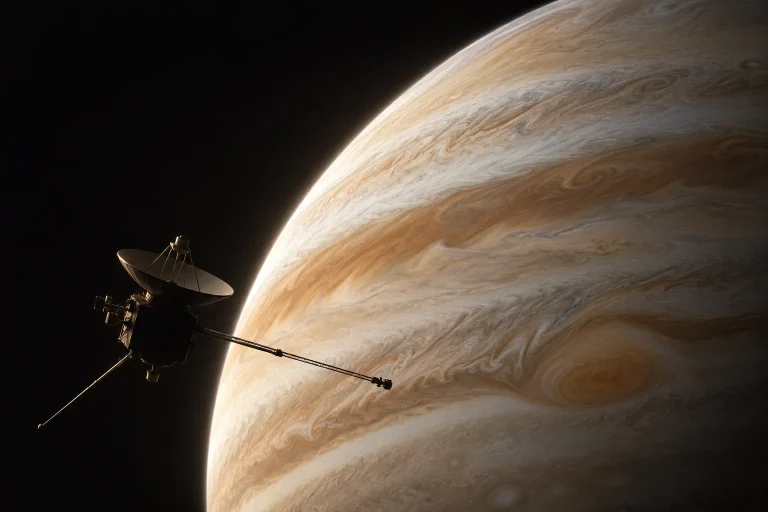
The distance from which sunlight last scattered tells us about the visible clouds. The depth to which gas moves with the jets is a separate measurement. NASA’s Juno mission used small variations in Jupiter’s gravity field to investigate the second question. Moving gas redistributes mass, and the distribution of mass affects the gravitational pull on a passing spacecraft. Scientists compared what they measured with models of flows extending different distances below the clouds.[4]
The result put the depth of the east–west flows at roughly 3,000 kilometres. That figure refers to moving material. It would be a mistake to picture a brown cloud extending down that entire distance with the same colour all the way through. A useful comparison is the distinction between the white foam tracing a current and the water carrying it. The visible tracer can occupy a much thinner layer than the motion it reveals.[4]
A way to read the next picture
Start with one of the two dark belts bordering the bright equatorial region. Follow it across the disk, then choose one small oval or streak along its edge. In a sequence of frames the belt remains easy to locate while the small marking tells you which portion of it has rotated into view. The Great Red Spot is an especially convenient landmark when it is on the visible hemisphere. Cassini’s full-rotation sequence follows it out of view and back again.[1]
Now ask which observation you would need to answer your own question. Two images some time apart can reveal drift. Two filters can reveal different layers. A gravity measurement can constrain motion far below the clouds. Taken together, these views explain how Jupiter can remain instantly recognizable from one night to the next and still surprise an observer who remembers precisely where a dark stripe ought to be.
Keep exploring
Follow how scientists study atmospheres on distant worlds and what keeps cloud particles aloft on Earth.
Sources and further reading
- NASA Science — Full Rotation
- NASA Science — Three Wavelengths
- NASA — Assessing the Time Variability of Jupiter’s Tropospheric Properties from 1996 to 2011
- NASA Science — Juno Reveals the Depth of Jupiter’s Colored Bands
- NASA — Colors on the Wind
Keep exploring.
One remarkable idea at a time—nature, science, history and beyond.
Last updated November 19, 2026.

Barnakle Editorial Team
Barnakle Editorial Team is the collective byline used for Barnakle’s editorial articles. The contributor profile explains the team identity and links to the publication’s editorial policies.
More from the editorial team →