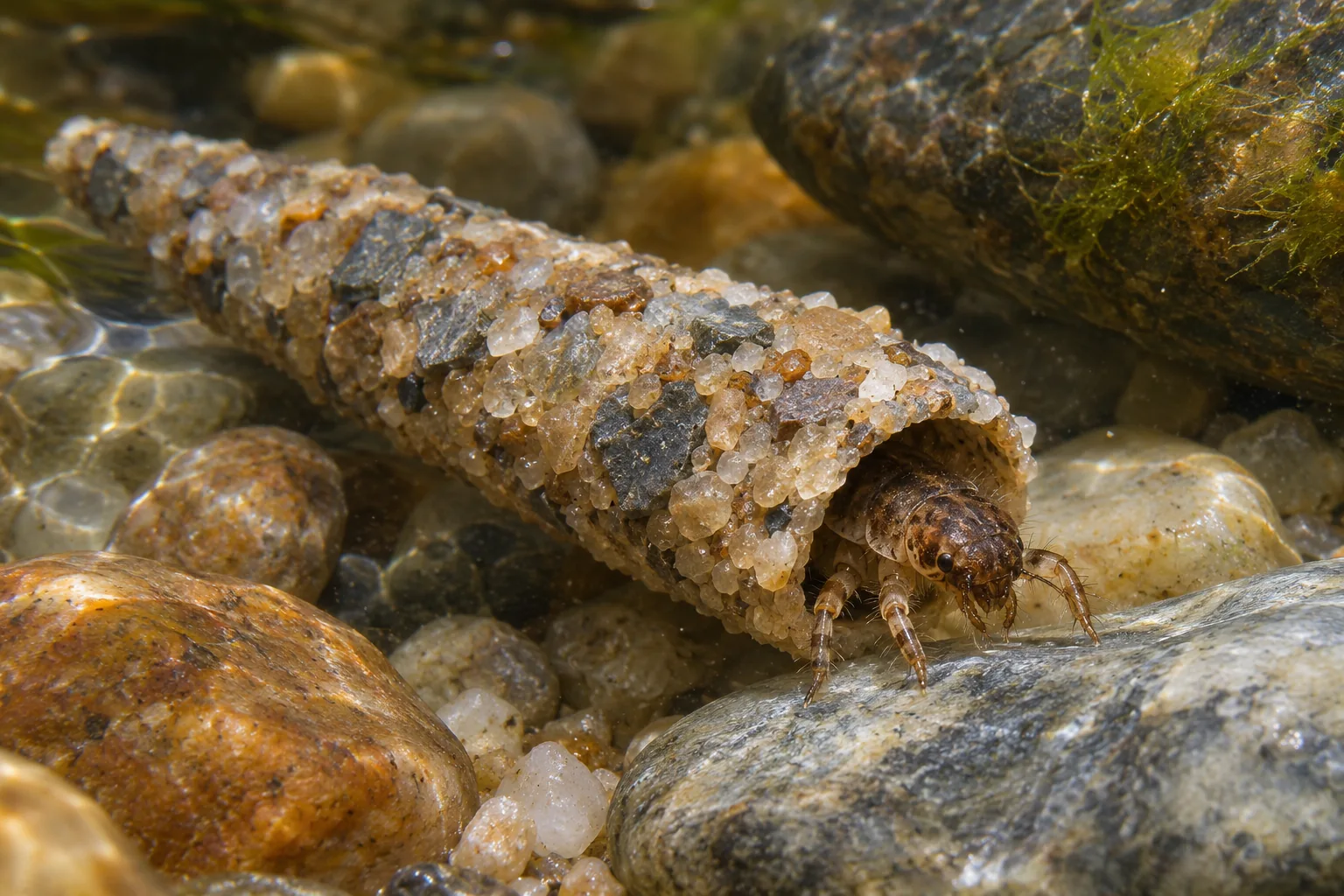
A small tube of gravel is making its way across the bottom of a stream. The current runs one way, but the tube pauses, turns and sets off in another direction. Look at its leading end and the puzzle resolves itself. A brown head and three pairs of legs project from the opening. The insect inside is a caddisfly larva, and the gravel is a shelter it assembled for itself.[1]
Many caddisfly larvae use silk that works underwater to join grains of sand, tiny stones or pieces of plants into portable cases. The silk provides the connections, while the material collected from the streambed supplies most of the visible wall. A larva can reach out to feed or add material at the opening while its softer abdomen remains inside. In a clear stream it is often easier to see the building move than to see its builder.[1, 2]
What holds a pile of sand together?
Tip a spoonful of wet sand back into a stream and the grains lose the temporary shape they held on the spoon. A caddisfly solves a different problem from someone patting sand into a mould. Its wall must remain a wall while the outside is soaking wet, while the animal crawls and while water flows past openings in the structure. The contacts between neighbouring grains need a lasting connection.
The larva draws silk from a spinneret near its mouth. Researchers studying stone-building caddisworms describe a flattened silk fibre with an adhesive outer layer and a tough inner part. That arrangement gives a strip of silk two jobs. Its surface makes contact with a wet building piece, while its core carries tension along the strip. A stone need not fit its neighbour perfectly if a strip can bridge the small gap between them.[2]
Imagine looking closely enough to remove just the mineral grains from such a case. What is left would have to tell you where the larva had laid silk. Removing just the silk would produce a very different result, a collection of loose pieces with little to show which piece once sat beside which. The larva contributes both a material made inside its body and a particular arrangement of objects found outside it.
Building from the opening outward
The front of a tubular case is a convenient place to work. A larva can hold or position a new piece near the rim, bring its spinneret to the joint and add silk while remaining largely sheltered. In forms that extend their tubes as they grow, new construction takes place at the front. The larva can trim material at the rear. A wider addition at one end and removal at the other allow a growing animal to keep using the shelter.[1, 5]
That sequence helps explain a tapered case. The narrow end can include material placed when the larva was smaller. The broader front fits the animal at a later size. The difference is easier to visualize if you picture adding short sections to a sleeve than if you picture stretching an existing shell. No amount of stretching would turn yesterday’s tiny pebbles into larger ones.
A University of Utah laboratory example makes the direction of construction unusually easy to see. A larva carrying a case of natural grains was given glass beads and used the beads to extend it. The old and new materials remained visible in adjoining parts of the same case. A photograph of the result records a change in the larva’s building supplies. It would take a separate choice experiment, with both materials on offer together, to establish which the animal preferred.[3]
One order of insects, many kinds of shelter
A case need not look like a miniature gravel pipe. Different caddisflies use fragments of twigs, leaf pieces and other local material. Some mineral cases form low domes rather than long tubes. The Missouri Department of Conservation illustrates plant-fibre cases, pebble cases and even spiral cases. A field observer who searches only for one textbook shape can pass over several kinds of builder in the same outing.[1, 4]
There is another reason to look beyond the tube. The insect order also includes larvae with different ways of using silk. Some build fixed retreats and nets instead of carrying a portable home. A net stretched across moving water can intercept food. A tube carried by a walking insect has to protect the body while allowing the legs to reach the ground. The availability of a useful wet adhesive leaves room for both solutions.[1]
What happens to the sand after the insect leaves?
Suppose you place an empty gravel case in a current and compare it with the same case gently taken apart. Which will move first, the assembled structure or the individual grains? It is tempting to choose the loose grains because each weighs so little. Yet the water meets a different outline when it reaches the intact case. A hollow tube can roll, and its outer dimensions are much larger than those of the grains in its wall.
Researchers tested the question in a flume, a channel in which the flow can be controlled. They compared empty cases from three species with the sediment recovered from those same cases. The two tube-shaped designs began moving more readily than their constituent grains. The third design, a low dome, resisted rolling and required the greatest bed shear stress of the three to start moving, despite its small mass. Geometry changed the outcome.[4]
The word empty matters. A living larva can hold onto the bottom, choose a route and move its case. The flume comparison isolated what the structure itself did after its occupant was gone. A case could therefore influence sediment transport at two distinct times, first when an animal carries its building materials across the bed and again when the abandoned structure meets a stronger current.[4]
Reading a moving case
From the bank, first locate the end that advances when the case moves. Look for the legs taking short steps, then follow the change from the widest part of the rim toward the rear. Differences in colour or grain size may help you distinguish separate additions. Matching local gravel can make the case almost disappear as soon as the larva stops walking.
Its most easily overlooked feature is the one that made all the other features possible. The stones are conspicuous. The silk connections are small and partly hidden. Yet it is those connections that let a collection of streambed grains move upstream together for a few moments, at the pace set by an insect inside.
Keep exploring
Compare two materials and scales at work here, from silk spun by a spider to sediment moving through river channels.
Sources and further reading
- Missouri Department of Conservation — Caddisfly Larvae
- Ashton, Wang and Stewart — The adhesive tape-like silk of aquatic caddisworms
- University of Utah — Caddisfly Larva in Its Mobile Home
- Mason and colleagues — Aquatic Insect Bioconstructions Modify Fine-Sediment Entrainment and Mobility
- Vivian — Caddisfly updates and assessment of threats
Keep exploring.
We’ll email you when the first edition is ready.
Last updated November 25, 2026.

Barnakle Editorial Team
Barnakle Editorial Team is the collective byline used for Barnakle’s editorial articles. The contributor profile explains the team identity and links to the publication’s editorial policies.
More from the editorial team →