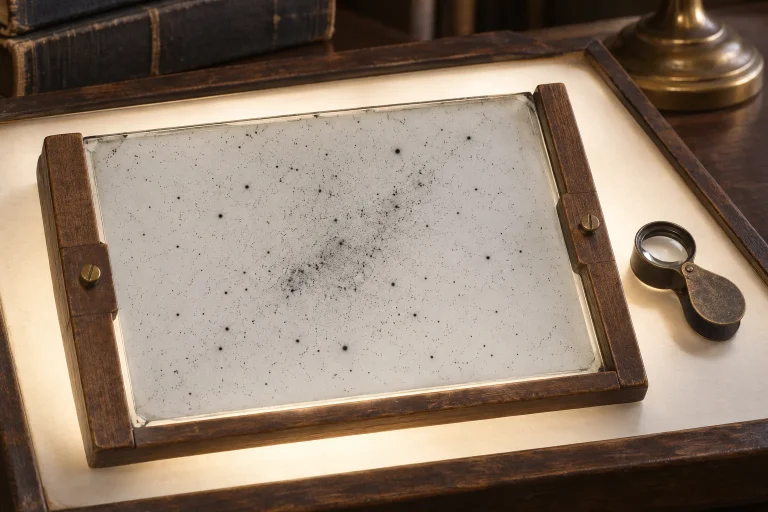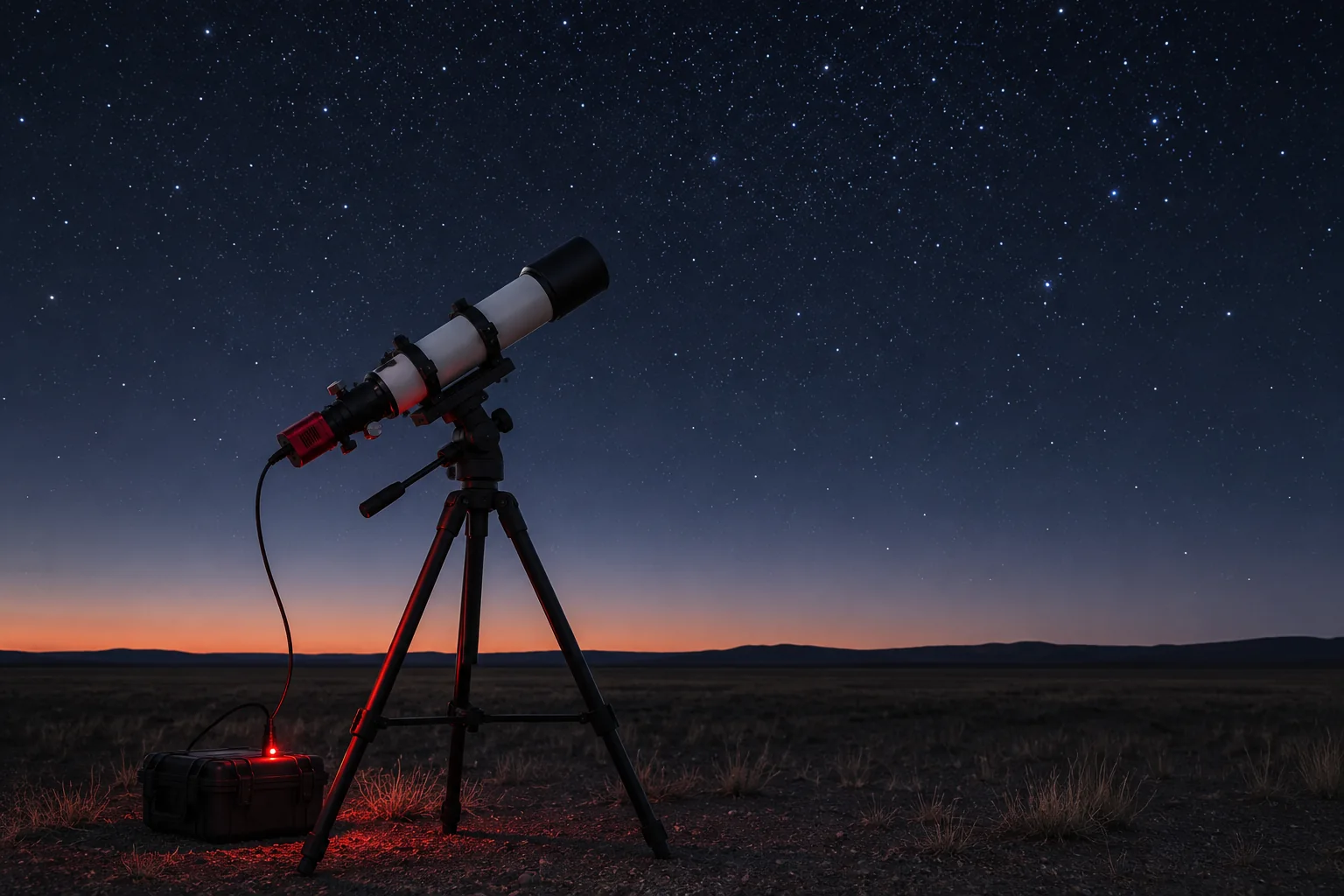
Centre a star in a telescope, step aside to let someone else look, and it may already have wandered to the edge of the eyepiece. Switch on a well-aligned tracking mount and the star can hang in the middle while several people take turns. The lens is doing the same job in both cases. The part that made the difference is down at the joint between the telescope and the tripod.
A tracking mount turns the telescope to compensate for Earth’s rotation. One common design lines up an axle parallel to Earth’s axis and turns it at the rate the stars appear to circle the sky. Another moves the telescope up or down and sideways at the same time. Both can keep a star centred. Attach a camera for a long exposure, however, and the two designs can produce quite different pictures.[1, 2]
The clock a star would keep
A day on a household clock is based on the Sun. By the time Earth completes a turn relative to distant stars, it has also travelled a short way around its orbit. It has to turn a little farther for the Sun to return to the same place relative to a local meridian, the imaginary north–south line across the sky. A distant star crosses that line again after about 23 hours and 56 minutes. Astronomers call this interval a sidereal day.[3]
The four-minute difference is easy to put on a larger calendar. If a particular star crosses the meridian around ten tonight, a month from now it will cross roughly two hours earlier by the clock, assuming the same time zone and no clock change. That gradual shift determines which constellations greet us after dinner as the seasons pass. Over a single observing session, the much faster motion due to Earth’s turning is the one a mount has to follow.[3]
A full circle divided by a sidereal day gives a rotation rate a little over 15 degrees an hour. Near the celestial equator, an untracked star can therefore cross a true field of view half a degree wide in about two minutes. If you left it in the middle, it has only half that distance to go before it slips out. Near a celestial pole, the same turn of Earth carries a star along a much smaller circle, and the crossing takes longer. That is why the two-minute example needs both a field width and a location in the sky.
How one axle can follow a whole sky
Picture a globe with a pin through the two poles. Extend that pin far into space and you have the direction of Earth’s spin axis. An equatorial mount has its own axle, called the polar or right ascension axis. Once it is parallel to the imaginary pin, turning that axle relative to the ground can cancel the ground’s rotation beneath the telescope. The telescope tube itself is free to point well away from the pole, at whatever star you want to observe.[1, 4]
This distinction clears up a common puzzle about polar alignment. At a northern observing site you might first aim the mount’s polar axis near Polaris. A few minutes later the tube might be looking low in the southeast. The alignment still works because you moved the telescope on its bearings while leaving the direction of the polar axle alone. Polaris is a convenient marker close to the north celestial pole. More precise alignment allows for the distance between the star and the actual pole.[4]
The second axle lets the observer choose how far north or south of the celestial equator to point. Once a distant star is centred and the polar axis accurately aligned, its north–south setting changes very little during an ordinary session. The drive can do the routine work on the polar axle alone. A simple motor that keeps time can follow a star someone found by hand. A computer that can find thousands of objects adds a different ability. Finding a target and staying with it are separate jobs.[1]
What happens on a mount that turns like a camera tripod?
An altitude-azimuth mount is easy to picture. It can tip the tube towards the zenith, directly overhead, and swivel it around the horizon. A star climbing in the east needs a combination of those motions. Later in the evening the same star might be near the highest point of its arc, with its height barely changing for a while. A drive that can vary both motions can keep the target in the middle as the required combination changes.[1, 2]
Now imagine a clock face painted on a transparent sheet over that star. Its centre stays pinned to the target. As the telescope follows it, the top of the imagined clock, defined relative to the stars, need not stay towards the top of a camera attached to the tube. Keeping the centre in place controls where the telescope points. Controlling which way the rest of the picture faces requires one more piece of information. Astronomers call the resulting change in orientation field rotation.[2]
For someone at an eyepiece that slow turn may be inconsequential. A camera adds light for the whole time its shutter is open. During a long exposure a star at the frame’s edge can sweep an arc while the target on the rotation axis stays sharp. The farther a point lies from the centre, the farther it must travel through the same small angle. A sharp central star and streaked corners can therefore coexist in a telescope that has kept its target beautifully centred.[2]
What the corners of a photograph reveal
Draw two dots on a sheet of paper, one near the middle and one by the edge. Press a pencil point on the central dot and rotate the sheet a little. The edge dot moves through a much longer path. That small experiment also explains why lining up the centres of two photographs is sometimes insufficient. You may need to turn one frame slightly before the stars at the corners line up too. Rotating completed frames can help combine short exposures. It cannot recover the precise original shape of a star that smeared during a single exposure.[2]
One solution is to rotate the instrument as the telescope tracks. The camera then compensates for the turning star field around the line of sight. Professional altitude-azimuth telescopes use instrument rotators for this purpose. An accurately aligned equatorial mount solves the same geometrical problem through the orientation of its main axle. In either case, a successful long exposure has met two conditions: light from the target kept landing in one place, and the surrounding stars kept their places around it.[2, 5]
At the eyepiece the result looks wonderfully uneventful. One person steps back, another leans in, and the same little star is waiting. Down on the tripod a bearing has been moving the whole time. The best evidence that it moved just enough is that nobody looking through the telescope had to think about it.
Keep exploring
Curved trails record Earth’s turn in a fixed camera. Twinkling adds a separate disturbance even when a mount tracks perfectly.
Sources and further reading
- British Astronomical Association — Mounting your telescope
- Royal Astronomical Society of Canada, Calgary Centre — Field rotation
- NASA Glenn Research Center — Telling time by the stars
- Sky & Telescope — Accurate polar alignment
- European Southern Observatory — Requirements for VLT Unit Telescope instruments, instrument rotator
Keep exploring.
One remarkable idea at a time—nature, science, history and beyond.
Last updated November 20, 2026.

Barnakle Editorial Team
Barnakle Editorial Team is the collective byline used for Barnakle’s editorial articles. The contributor profile explains the team identity and links to the publication’s editorial policies.
More from the editorial team →