A television presenter can read a name with several unfamiliar syllables while appearing to look you straight in the eye. Pause the picture and there is no writing across the presenter’s face. Walk to the presenter’s end of the studio, however, and whole lines of script appear to float in front of the camera lens. The two views are possible because light reaches the two observers along different routes.[1, 2]
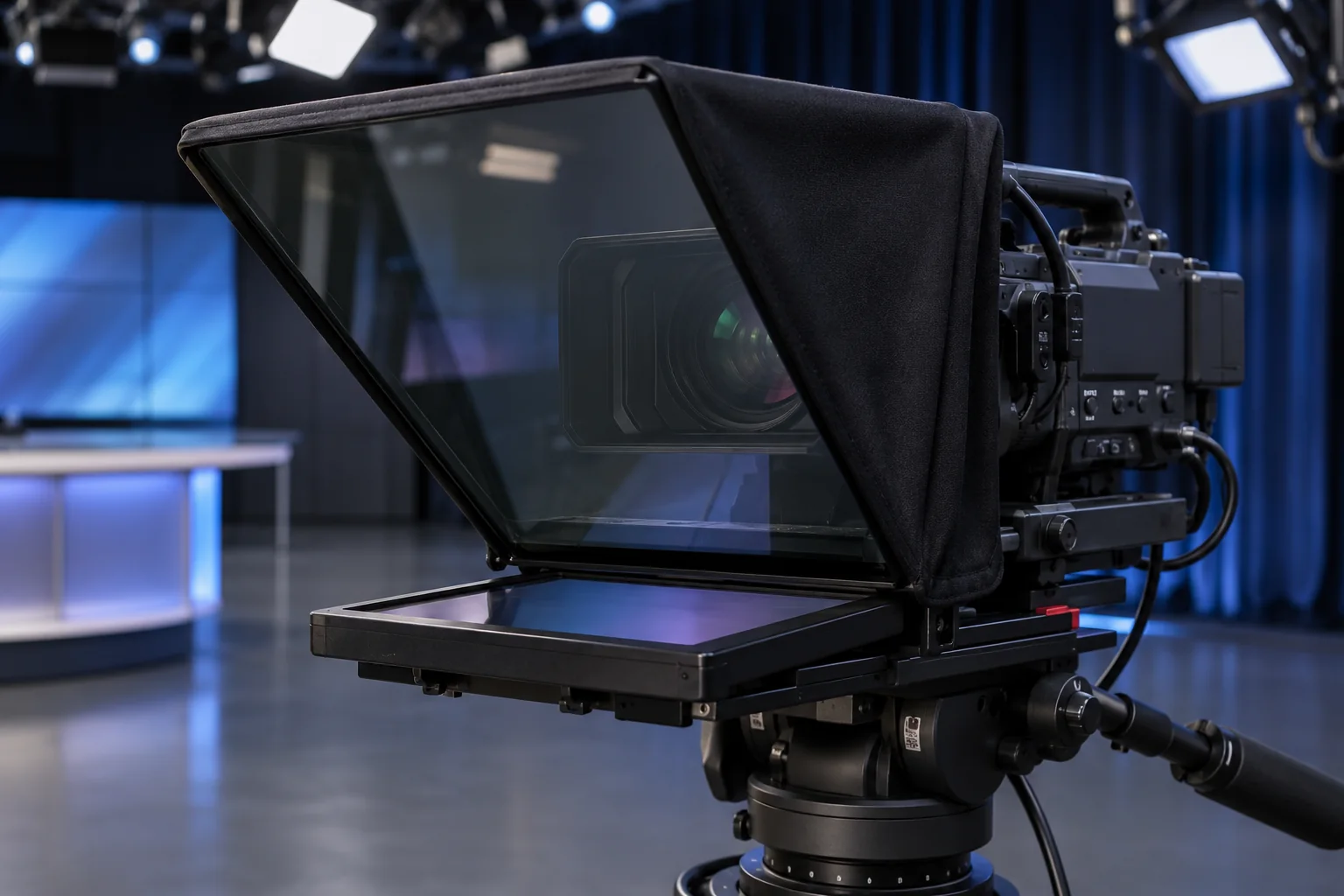
A studio teleprompter puts a tilted sheet of partially reflective glass in front of the camera. A monitor below it faces upwards. Light from the words on the monitor reflects towards the presenter. Light from the presenter passes through the glass towards the camera. Both routes cross at the glass, but the lens receives a different view from the person reading.[1, 2]
Follow the light from a single letter
Pick a white dot at the top of a letter on the screen. Light leaves that dot in many directions. Some of it travels upwards and meets the glass, which is usually mounted at about 45 degrees. The law of reflection gives the useful part of the arrangement. Measured from a line perpendicular to the glass, the angle at which a ray arrives equals the angle at which it leaves. The tilted surface can fold an upward path into a roughly horizontal one aimed at the reader.[1, 3]
Now stand in the presenter’s position. Your eyes receive rays that spread out as though the dot lay behind the tilted surface. Trace them backwards in a straight line and they appear to come from the space in front of the camera. Opticians call that apparent location a virtual image. Hold a piece of paper there and it will not catch a projected letter. The real source of the light is still the monitor below, even though that is not where you look to read the line.[3]
One consequence is easy to miss in a drawing. The reader does not have to focus on the glass itself. A speck of dust stuck to the glass and the reflected letters are at different optical distances. This is familiar from an ordinary mirror. You can look at a mark on its surface or at the reflected room beyond it. Both are visible in the same direction, yet the room appears to extend behind the mark.[3]
What reaches the lens on the other side?
Start a second ray at the presenter’s cheek. Studio light illuminating the face scatters in many directions. Some of it heads towards the lens. The prompter glass transmits a portion of that light, so it continues into the camera and contributes to the image. A portion also reflects away. The sheet sacrifices some light in each route in exchange for placing a readable reflection on the camera’s line of sight.[1, 2]
The glass needs no way to distinguish writing from skin. Light coming up from the screen and light heading towards the camera arrive from different directions. The main reflection of the screen goes towards the presenter. Its transmitted portion keeps going through the glass along an upward path. Neither of those directions takes the bright lettering straight down the camera lens. If the system instead painted opaque white letters on the glass, those marks would physically obstruct the view.[1, 2]
An ordinary window gives a good preview of the effect. At dusk you may be able to see both a tree outside and a lamp behind you reflected in the pane. Switch the lamp off and the tree becomes easier to see, although nothing about the window has changed. In the studio, the dark hood behind the prompter glass gives the lettering a relatively dark background and helps keep stray light away from the lens. The desired reflection has less competing with it.[2, 4]
Why the screen looks strange from above
Lean over the actual display while a prompter is running and the letters can appear reversed. The software or display electronics prepare the image for the reflection the reader will see. The useful test is to look at an asymmetric word from the presenter’s position. If the word reads correctly there, the monitor has supplied the orientation the optical path needs. Reading the monitor itself was never the goal.[1, 4]
A manufacturer may describe a piece of glass with two percentages. For example, Autocue describes a beamsplitter that transmits about 70 percent of the light and reflects about 30 percent. The split belongs to that product. It is separate from the angle at which the sheet is installed. A glass panel tilted at 45 degrees does not automatically divide the light in half. The angle steers the reflection. The optical coating helps determine how much light goes each way.[1, 3]
What changed when the script moved in front of the lens?
Earlier prompting devices could get lines close to the camera without putting them directly on its axis. Smithsonian Magazine describes a 1950 television production using a prompting device mounted beside the camera. The presenter could read without looking down at a script, yet still seem to be looking past the viewer. Later through-the-lens prompting put the apparent text where the audience expected the performer to be looking. A small optical change solved a distinctly human problem.[5]
The distance from camera to performer shows why the change helps. Suppose a cue card sits twenty centimetres to the right of a lens and the speaker stands two metres away. Looking at the card turns the gaze by roughly six degrees. Move the card into the apparent position of the lens and that sideways offset largely disappears. A very wide line of text could still make a close reader’s eyes travel visibly from side to side. The optics bring the script to the right place. They do not hold the speaker’s eyes still.
A lectern prompter uses the same reflection for a different reason. A monitor at the base of a stand sends text up to a glass panel near the speaker’s eye level. A pair of stands can give a speaker two directions in which to turn while addressing a room. The audience sees mostly through the panels, while the speaker is in position to receive the bright reflection. The whole arrangement works even when there is no camera behind either pane.[1]
Look again at the television presenter. The words they see and the face you see have one piece of glass in common. To understand why the words disappear from your version of the scene, begin at the screen, begin again at the presenter’s cheek, and follow each ray to its destination.
Keep exploring
Explore how a mirror changes the view of a word and why a sheet of glass allows visible light to pass through.
Sources and further reading
- Autocue — How a prompter works
- B&H — Anatomy of a teleprompter
- OpenStax University Physics — Images formed by plane mirrors
- Teleprompter.com — How a teleprompter mirror works
- Smithsonian Magazine — A brief history of the teleprompter
Keep exploring.
One remarkable idea at a time—nature, science, history and beyond.
Last updated November 19, 2026.

Barnakle Editorial Team
Barnakle Editorial Team is the collective byline used for Barnakle’s editorial articles. The contributor profile explains the team identity and links to the publication’s editorial policies.
More from the editorial team →