The first clue to helium was almost the colour of the wrong element. Astronomers knew a familiar pair of yellow lines belonging to sodium. In light from gas at the edge of the Sun, they found another yellow line close by. It sat just far enough away from the familiar pair to cause trouble. A slightly different shade of yellow in sunlight would be an unlikely place to look for a new member of the periodic table. Yet that is where this particular search began.[1, 2]
In 1868, observations of the Sun’s atmosphere brought the unexplained line to astronomers’ attention. The proposed solar substance acquired the name helium, from the Greek word for the Sun. In 1895, William Ramsay obtained gas from a mineral on Earth that showed the same yellow signature. Nearly three decades separate the two events. The first gave scientists something precise to look for. The second gave them actual material to test.[1, 3, 4]
A brief view of the Sun's edge
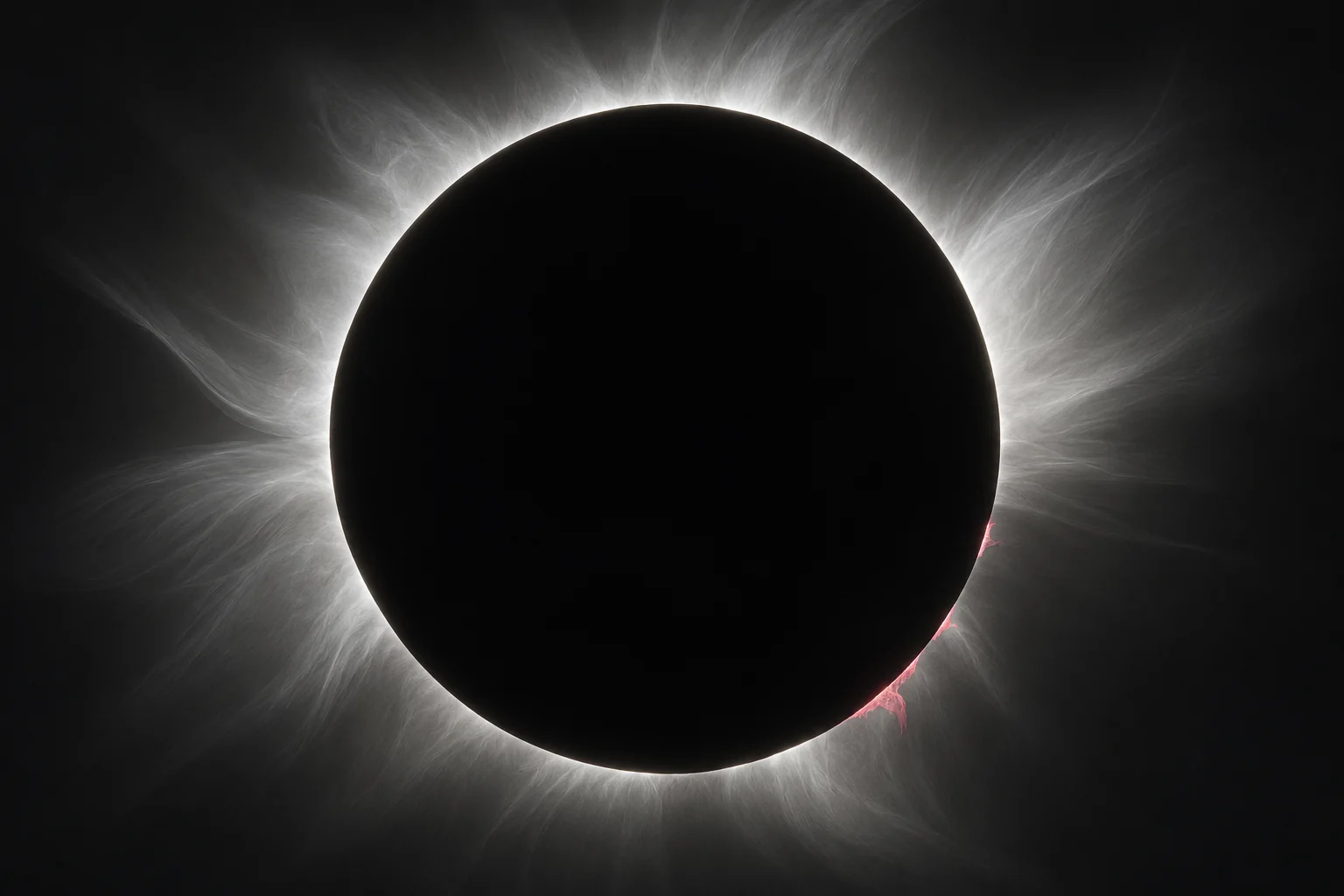
During the total solar eclipse of August 18, 1868, the French astronomer Jules Janssen observed from India. As the Moon covered the Sun’s brilliant face, gas protruding beyond its edge became much easier to study. These features are called prominences. To an observer interested in their chemistry, their outline was only part of the attraction. Janssen could send some of their light through a spectroscope and see which colours made up their glow.[1]
It helps to imagine two pictures made from the same beam. In the first, a telescope brings the light together to show where a prominence lies along the Sun’s rim. In the second, a spectroscope spreads the light out according to wavelength. A narrow band of emission shows up as a bright line at a particular position. The first picture lets you point to a feature in the sky. The second lets you ask what kind of matter could be producing its light.[1, 2]
The eclipse also suggested an opportunity that would last beyond totality. Some emission lines were strong enough to study with a spectroscope in daylight at the Sun’s edge. Janssen went on observing after the eclipse. In England, Norman Lockyer independently obtained daylight observations of solar prominences in October. An event that had seemed to require travel to the path of the Moon’s shadow was becoming a repeatable observation. Astronomers could return to the line instead of waiting years for another few minutes of darkness.[1]
The difference between yellow and yellow
Sodium has two strong lines in the yellow part of the spectrum, known as D1 and D2. The mysterious line nearby became known as D3. The label located a feature that different observers could discuss before they agreed on what made it. Suppose you mark where two wires cross a ruler, then find a third mark just beside them. Calling it mark three doesn’t imply that all three marks came from the same wire. The ruler gives you a way to test that idea.[1, 3]
Modern measurements put the principal yellow helium feature near 587.6 nanometres. The US National Institute of Standards and Technology lists closely spaced components there. Its table uses ångströms, so an entry near 5876 corresponds to about 587.6 nanometres. That conversion matters if you compare the modern table with a historical account. Moving a decimal point without checking the units would put the line in entirely the wrong part of the spectrum.[2]
Why do such small separations mean anything? An excited atom can give up energy as light when it changes state. The differences between its allowed energies determine which wavelengths it can emit. A gas rich in a particular element can therefore produce a set of narrow, repeatable features. A second gas can look much the same colour to the eye while emitting its strongest lines in measurably different places. It is the position of the line, alongside the rest of the evidence, that makes the chemical comparison possible.[1, 2]
When was the element actually discovered?
The neat version assigns the discovery a day on the calendar. The historical record raises a better question. Does discovery mean recording an unfamiliar line, suggesting a new substance, or demonstrating which substance it is? Historian Helge Kragh traced how uncertain the status of the proposed solar element remained. Its name circulated while the identity of the emitter was still open to argument. Looking back from a laboratory that stocks helium makes a much tidier story than the one an observer faced in the nineteenth century.[3]
There were good reasons for caution. An unexplained line establishes a mismatch with the comparisons available at the time. A claim about a new element must also account for alternatives, such as incomplete measurements of known substances. And a distant line leaves many questions unanswered. You cannot weigh a sample of gas you do not have, see how readily it reacts with other materials or repeat a test under carefully changed conditions. The Sun was supplying light quite generously while keeping possession of the experiment.[1, 3]
A gas comes out of a mineral
In 1895 Ramsay examined gas released from cleveite, a uranium-bearing mineral. He was investigating terrestrial gases. Kragh’s account emphasizes how little his route to the discovery depended on a deliberate hunt for Lockyer’s hypothetical substance. The resemblance between the gas’s spectrum and the solar line connected two investigations that could easily have remained in different scientific conversations. A mineral in a laboratory and a glowing prominence high above the Sun could now be compared on the same wavelength scale.[1, 3, 4]
Other investigators could work with the material as well. In Sweden, Per Teodor Cleve and Nils Abraham Langlet identified helium and measured its atomic weight. The gas had chemical and physical properties independent workers could investigate, as well as a line that could be sought in sunlight. Even the fact that helium had been trapped in a mineral makes sense in modern terms. Radioactive decay can produce helium nuclei, and some minerals retain the resulting gas.[1, 4, 5]
Look again at a table of helium wavelengths and the famous yellow feature takes up just a few rows among many. For an astronomer in 1868 it was a discrepancy in a very familiar part of the spectrum. For a chemist in 1895 it was a way to compare an unfamiliar gas with the Sun. To a reader today it is both, and a reminder of how much can follow from noticing that a line is just a little out of place.[2, 3]
Related reading
Sources
- American Physical Society — The 1868 solar observations
- National Institute of Standards and Technology — Strong lines of helium
- Helge Kragh, Annals of Science — A reconsideration of helium’s early history
- Royal Society of Chemistry — Helium, its properties and terrestrial discovery
- Henri Becquerel, Nobel lecture — Spectral evidence for helium in radioactive decay
Keep exploring.
One remarkable idea at a time—nature, science, history and beyond.
Last updated November 22, 2026.

Barnakle Editorial Team
Barnakle Editorial Team is the collective byline used for Barnakle’s editorial articles. The contributor profile explains the team identity and links to the publication’s editorial policies.
More from the editorial team →