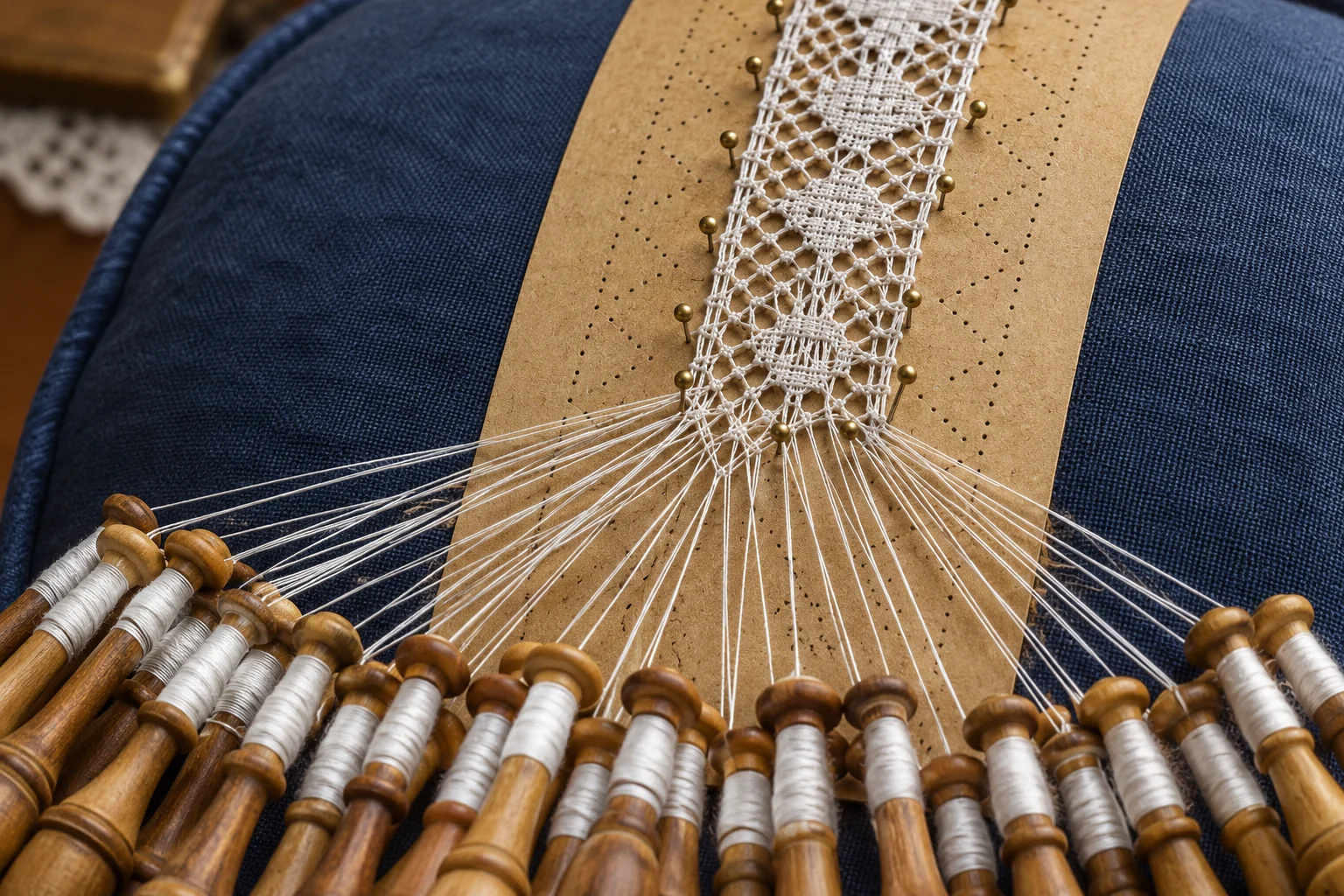
At one end of a lace pillow there is already a narrow white edging. At the other end dozens of wooden bobbins hang in a fan. Between them sits a little forest of pins. If you look only at the finished lace, it is tempting to imagine someone starting with a fine cloth and cutting away all those tiny holes. Watch the bobbins instead. The maker is building the strands and the spaces between them at the same time.[1, 2]
Each bobbin carries a length of thread. The maker moves pairs of bobbins across and around one another, setting pins into a pattern to hold the threads in place as the work advances. Close interlacing produces dense areas. Pairs that separate, travel and meet other pairs form open ground. The pins can eventually come out because the threads are now interlaced with their neighbours. The pattern that supported a new piece of lace stays on the pillow when the finished work comes away.[1, 2, 3]
Why put the work on a pillow?
A lace pillow has a different job from the cushion on a chair. It needs a surface firm enough to hold many pins precisely where the maker puts them. A card or piece of stiff paper sits on top, pierced at selected points in the design. Lacemakers call that perforated pattern a pricking. Pinning it to the pillow gives a piece of lace under construction a temporary set of coordinates. The width of a repeat and the place where threads divide can be set down before the first stitch is made.[1, 2]
A bobbin does two things at once. It keeps a reserve of fine thread wound up and gives the hand a much larger object to pick up and move. Picture doing the same work with a fan of long, loose threads lying across your knees. Finding the right two for each move would be harder, and pulling one thread could disturb several others. A bobbin gives each length of thread its own handle. The hanging bobbins also help keep the threads extended below the work.[1, 2]
Two moves under a complicated pattern
Take the four bobbins nearest the area being worked and think of them as two pairs lying side by side. In the convention illustrated by the Powerhouse Museum, a cross moves the middle two threads across one another, left over right. A twist exchanges the positions of the threads within each pair, right over left. These are small movements, involving just four threads at a time. Changing the order in which they occur changes which threads emerge together for the next stitch.[3]
In cloth stitch the sequence is cross, twist, cross. With many pairs present, a working pair can pass across a row of other pairs and back again. The threads pack together into a little patch that resembles woven cloth. Compare that patch with a narrow plait worked repeatedly using the same two pairs. In one case a working pair crosses a broad field of threads. In the other the threads remain together as a narrow bar. A maker can use either structure as part of a larger design.[2, 3]
The holes are part of the work
Look at a simple diamond mesh and follow one side of an opening. At each end the thread meets other threads. Between those meetings it spans a gap. A pin temporarily holds a meeting point while the maker tensions the surrounding threads and works onward. Move the meeting points nearer to each other and the openings become smaller. Add or change twists and the strands between those points can look quite different, even when the pinholes define the same outline.[1, 2, 3]
The pricking is therefore only one part of the information needed to reproduce a piece. Two people tracing the outline of the same flower might agree on its shape yet make visibly different petals. One might work the inside closely, so that the flower reads as a pale solid shape against a darker background. Another might leave decorative openings inside the motif. The pins establish positions. Choosing how the threads travel between them is part of the lacemaker’s skill.[2, 3, 4]
Did all those flowers grow on the same pillow?
In some continuous bobbin laces, the pattern and the mesh around it develop together as the work moves across the pillow. Other laces are made in parts. A maker can complete a leaf, flower or other motif individually, then connect it to neighbouring motifs with bars or a net ground. This distinction is easiest to understand by imagining the work half finished. Would you find the growing edge of an entire strip, or a collection of finished sprigs still waiting to be arranged?[3, 4]
A stole and a bonnet veil documented by Art Fund offer a real example of the latter approach. The objects belong to the Honiton tradition associated with East Devon. The makers worked natural motifs separately before incorporating them into a net background. Looking for the joins in such a piece tells you something about the order of manufacture. A flower surrounded by open mesh may have existed as a small, complete object before any thread connected it to the next flower.[4, 5]
What to look for in a finished piece
Begin with a small area where the threads are easy to distinguish. Follow a plait until it reaches a junction. Then compare it with a dense patch and see whether a pair travels sideways across several other pairs. Lastly, look at the edges of the motifs. In a museum photograph a contrasting backing often makes the negative spaces more legible than the pale threads themselves. Enlarging the picture can reveal why two areas that look equally white from a distance have quite different textures.[2, 3, 4]
Once you’ve seen a pair of threads part and meet again, the jumble of bobbins looks a little more orderly. Each one belongs to a thread whose route is still unfinished. Above the pins, those routes have already become petals, mesh or an edging. Below them, the same piece of lace is still a handful of choices about which two bobbins to move next.[1, 2]
Related reading
- How Do Punched Cards Guide a Jacquard Loom?
- How Do Ikat Weavers Dye a Pattern Before the Cloth Exists?
Sources
- Museum of New Zealand Te Papa Tongarewa — Lace-maker’s pillow with bobbins and pins
- Textile Research Centre, Leiden — Bobbin lace
- Rosemary Shepherd, Powerhouse Museum — Illustrated glossary of lace terms
- Dress and Textile Specialists — Identifying handmade and machine lace
- Art Fund — A Honiton lace stole and bonnet veil
Keep exploring.
One remarkable idea at a time—nature, science, history and beyond.
Last updated November 21, 2026.

Barnakle Editorial Team
Barnakle Editorial Team is the collective byline used for Barnakle’s editorial articles. The contributor profile explains the team identity and links to the publication’s editorial policies.
More from the editorial team →